
We may earn revenue from the products available on this page and participate in affiliate programs. Learn more ›
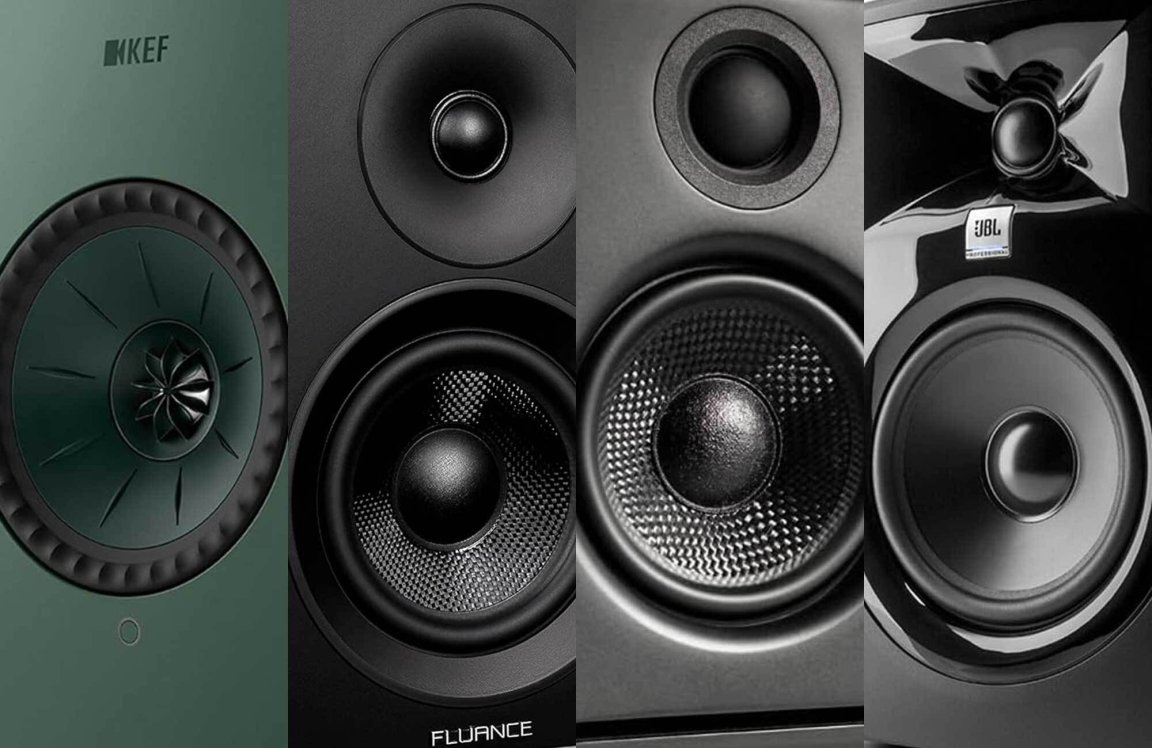
When it comes down to it, the best of the best speakers are top-of-Mount-Olympus music reference units that run into the tens of thousands of dollars … but don’t despair. You don’t have to forego buying a house or having children just to afford amazing speakers for music. There are plentiful options we have tested and reviewed that don’t cost audiophile prices. Our picks for the best speakers for music on any budget include different sizes and use cases, from computer speakers that accompany you at work to showpieces that highlight your den of relaxation.
- Best overall: KEF LSX II LT
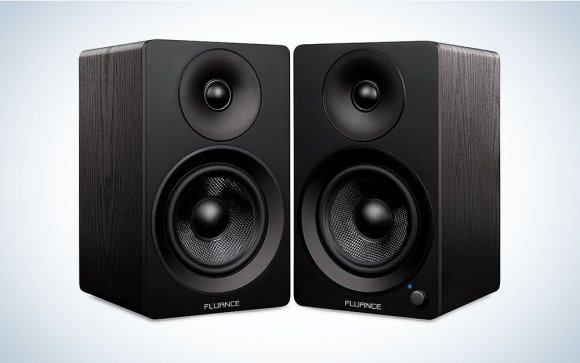
- Best value: Fluance Ai41
- Best Bluetooth: Sonos Move 2
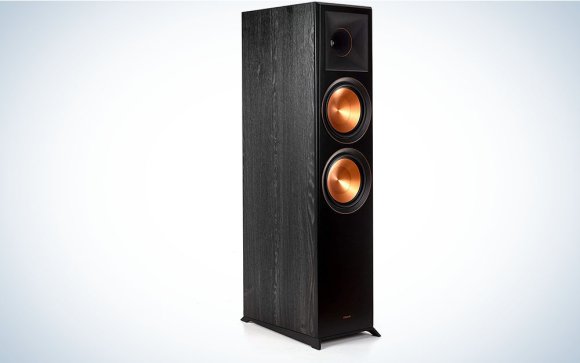
- Best floorstanding: Klipsch RP-8000F
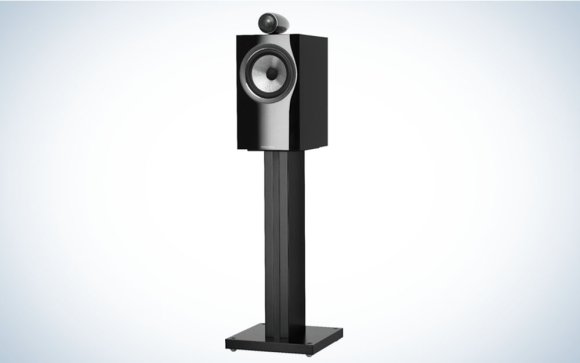
- Best stand-mounted speakers: Bowers & Wilkins 705 S3
- Best passive bookshelf speakers: KEF LS50 Meta
- Best for music production: JBL LSR 305P MKII
- Best for computers: Audioengine A2+ Wireless
How we chose the best speakers for music on a budget
Sifting through hundreds of choices to find the best speakers for music may be impossible if it weren’t for relying on a combination of our own experience, the input of trusted listeners, and the consensus of experts. The sets of speakers on this list range widely in price, but all present their own case for value when it comes to the performance you get for the money. Every pair of speakers here has set a recognized standard for audio quality within its own category and is built on meticulous and innovative audio research and engineering.
The best speakers for music: Reviews & Recommendations
Taking those factors into mind, and considering that the best speakers for music can’t be determined by descriptive writing alone, we’ve rounded up specs and specifics that offer something for everyone who’s passionate about music. While we’ve rounded up the best desktop speakers for workstations and the best studio monitors for music production in the past, the following speakers offer the best designs for those serious about dedicating space to a rich home listening experience, whether using bookshelf, floorstanding, or stand-mounted pairs that play nicely with everything from turntables to streaming.
Best overall: KEF LSX II LT
Pros
- KEF’s Uni-Q driver array delivers excellent sound
- Abundant connectivity options
- Compact size
Cons
- Price
Specs
- Frequency response: 49 Hz- 47 kHz
- Power handling: 30W High Frequency and 70W Low Frequency amps
- Connectivity: speaker wire binding posts, AirPlay, Chromecast, Wi-Fi, Ethernet, Bluetooth 5.0
- Drivers: 12th-generation Uni-Q driver, embedding a 1-inch tweeter within a 5.25-inch woofer
- Dimensions: 9.5 x 6.1 x 7.1 inches each (HxWxD)
- Weight: 15 lbs. each
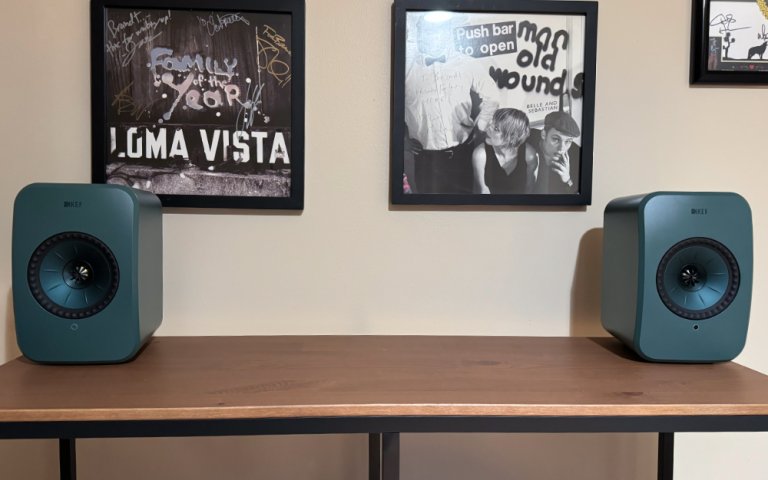
The LSX II LT is KEF’s newest set of bookshelf speakers, and they’re a sonic delight in a package that can fit on any shelf, desktop, or media center. Setting the speakers up took no time at all, thanks to the instructions provided by KEF’s Connect App. After connecting the left speaker to power and hooking it up to the right speaker with an included USB-C cable, we used the Connect App to add the speakers to our home Wi-Fi network. Once connected, we could stream music to the LSX II LTs over AirPlay 2, which is how our listening tests were conducted. These speakers also support wireless streaming over Bluetooth or Chromecast, along with HDMI, coaxial, and optical audio inputs for wired connectivity. If your listening area isn’t close to your Wi-Fi routers, or you prefer a wired connection, the LSX II LTs are equipped with an Ethernet port.
A big part of the LSX II LT speakers’ sonic appeal comes courtesy of KEF’s Uni-Q® Technology. We encourage you to read about the technology in greater depth, but the upshot is that KEF built a vented tweeter in the center of its single mid- and low-frequency driver. As you can see in the photo above, a single driver is responsible for handling the entire frequency band. Typically, this would be a limitation, as multi-driver speakers can present sounds in different frequency bands distinctly from one another, but KEF’s technology offers better results in a more compact package. Additionally, the company says that using this technology disperses sound more evenly, so you don’t have to sit in a “sweet spot” in the middle of the speakers to get great sound.
In our listening tests, which included songs from Paul McCartney and Ornette Coleman to Lorde and Olivia Rodrigo, the LSX II LTs had no problem playing them back with stunning fidelity. We could distinctly discern every note being played by each player thanks to the speakers’ exceptional frequency separation and soundstage. We were especially pleased by the fidelity of harmony vocals, as lesser speakers can make it hard to separate each voice when vocalists are singing together. That wasn’t a problem here. We could hear both Simon and Garfunkel while appreciating the way their voices blended on “Scarborough Fair/Canticle.”
The speaker’s woofer could handle the brilliant, cacophonous opening to the Flaming Lips’ “Ego Tripping at the Gates of Hell,” which features sound effects from across the frequency spectrum, bleeping and blooping at different intervals. The only time these speakers struggled was when bass notes were being played at the same time as a kick drum, as was the case on Paul McCartney & Wings’ “Bluebird.” In that case, there was a little muddiness when both instruments were played at once. An easy solution, if you have the budget, is to take advantage of the speakers’ subwoofer output (we love the pricey but powerful KEF KC62).
While $1,000 is not a price to sneeze at, KEF’s LSX II LT speakers are the best value in the company’s portfolio based on their fidelity and connectivity options. KEF also offers a standard LSX II speaker set, which adds support for Roon and MQA audio files, a 3.5mm AUX input, and the ability to connect the two active speakers wirelessly. And if you crave even bigger sound without needing a tremendous amount more space, you can step up to the KEF LS50 Wireless II—one of our long-time best powered speakers. Regardless, it would be hard to find speakers that sound better and look nicer than KEF’s LS/LSX speakers at their price.
Best value: Fluance Ai41
Pros
- Spacious stereo soundstage
- Clarity and balance to the audio
- Sound quality and loudness belie its size and price
Cons
- Tricky to dial in EQ settings on the remote
- Hard-to-reach, angled binding posts on the left speaker
Specs
- Frequency response: 35 Hz-20 kHz (DSP enhanced)
- Power rating: Class D 90W continuous average output (2 x 45W RMS)
- Connectivity: Bluetooth 5.0, digital optical, analog RCA (with subwoofer output)
- Drivers: 1-inch silk soft-dome neodymium ferrofluid-cooled tweeter, 5-inch woven glass fiber composite driver
- Dimensions: 10.9 x 6.5 x 7.6 inches each (HxWxD)
- Weight: active speaker: 8.52 lbs. / passive speaker: 7.44 lbs lbs.
Why it made the cut: Fluance makes audio products that deliver hi-fi sound without the high-end price tag, and the compact Ai41 provides the convenience of Bluetooth connectivity with a full-bodied stereo soundstage. It’s definitely one of the best Bluetooth speakers for music.
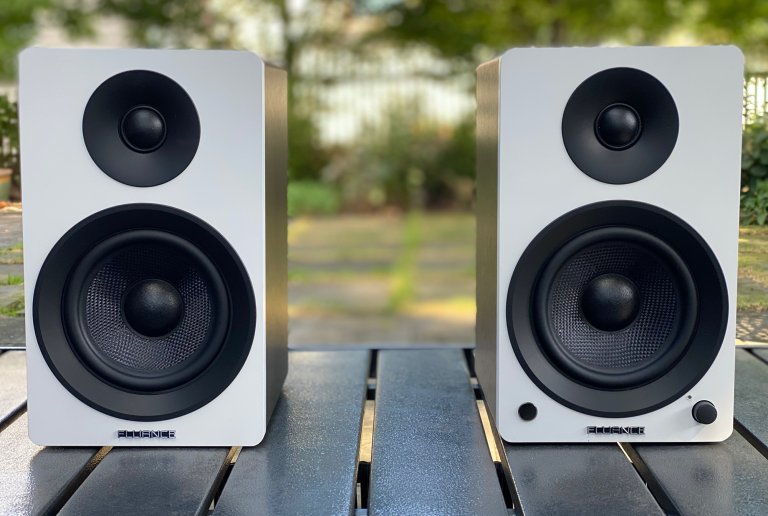
For just under $250, the Fluance Ai41 stereo bookshelf speakers emit a beautiful and balanced wide stereo image with a Bluetooth option that beats the listening experience of most single wireless speakers. The powered speakers are somewhat portable, small enough for a bedroom or kitchen, yet sound good enough and loud enough to be the upgrade to your TV speakers in a living room.
The Ai41 speakers handle any musical genre, from bluegrass to bass music, with clear details and balanced frequencies. You will hear the thump of kick drums more than might be expected from its 5-inch drivers, while high-end elements like cymbals stay crisp without sounding harsh. All the midrange and upper-mid frequencies come through as well; transient response is very natural on sounds like stringed instruments and plinking pianos. While the Ai41 gets impressively loud for its size without distorting, you could opt for the larger and more voluminous Ai61 speakers for a little extra or go all-in on the best budget floorstanding speakers, the Fluance Ai81. However, the affordable Fluance Ai41 stereo speakers find a sweet spot of rich sound, connectivity options, and surprising power in a compact package suitable for listening to music in a variety of settings. (And if you’re determined to play your Bluetooth music through a single small-footprint speaker and aren’t that concerned with portability, the Tivoli Model One Digital (Gen. 2) retromodern speaker is a visual and audible treat compared to many compact choices.)
Best portable: Sonos Move 2

Pros
- Works with all other Sonos systems
- Fantastic sounds
- Automatically adjusts sound to its environment
Cons
- Expensive for a portable wireless speaker
Specs
- Dimensions: 9.49 x 6.3 x 5.00 inches (HxWxD)
- Weight: 6.61 pounds
- Battery life: 24 hours
- Bluetooth Range: 800 feet
- IP Rating: IP56
Why it made the cut: This portable speaker seamlessly ties into the Sonos wireless music system and pumps out excellent audio quality, making it one of the best-sounding Bluetooth speakers.
The Sonos Move 2 has a ton of options when it comes to connectivity. Known for its multiroom speakers, Sonos gear typically operates over Wi-Fi 6. And this wireless wonder can instantly integrate into an existing Sonos multispeaker network, connect to Apple AirPlay 2 for high-fidelity listening, and use a built-in Alexa voice assistant that you can enable and disable as you like. But the Move 2 is also capable of connecting to devices via line-in and, most importantly, Bluetooth 5.0, making it a truly great portable party speaker.
It lasts up to 24 hours per charge, which is a 13-hour improvement over its predecessor, and that’s not the only change Sonos made this time around. The Sonos Move 2 has a completely different acoustic architecture, with a faster processor, three precision-tuned Class D amps, and improved drivers. The result is an excellent-sounding true-stereo connected speaker that takes many cues from the dual tweeters and custom waveguides of Sonos’ new Era 100, which we reviewed favorably earlier this year.
If you care deeply about audio quality, baked-in Sonos EQ settings do a great job of accentuating different frequency bands without feeling heavy-handed. While the Sonos Move 2 isn’t a totally neutral speaker, its DSP made the music we listened to sound lively and fun. A feature called TruePlay uses the speaker’s built-in microphone to make adjustments to its sound based on the room (or even part of the room) it’s in. And a custom woofer in a sealed enclosure can produce plenty of clean kick. The result is a speaker that sounds good both indoors and as an outdoor Bluetooth speaker.
You can easily control all of the various services and settings like Sonos Radio, Alexa, Spotify, Apple Music, and more using the Sonos singular app, making it easy to change things up at the drop of a hat. That’s a lot of options, though they come at a fair amount of dollars: $400 on average. Looking for a Sonos speaker that’s even more transportable and weather-resistant and even eco-friendly while also more affordable? Check out the palm-sized IP67 Sonos Roam, which still sports many features and great fidelity but for less than $200.
Best floorstanding: Klipsch RP-8000F
Pros
- Accurate and sensitive audio response
- Meticulous build quality
- Large sweet spot envelopes listening spaces
Cons
- Not compatible with Dolby Atmos audio
- Harmonics and sound coloration may be pleasant, but counter to purists
Specs
- Frequency response: 32 Hz-25 kHz
- Power handling: 150W RMS (600W peak)
- Connectivity: two pairs of speaker wire binding posts
- Drivers: 1-inch titanium LTS vented tweeter with hybrid Tractrix horn, dual 8-inch spun copper Cerametallic woofers
- Dimensions: 43 x 10 x 18 inches each (HxWxD)
- Weight: 60 lbs. each
Why it made the cut: Klipsch has earned a reputation over 70 years as the American torchbearer for hi-fi sound, and the RP-8000F, the best floorstanding speakers, represents that legacy well at a mid-tier price that makes it accessible.
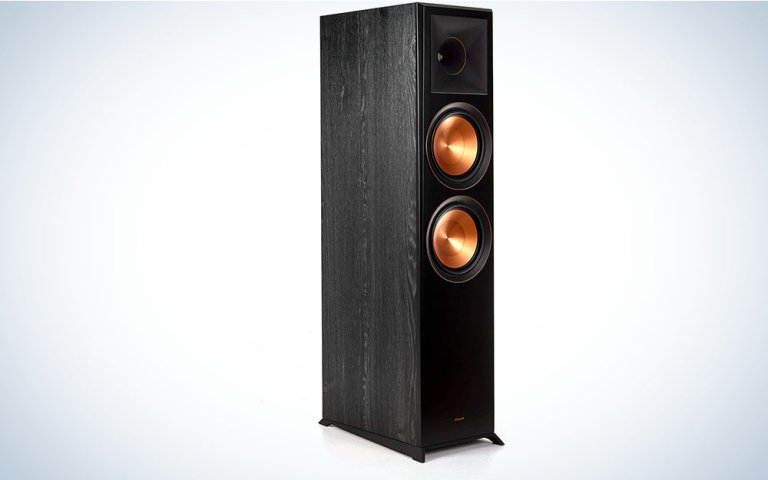
The Reference Premier line is one of the most popular loudspeaker series for its powerful and very dynamic sound at an accessible, moderate price. The RP-8000F floorstanding speakers fill up large spaces with consistently high-quality sound regardless of where you are in the room. Their dual 8-inch woofers pump out resounding, deep bass with low distortion and precise articulation even at high levels. The midrange and top-end frequencies also perform superbly, with a warm, detailed sound and significantly low resonance coming from the injection-molded silicone tweeters.
When listening to music, the RP-8000F provides focused imaging and precise details, so you hear not just stringed and percussion instruments, but also the nuances of their fretboards and bodies. The distinct spacing of musical elements throughout the soundstage and the tangibility of the acoustic space in musical recordings come through the speakers with admirable authenticity. Instruments like brass sound visceral without any distorted tones; vocals sound pristine.
Klipsch speakers may have a reputation for rock ’n’ roll expression, but these wired speakers do justice to not only loud and grinding styles, but also to nearly any genre, such as soft choral music, intimate acoustic music, bass-heavy electronic music, and more. In the highly competitive space of mid-priced floorstanding speakers, the RP-8000F makes for a smart, well-rounded choice that pumps out powerful sound with balanced, full-frequency clarity and accuracy in a sleek and sturdy construction.
Don’t want to invest in amplification or don’t have the space for towers? Klipsch has some other great, high-output options, like the Nines, that can fill a big space with sound without taking up quite as much space.
Best stand-mounted: Bowers & Wilkins 705 S3
Pros
- Transparent but robust sound perfect for music
- Exquisitely detailed audio
- Gorgeous design and superior build
Cons
- Excited sound may be fatiguing over time
- Top-notch speakers need a top-notch amp to match
Specs
- Frequency response: 50 Hz-28 kHz
- Power handling: 120W RMS continuous power
- Connectivity: two pairs of speaker wire binding posts
- Drivers: 1-inch Decoupled Carbon Dome tweeter, 6.5-inch Continuum midbass driver
- Dimensions: 16 x 7.9 x 11.9 inches each (HxWxD)
- Weight: 20.5 lbs. each
Why it made the cut: For more than 50 years, British speaker designer Bowers & Wilkins has practiced innovation in the service of exceptional music listening, creating hi-fi products for audiophiles with elevated taste and budgets.
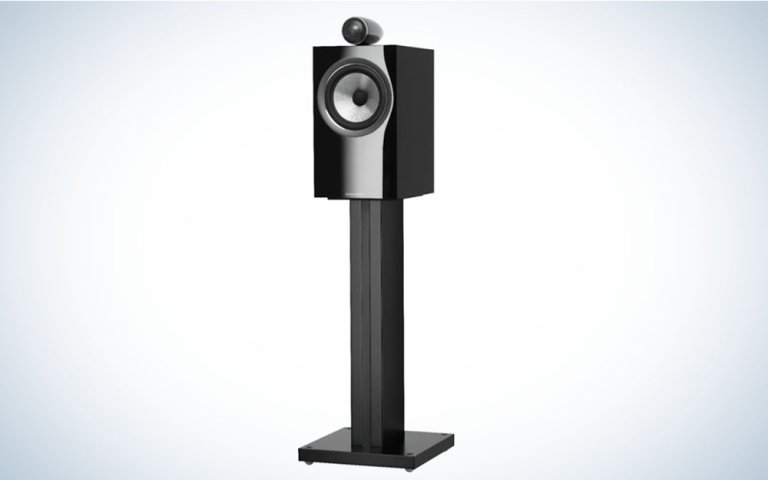
The Bowers & Wilkins 705 S3 stand-mounting passive speakers pay off in extraordinary musical sound for those willing to pay the significant toll for not only the speakers, but also for a high-end amplifier to power them. And while they are more indulgent than other options on this list by at least two grand, they are actually a mid-priced set in the company’s product range, representing a significant step up from the less costly but also worthy 706 S3 and entry-level but still impressively expressive 606 S3 stand-mounters, in part because of the technology pulled from the high-end 800 series, which costs far more per speaker. Both of the 705 S3’s audio drivers descend from the 800 series: its top-mounted, solid aluminum tweeter banishes resonance from the main cabinet, and the composite midbass driver ensures precise and smooth music reproduction.
The result is a pristine, unencumbered sound tailor-made for music lovers. A spacious, lifelike soundstage provides the setting for rich and full-bodied instrument tones and perfectly natural vocals, clear and evenly balanced from top to bottom. When you want to not just listen to masterfully performed, recorded, and engineered music, but also feel it emotionally, the 705 S3 faithfully reproduces classical, blues, rock, jazz, and other styles with an authoritative sound seemingly bigger than the speakers themselves. Their bass has weight and punch, but an added subwoofer can only help for true believers in the low-end theory.
Just one shelf or countertop available for audio, but still want some of this top-tier trickle-down tech? Bowers & Wilkins also makes the fabulous Zeppelin smart speaker, which we love for its distinctive design and all-in-one expressiveness—inherited from its hi-fi siblings.
Best passive bookshelf speakers: KEF LS50 Meta
Pros
- Entirely transparent sound
- Extraordinary detail
- Singular style
Cons
- Pricey
- Not as good in the low end as some less expensive passive speakers
Specs
- Frequency response: 79 Hz-28 kHz
- Power handling: 40-100W amp recommended
- Connectivity: speaker wire binding posts
- Drivers: 12th-generation Uni-Q driver, embedding a 1-inch tweeter within a 5.25-inch woofer
- Dimensions: 12 x 8 x 11 inches each (HxWxD)
- Weight: 17.2 lbs. each
Why it made the cut: KEF speakers stand out with the impeccable sound that audiophiles revere just as well as they stand out in appearance.
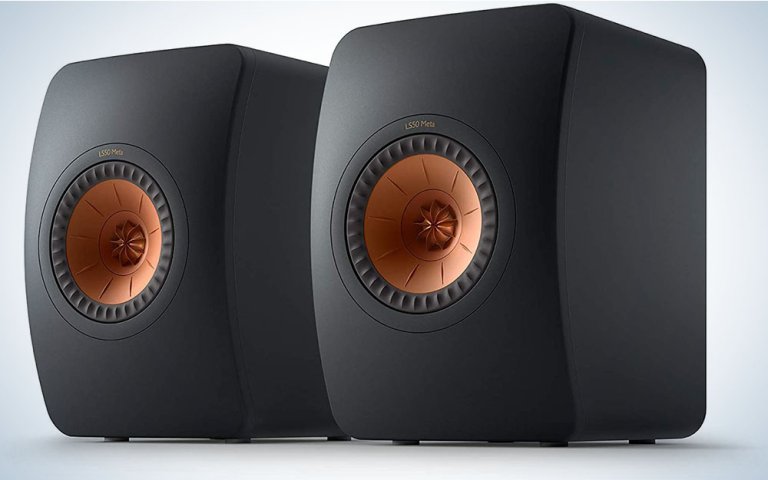
The dazzling KEF LS50 from 2012 has been updated with even greater accuracy and detail in the LS50 Meta two-way bass-reflex speakers. A new 12th-generation Uni-Q driver embeds the 1-inch tweeter within the 5.25-inch woofer to give the LS50 Meta a stark, single-cone look, while new, proprietary Metamaterial Absorption Technology (MAT) greatly reduces distortion and resonance. The result is a beautiful design and an even more satisfying sound.
As passive (unpowered) speakers, the LS50 Meta needs an amplifier to go with it, and something like the compact NAD D 3045 will give it ample analog and digital inputs—including phono and high-resolution USB computer inputs—as well as HDMI ARC connectivity and 60W per channel. By taking their predecessor’s stunning sound clarity to an even higher level, the KEF LS50 Meta speakers are the best bookshelf speakers for music at this price point. If you’d prefer to achieve the same sound in an all-in-one powered package, the KEF LS50 Wireless II builds in 100W of power; HDMI, analog, and digital audio ports; plus Bluetooth and Wi-Fi connectivity, including 24-bit/96kHz wireless streaming and compatibility with AirPlay 2, Chromecast, Roon, HD and Ultra HD music from Amazon Music, and more.
Best for music production: JBL LSR 305P MKII
Pros
- Details stand out in dense music mixes
- Wide sweet spot
- Room-correction EQ settings
Cons
- Frequency response begins a little high
- No audio cables included
Specs:
- Frequency response: 49 Hz-20 kHz
- Power rating: 82W per speaker
- Connectivity: 1 XLR, 1 TRS per speaker
- Drivers: 5-inch woofer, 1-inch woven-composite Neodymium tweeter, both magnetically shielded.
- Dimensions: 11.75 x 7.3 x 9.9 inches each (HxWxD)
- Weight: 10.43 lbs. per speaker
Why it made the cut: JBL imbues its affordable studio monitors like this pair with innovative technology from its high-end models, which are the legacy of decades of development, and they have become the trusted choice of legions of professionals.
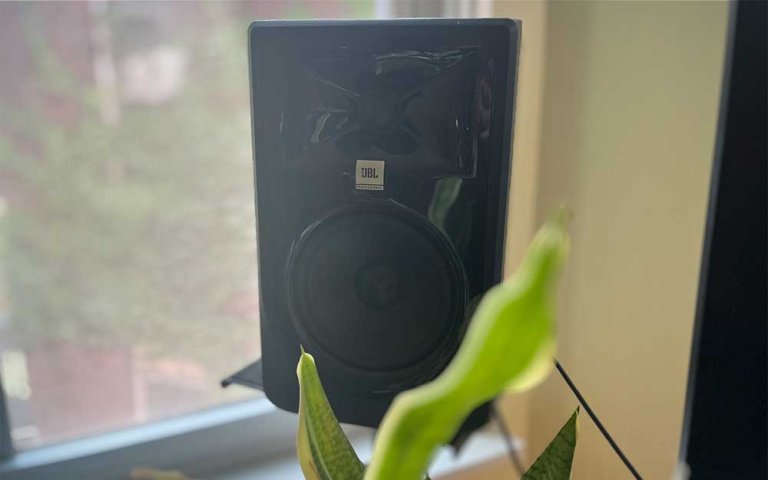
Home studio musicians, DJs, and music producers can benefit from the professional technologies that JBL has passed down to the LSR 305P MKII from some of its highest-end loudspeakers. For example, this affordable bi-amplified speaker incorporates JBL’s proprietary Image Control Waveguide: the bowtie-shaped, beveled tweeter panel, which contributes to the monitor’s wide stereo soundstage, precise imaging, and remarkable high-frequency detail. The broader-than-usual sweet spot for a studio monitor allows listeners to move around more while still hearing an accurate soundstage. And the “Linear Spatial Reference” technology takes dozens of measurements 360 degrees around the speaker to optimize what you hear when you’re not in that sweet spot.
This MKII series updates the previous LSR3 line with high-frequency and low-frequency transducers, and its bass response is even fuller and punchier with lower distortion. Because accuracy is important when producing music, it’s not bass overkill. The rear-firing Slip Stream bass port helps output accurate bass even at low playback levels. Because of its 5-inch woofers, however, the LSR 305P MKII’s frequency response is not quite as low as the larger LSR 306P MKII and LSR 308P MKII monitors in the series, which can reproduce lower frequencies while still maintaining accuracy in the mix. Advanced technology, reliable and accurate frequency reproduction, and affordability all combine to make the JBL LSR 305P MKII some of the best studio monitors for music production at home or in small studios.
Best for computers: Audioengine A2+ Wireless
Pros
- Warm and clean sound
- Impressively loud for small speakers
- High-quality components and design
Cons
- A little less bass than medium-sized smart speakers and desktop speakers
- Sound cohesiveness gets lost in large spaces
Specs
- Frequency response: 65 Hz-22 kHz
- Power rating: 60W peak power (2 x 15W RMS)
- Connectivity: USB input, Bluetooth 5.0 aptX HD, stereo RCA I/O, stereo mini-jack input
- Drivers: 0.75-inch silk dome tweeter, 2.75-inch aramid fiber woofer
- Dimensions: 5.25 x 4 x 6 inches each (HxWxD)
- Weight: 6.61 lbs. total
Why it made the cut: The Austin, Texas-based Audioengine manufactures many of its speakers’ own components, such as woofers and tweeters, and its commitment to affordable, quality sound have made its speakers favorites since its founding in 2005. They are some of the best computer speakers for music you can buy.
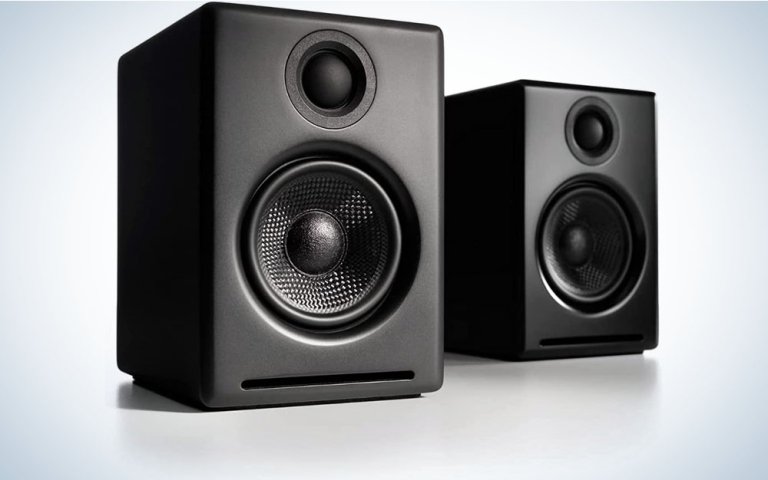
The Audioengine A2+ Wireless look good in their Satin Black, Hi-Gloss Red, and Hi-Gloss White finishes but, most importantly, they impress listeners with a clear, warm stereo sound and powerful volume that overachieve for their conveniently compact size. The A2+ Wireless pair updates the older A2 speakers by adding Bluetooth aptX HD and, most importantly for computer audio, a USB input, making them the perfect companion to improve upon computer speakers in an office, bedroom, or other small room.
When listening to music, the A2+ Wireless system sounds great for genres like rock and Americana, delivering strong, present vocals and tight, clear response to instruments with satisfyingly wide stereo separation. They can even do justice to bass-heavy genres like EDM; however, for seriously gut-rumbling bass, add an optional subwoofer.
To get the same quality hardware components and design but with more bass and louder output, the A5+ Wireless has you covered. It does not, however, have the USB input of the A2+ Wireless, which makes a computer setup easy while skipping an analog-to-digital conversion step in the signal chain. The A2+ Wireless fills up small rooms with rich musical sound and are highly portable, coming in soft, microfiber bags for taking with you to a rental (or parental) house. They make wonderful computer speakers for listening to music whether at the home office or on the road.
Things to consider before buying speakers for music
With so many attractive options available, it’s easy for music fans to fall into bouts of shiny-object syndrome when shopping around for speakers. The sleek designs, impressive specs, and latest technological tweaks can pull you in many different directions fast. Remember to keep it personal and narrow down the choices to match your specific needs.
The build
Quite a few factors related to the build quality, materials, and components help determine how good a set of speakers sound: their depth of audio detail, ambient soundstage, and realism. And all of the following factors potentially affect the price of the speakers:
Drivers — The cones and domes that actually produce the sound from a speaker (and which are sometimes covered by grills) have a huge impact. Cheap drivers may not be able to reproduce quality sound at high levels because their components cause vibrational resonance. Better drivers require heavier, more expensive coils and rigid cone materials, often made of high-tech composites or other expensive materials, in order to push more air by moving back and forth farther without producing distortion.
Enclosure — The speaker’s enclosure, or cabinet, can resonate with the sound waves coming from the drivers, creating unwanted noise. To reduce or avoid that, the enclosure must be made of stiff, dense, rigid material that vibrates as little as possible from sound frequencies. That usually requires more expensive, fabricated materials such as high-density fiberboard, aluminum, laminated panels, Corian, etc., and more of those materials to add weight.
Crossover — A speaker’s crossover component splits the audio signal and sends the split signal to the drivers—the low-end to the woofer and the treble to the tweeter. Manufacturers sometimes also put filters in the crossover to make the transition between the low and high frequencies smooth. A cheaply made crossover can make the midrange frequencies sound too thin and make it hard for the speaker to sound good at high volumes.
Quality Manufacturing — Poor quality control in manufacturing can lead to inconsistencies from speaker to speaker, and when you have two speakers, you want them to be as perfectly matched as possible for the best stereo image.
Bigger=Bassier — As a general rule, larger speakers with larger woofers can push more air and produce deeper, more powerful bass. Achieving better bass is one of the most common reasons for purchasing larger speakers or adding a subwoofer to an existing system.
Want to know more? It can’t hurt to scroll through our primer on what makes up a speaker while you’re weighing your options.
The listening space
Where will you use the speakers? An imposing set of tower speakers may look cool in a dorm room but will be overkill as far as the power they put out for the space. If speakers are too big for a space, you may end up running them at low levels that don’t maximize their potential. And if you crank up speakers to 11 that are too small for a large space, they may distort the sound and burn out faster.
Complexity of setup
Do you want a single set of stereo speakers to be the only component you buy? If so, then you’ll need powered speakers, which have their amplifier and different audio connections built in. And they should be big enough and bassy enough to give you as much low-end frequency as you want without having to add a subwoofer. Passive (unpowered) speakers often provide better sound for the same price as powered speakers, but they also require an amplifier/receiver to power them and supply audio connections (as well as speaker wire).
Connectivity needs
The diversity of audio sources you plan to play from will affect your speaker choice or the amplifier/receiver choice if you purchase passive speakers. To play from turntables, you’ll need a phono-level analog input. To stream from devices, Bluetooth or Wi-Fi connectivity is in order. Speakers and amps range from including sparse, basic connections to the whole works of analog and digital connections, including USB audio inputs and HDMI ARC ports for home theater.
Look and feel
While many speakers look similar, there are more and more designers doing different things with speakers, including experimenting with the shape of the enclosure, going all-out on glossy veneers and finishes, reaching back in time with retromodern looks, and so on. In this highly subjective area, one person’s trash is another person’s treasure. As a music lover, the audio should probably come first, but you can also find something that sounds great and suits your style as well.
FAQs
While we’re quite fond of our indulgent options that cost many many thousands, a company like Edifier can over-deliver at under $500. Fluance manages to come in even more affordable at $250. Our point is that you can find satisfaction no matter how much you want to spend, if you shop wisely.
At a very general level, speakers costing, say, $1,000 a pair will almost invariably sound better than a $100 pair. Audio companies put money into more expensive materials and sophisticated engineering that can increase manufacturing costs. Those investments often increase the speakers’ sound quality, but not always. Sometimes more extravagant materials and design costs serve to increase the speakers’ durability and/or aesthetic appeal. And sometimes equivalent speakers may cost more or less than each other based on brand recognition and reputation. Even when a higher price means better sound, the performance-to-price correlation is often a logarithmic curve, rather than linear. In other words, the increase in price is not equal to the increase in sound quality. Much like many other consumer goods—for example, wine—upgrading from the lowest-price tier of speakers to the next step up and then another step up will typically yield very noticeable results. But once you get into high-priced systems, you may end up paying an additional 50 to 100 percent or more for an incremental step up in sound quality.
A speaker’s wattage tells you about how loud it can go without distorting. Wattage does not really pertain to how good a speaker’s sound is—only its sound levels. Also, more wattage is less expensive to add than excellent sound, so don’t put too much stock in it. For small-room home listening, 15W to 30W per speaker is sufficient for most people. For large rooms, home theaters, or for hosting parties, 50W to 100W per speaker should be enough.
Final thoughts on the best speakers for music
- Best overall: KEF LSX II LT
- Best value: Fluance Ai41
- Best Bluetooth: Sonos Move 2
- Best floorstanding: Klipsch RP-8000F
- Best stand-mounted speakers: Bowers & Wilkins 705 S3
- Best passive bookshelf speakers: KEF LS50 Meta
- Best for music production: JBL LSR 305P MKII
- Best for computers: Audioengine A2+ Wireless
For the reasons we have outlined, the best-sounding and loudest speakers generally do cost more money, but the extra cost does not always lead to better sound, and there are still amazing sets available at affordable prices. That’s why almost any music fan can enjoy some of the best speakers for music on any budget. Decide your highest speaker priorities, such as the size and power needed for your space, connectivity options, and style. There’s always going to be something better out there that almost none of us can afford. However, with the quality of modern speakers and the number of choices available, we’re confident that you can find the perfect speaker for you to elevate your music listening to a higher level.
