
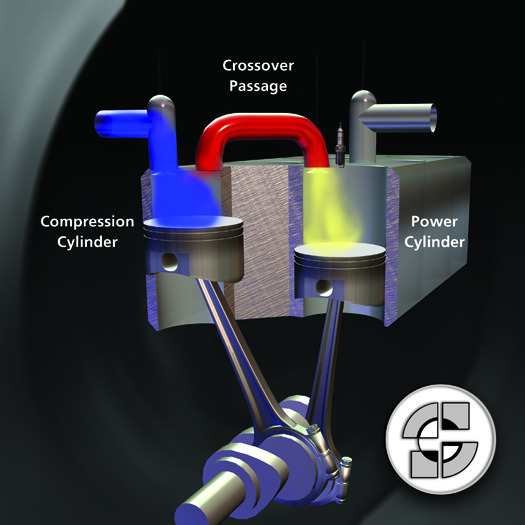
Split cycle engines—engines that split the functions of a normal four-cycle piston into two separate but adjacent and complementary pistons—have never been able to match the efficiency and overall function of traditional internal combustion engines, but a new design could change all that. By tweaking the standard split-cycle design with new features like a compressed air tank that captures wasted energy from the system, the Scuderi Group claim not only to have matched the efficiency of the standard four-cycle engine, but to have far surpassed it.
The Scuderi Group’s design has drawn interest from nine major carmakers, the company says, but has yet to prove the technology in real world prototype tests. But in computer simulations that install a Scuderi engine in a 2004 Chevy Cavalier, the split-cycle engine shows to reduce fuel consumption by 25 to 36 percent, translating roughly to a 50 percent improvement in overall fuel economy.
The engine does so by tweaking old split-cycle designs to be more efficient and to trap wasted energy so that it can be fed back into the system. Traditional four-cycle engines have four piston strokes: a down-stroke that pulls air into the cylinder, a compression up-stroke that compresses air (and fuel) in the cylinder, a combustions stroke in which the fuel and air is ignited and turned to kinetic energy, and another up-stroke in which the exhaust is cleared from the cylinder.A split-cycle engine distributes those functions between two cylinders one cylinder handles the intake and compression strokes, then that compressed air is fed through a connecting tube into the second cylinder where it is combusted and expelled (this is demonstrated in the video below). Scuderi further improved on this design by adding an auxiliary compressed-air storage tank and by changing the the point at which combustion happens in the second cylinder (conventional engines ignite the gas just before the piston hits its peak on the up-stroke, but he Scuderi ignites just as the piston begins its down-stroke).
How does all this translate into better efficiency? First, the change in combustion timing gives the piston better leverage on the crankshaft, improving efficiency when the engine is working at low speeds. Further, a separate compressed air tank siphons off the air intake that isn’t used for combustion. When the tank is full, the air inside is used to drive the engine, allowing the compression piston to stop compressing air for a period until the storage tank is spent, saving even more fuel.
It’s an interesting and clever design, but while Scuderi does have a prototype engine completed these fuel economy improvements currently exist in computer models only, and there are no guarantees that they will translate into real savings on the road. Moreover, it’s not clear that the Scuderi engine’s savings will be able to compete with improvements in the gas-electric hybrid and EV engines automakers are already making. With automakers trying to move—albiet, slowly—toward whole new kinds of power plants, a redesigned conventional internal combustion engine may have missed its opportunity to be a true game-changer.

Five amazing, clean technologies that will set us free, in this month's energy-focused issue. Also: how to build a better bomb detector, the robotic toys that are raising your children, a human catapult, the world's smallest arcade, and much more.


Online Content Director: Suzanne LaBarre | Email
Senior Editor: Paul Adams | Email
Associate Editor: Dan Nosowitz | Email
Assistant Editor: Colin Lecher | Email
Assistant Editor: Rose Pastore | Email
Contributing Writers:
Rebecca Boyle | Email
Kelsey D. Atherton | Email
Francie Diep | Email
Shaunacy Ferro | Email
Pardon my ignorance, but, isn't this just a glorified 2 stroke engine with eight times as many moving parts? I predict that it will never see the light of day in a production vehicle.
By using the compressor/storage tank mode for regenerative braking, this engine does everything that an electric hybrid does -- and more. Electric hybrids only capture a small fraction of the braking energy -- a compressor could capture much more; and thus be more efficient.
@Mikeyboy -- no it isn't just a "glorified 2 stroke engine..." Look at the video again -- in effect, the split cycle engine is a compressor, combined with an engine.
perhaps i'm ignorant -- why couldn't this engine design be used in a hybrid, or in a range-extender like the Volt's?
@ Clay: Good God, man, proofread. I had to stop and reread in three places to figure out what you'd meant to type.
@ tundrasea: That's assuming a lot from the pressure system and mechanical linkages in the powertrain. We can't really know the efficiency of the power storage from watching a little video. I mean, that *shouldn't* be bad, in theory, since it doesn't have to convert into another form of energy entirely in the way a generator does. I'd really question how much energy you could really store mechanically, as compression, though.
Still, it's a really neat trick to do something like this *entirely* mechanically.
@ deegeezee: Other than the fact that this company apparently doesn't like hybrids, I really wonder if it would be practical to do so. That whole compressor arrangement and the air tank could potentially be rather bulky or heavy, and the idea is that the air-compression is supposed to serve in place of storing energy electrically. As tundrasea noted, it really might be more efficient at getting that energy out - electric motors are ludicrously efficient, batteries less so, so there's some energy lost in storage of electrical energy. I can't imagine that you could store as *much* energy mechanically as you could with a battery, but it might be enough to make a real difference in stop-and-go.
Potentially, you could take the split cylinder engine without the tank and get a slight increase in efficiency, then couple that with the electric half of a hybrid system....
I am kind of confused why this is more efficient than a conventional internal combustion engine. Correct the following statements if I'm wrong but it seems that:
-this only fires on half the cylinders.
-this fires after TDC
-its desirable to inject and burn fuel before TDC (diesel engine).
-a turbo charger can easily be set up to produce 2.5 bars with less hassle.
-a turbo charged engine fires on all cylinders, (power to weight ratio??).
-a turbo charger does not steal energy from the crankshaft.
Those are just some things that came to mind when I read this article.
Also, on the "Compression Braking", at 1200rpm (20 ups and 20 downs per piston/second) and .5L of displacement/cylinder how big of a compressed air storage tank is needed to really make a difference?
Problem is that a normal car engine could be improved as far as fuel consumption is concerned. Many things have been altered to provide a clean exhaust. The two things don't go hand in hand.
I fell into the great new engine design in the '60 when Wankel sold his engine to the world. Where are they now?
Gimme a diesel or hybrid diesel or electric when it makes sense.
Would this dual cylinder injection engine sound different? Wouldn't it sound like a heartbeat?
Fox
An interesting idea springs to mind.
A long time ago, there was an article about a two stroke engine consisting of a single piston going back and forth in a cylinder like a shuttle, each end being a power and intake chamber in turn and powered by the other, and having no valves but relying on briefly uncovered side ports for intake/exhaust function. It was noisy, inefficient, but had lots of potential power and very few limits on RPM. I think it was by Chuck Yeager, but it was a long time ago and I am not sure at all on the authorship.
My suggestion is to use two, or better yet, four of these two-stroke shuttles so arranged and timed as to create a true split four cycle action evenly across each of the shuttles with two consecutive power strokes driving consecutive intake, compression, and exhaust strokes.
Such a design might require valves at least at certain points and a way of "charging" the system to initiate the distributed cycle. But I would envision such a motor as very small, less than 75-100 cc total probably. How would it be used? Not as a drive train engine but as an addition to a hybrid system The bulk of the center of the shuttles, each double-ended piston, would be a very hi gauss permanent magnet rocketing back and forth and generating electricity to recharge a primarily electric car when required during an extended drain on the batteries.
If it ran on diesel, no plugs, no points, no dedicated electrical system, no starter motor, and of course, no valves needed. To start would require only reversing/pulsing the current through the generating coils to move the pistons to compression and self-ignition. If the main battery were completely discharged, no doubt an average booster cable current from another source would suffice to start this recharger engine. A tiny moped-sized muffler and scaled down catalytic converter could handle the small exhaust; an electric mini supercharger would be an added bonus for extra fuel efficiency.
The two starting points are others' intellectual property, but the fusion of the ideas is mine, and if someone out there can make it work, go for it; but if it works and you can get it to market, give me credit and 0.5%.
Richard EJ Campbell
Vancouver BC
@jefro: The Wankel engine is still used today but primarily in airplanes. This is due to the fact that the Wankel uses more gas than a piston engine because it inherently has more surface area, effectively reducing the efficiency because the walls absorb some of the heat for combustion. It still has advantages in airplanes because it weighs approximately 1/3 that of a similar horsepower piston engine.
Another thought on the split engine. Wouldn't real world efficiency be reduced because the distribution of the gas/air mixture via the cross over passage would not provide the particulate separation required for efficient burning that today's injection systems can achieve?
that's a cross breed between a stirling engine and an ineternal combustion engine.
smart...
i might be ignorent...
but i think its time we "reinvented the wheel" not improve it... we need to revolutionize other means of auto-energy... electricity?
cool and very useful concept though.
So according to the video the ignition occurs with the intake vale open, so what prevents the exhuast valve on the compression cylinder from blowing open?
well i have a few thoughts,
1. the firing after top dead center is like retarding the timing on a injection pump to gain milage witch is nothing new
2. if its half compressor, half engine, that means the two cylinders that fire will have to make power to move the the comprssor cylinders also just to get air, how is that effecient?
3.if they would retard the timing on a two cylinder with a long stroke, like a diesel for torgue, with a turbocharger and high compession ratio, couldnt this be as or more efficient.
just my two cents
@Dirk: Yes, I made some assumptions about this particular compressor design. However, there are other compressor/engines which do have high efficiencies & I was extrapolating from that. (Sorry, no citations -- but, as they say, you can look it up.)
The limiting factor for the regenerative-braking efficiency of electric hybrids, is the amperage that a battery can accept. For example, IIRC, a Prius only captures about 15% of the kinetic energy, using the regenerative braking. The batteries are simply unable to take a greater rate of charge. OTOH, pneumatic or hydraulic compressors can rapidly transfer a lot more energy to the storage tank, and are therefore much more efficient at regenerative braking.
how about we ban gasoline altogether.(period) Primitive method if you ask me (waste too much in heat dude, stinky, toxic,"bloody"), it is the same engine design/method since the 1900's? what's the problem... whoever kept this system is keeping you on your knee's.
let our engineer's work damnit!
why did microchips advance but not combustion engine?
TEJJ IC ENGINE
(CONSTANT TORQUE RECEPROCATING IC ENGINE)
In all IC engines built so far, the reciprocating motion of the connecting rod
is converted in to rotary motion for wheel through crankshaft. This was most appropriate technology when the engine was invented. However, with continuously rising fuel prices around the world, many attempts are being made for improving engine efficiency.
I have studied existing technology in detail & have found out following disadvantages with existing system.
DISADVANTAGES IN EXISTING SYSTEM
1. The torque generated is always in a sine wave form.
2. Although, fuel combustion exerts tremendous force on piston from TDC to BDC (can be considered constant for any particular power stroke); all of it is never converted in to desired torque. When piston is near TDC or BDC, the force is wasted in compressing / stretching crankshaft radial arms towards / away from crankshaft bearings. Due
to this repetitive cyclic force, crankcase is required to be designed adequately strong & robust for bearing non converted force from Pistons.
3. Due to sine wave nature of torque conversion, maximum torque is available ONLY AT CRANKSHAFT ROTATION AT MULTIPLES OF 90 deg..
For all other times, the torque available is LESS THAN MAXIMUM POSSIBLE.
4. For a 4 cylinder engine with cranks placed at 90 deg. apart & firing order 1,3,2,4; cylinder 1 (say) has power stroke from 0 deg. to 180 deg.of crankshaft rotation; then other cylinders will fire as under
• Cylinder 1: 0 deg. to 180 deg..
• Cylinder 3: 180 deg. to 360 deg..
• Cylinder 2: 270 deg. to 450 deg..
• Cylinder 4: 450 deg. to 630 deg..
For cylinder 1, next power stroke starts at 720 deg. only & hence it can be seen that from 630 deg. to 720 deg., there is no power available in any of the cylinders. Engine has to cross this zone only by means of inertia of the over all system.
Considering all these disadvantages, I have developed a new concept in IC Engine, which WILL NOT HAVE ANY OF ABOVE DISADVANTAGES.
I have named it TEJJ IC ENGINE having following advantages:
ADVANTAGES OF TEJJ IC ENGINE
1. This Engine WILL PRODUCE CONSTANT TORQUE OVER ALL
POSITIONS OF CRANKSHAFT ROTATION. Torque wave will be a
rectangular one.
2. The torque will be comparable to that of ELECTRIC MOTOR.
3. As no force from piston will be wasted in exerting undue force on crankshaft bearings, crankcase design can be made relatively lighter.
4. Torque available will be EQUAL TO MAXIMUM POSSIBLE TORQUE of existing sine wave torque at 90 deg. multiples.
5. This engine can be easily made in existing plants since It is only addition / modification of components & rearrangement of existing engine using ALREADY PROVEN COMPONENTS ELSE WHERE.
6. No new technology yet to be tasted is used for this invention.
7. Work done PER POWER STROKE of ENGINE WILL BE ALMOST 55%
HIGHER THAN THAT IN AN EXISTING SINE WAVE IC ENGINE.
8. This will lead to TREMENDOUS INCREASE OF ENGINE EFFICIENCY / MILAGE FROM VEHICLE.
9. This Engine can be used for all IC engine applications as at present.
10. This Engine can be used for all 2-stroke / 4-stroke engines running on ANY FUEL.
IN CASE ANY INDIVIDUAL / INSTITUTE / MANUFACTURER IS READY FOR SPONCERING DEVELOPMENT OF A PROTOTYPE OF THIS NEW ENGINE;
KINDLY CONTACT ME ON MOBILE NUMBER 919424140739 OR E-MAIL
Rp_naik@in.com. I assure that concept is fully ready with drawings, animated presentations etc & only shop floor designing / manufacturing is remaining.
Links with relevant graphics are available at “http://www.scribd.com/doc/49011286/TEJJ-IC-ENGINE-Constant-Torque-IC-Engine”.
@rajeevnaik:
What? I don't know about all your other claims, but I'll correct one thing just for any future readers: a four cylinder 4-stroke engine fires something more like this:
C1) 0-180
C3) 180-360
C2) 360-540
C4) 540-720
Then cylinder 1 fires again at 720. each 180 degrees apart. 2 revolutions, 4 intake strokes, 4 compression strokes, 4 combustion strokes, 4 exhaust strokes. all evenly spaced.
You claim there is one shortened 90 degree gap, and one prolonged 270 degree gap. I can not think of any reason someone would design an engine that way.
But aside from that, good luck with your invention, or advertising clicks, or whatever you're after.
Why does everyone work so hard at keeping people confused about how an internal combustion engine works. there is NO such thing as a 4 cycle engine. all that means is that you have gone through a cycle 4 times. calling an engine 4 cycle is just plain stupid. an internal combustion engine cycle (or otto cycle) consists of: 1. intake, 2. compression, 3. ignition, 4. exhaust. that is 'a' cycle (note singular). now engines use different ways to complete that cycle and we should call them properly. you have a 4 "stroke" cycle (or 4 stroke) engine, a 2 "stroke" cycle (or 2 stroke) engine, and 1 "stroke" cycle (mono stroke) cycle engine. calling a 4 stroke cycle engine by the nomenclature of 4 cycle is misleading and confusing because ALL engines MUST perform all 4 parts of the cycle or they will not work. if you do not understand this you may want to go back and study the work of some of the original inventors of the concept like Nikolaus August Otto, Rudolf Diesel, even though Diesel's engine was modified from what he originally designed, and others.