CES 2011
I took a ride in the automated, wirelessly communicating EV-V in a Las Vegas parking lot
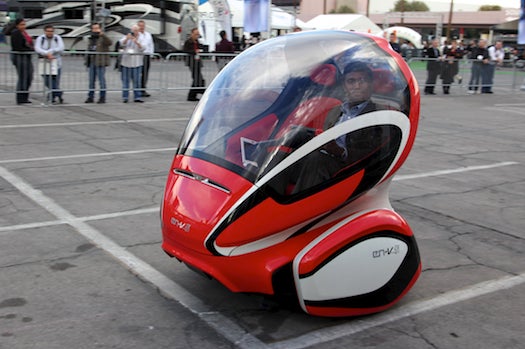
GM EN-V John Mahoney

GM's EN-V concept (it stands for "Electric Networked Vehicle") is designed to fill the niche of urban, short-range transport, where space is limited but travel distances are typically shorter than suburban or rural drives. I saw three designs of the car (shaped like a deep-sea diver's helmet, MF Doom's mask, and Urkel's clown car, respectively), all of which are about half the size of a Smart car and fitted on a two-wheel base co-designed by Segway.

The Segway base is called the "Skateboard," though a skateboard actually does have four wheels and typically boasts a minimum of gyroscopic sensors. But that base allows the EN-V to turn in place, and as a bonus, looks really cool. Moving from "park" to "drive," the entire chassis shifts back and forth on the gyroscopes to balance the cab's weight, though you don't actually feel it while driving. (The spinning-on-a-dime thing did give me immediate nausea, however.) The car itself is about half the length of a Smart car, which makes it about a quarter the size of a normal obese American parking space, and is about a third the weight of a typical sedan.

The EN-V's communication aspect is pretty interesting as well--it uses sonar (you can hear the telltale clicking sound) to detect other cars as well as pedestrians and cyclists, though in the demo it nearly ran down a GM rep before stopping. That communication also allows it to perform something GM's calling "platooning," basically forming an autonomous convoy with other EN-Vs. The automation doesn't stop there, as it's also able to park and retrieve itself without the help of a driver. You can control its parking with a smartphone or a laptop.

Will the EN-V ever be released? Probably not, at least not in this form. The car would need to be enlarged to come to market--at the moment, it doesn't have any storage space at all--and judging by my experience driving it, the automation needs a bit of work before it's really safe. But a lot of the ideas in the EN-V are super futuristic and interesting, and the concept of an ultra-light, presumably ultra-cheap, urban-only car is one that's just starting to be addressed.

See the rest of PopSci's live CES 2011 coverage here

Want to keep track of the latest concept cars, automotive innovations, and more? Subscribe to Popular Science today, for less than $1 per issue!

9 Comments

"...and as a bonus, looks really cool..."

Seriously?...I'd say it looks less ridiculous then the other designs but not even remotely "cool".

This might work in the over crouded cities of India or China, but it is going to be a hard sell in the USA. Not many American faminies can aford to a dedicated short range and minimal cargo vehical and a standard vehical for taking the kids to football games and hauling a weeks worth of groceries.

"the entire chassis shifts back and forth on the gyroscopes to balance the cab's weight"

As far as I know, it shifts back and forth on the WHEELS. The gyroscopes are just a kind of sensor used to measure the car's angular acceleration when it starts to tip forwards or backwards, and apply the necessary corrective torque to the wheels to keep it upright.

I think we are beginning to see why GM went bankrupt. Do they know how to learn a lesson?

You people understand these can be used like cabs in town... Less gas used, less smog in cities... It's rather obvious these aren't intended for suburban consumer families...

It's all about application...

This has to be a very very early experimental design. Think about how a Segway works: You lean forward to make it go and lean back to make it stop. The solid state gyroscopic sensors speed up the wheels when you lean forward and slow them down when you lean back. Now, how could this possibly translate into an enclosed vehicle where you would not be able to lean back and forth to control the thing? Answer: Lots of automation. The much-hyped brains inside are not just a feature, they are necessary to keep the thing balanced when you speed up and prevent it from pitching over when you slow down. I am guessing that the shifting of the chassis is also used to help keep the thing in balance when it accelerates or decelerates. To me that sounds like a lot of programming and electronics. Not the sort of thing that would be ultra-cheap. However, even if it was ultra-cheap and aimed only at college students for tooling around campus, it still looks like it would be totally destroyed by even the smallest pothole in the street.

Ever since I read about the first concept of this, I wondered why they wanted to use the complex and energy draining 2 wheel platform with gyros.

One trailing wheel would jeep the darned thing upright. It could eben pivot to allow the rotation. Would have to extend back a bit, bit probably you could make some kind of more compact parked configuration.

Something this size might have urban uses. Heck,maybe they could rack 'em up on a commuter transport fron the burbs to allow mass transit with flexibility.

But please stay away from complex engineering just because it's 'cool'.

There are already communities under construction where only electric vehicles will be allowed. In the United Arab Emirates, an entire city is being built where this vehicle would fit right in. It could also become a smart vehicle that drives itself. Imagine parking outside of a city you want to enter and a transport unit like that one but without a steering wheel pulls up. You get in, say where want to go and it safely takes you there. It may happen in your lifetime.

I agree with JamesDavis. They could've upgraded the EV-1 instead, and had a car available for immediate release.

2015 Chevette


June 2013: American Energy Independence

Five amazing, clean technologies that will set us free, in this month's energy-focused issue. Also: how to build a better bomb detector, the robotic toys that are raising your children, a human catapult, the world's smallest arcade, and much more.


Online Content Director: Suzanne LaBarre | Email
Senior Editor: Paul Adams | Email
Associate Editor: Dan Nosowitz | Email
Assistant Editor: Colin Lecher | Email
Assistant Editor: Rose Pastore | Email

Contributing Writers:

Kelsey D. Atherton | Email
Francie Diep | Email
Shaunacy Ferro | Email

circ-top-header.gif
circ-cover.gif
bmxmag-ps