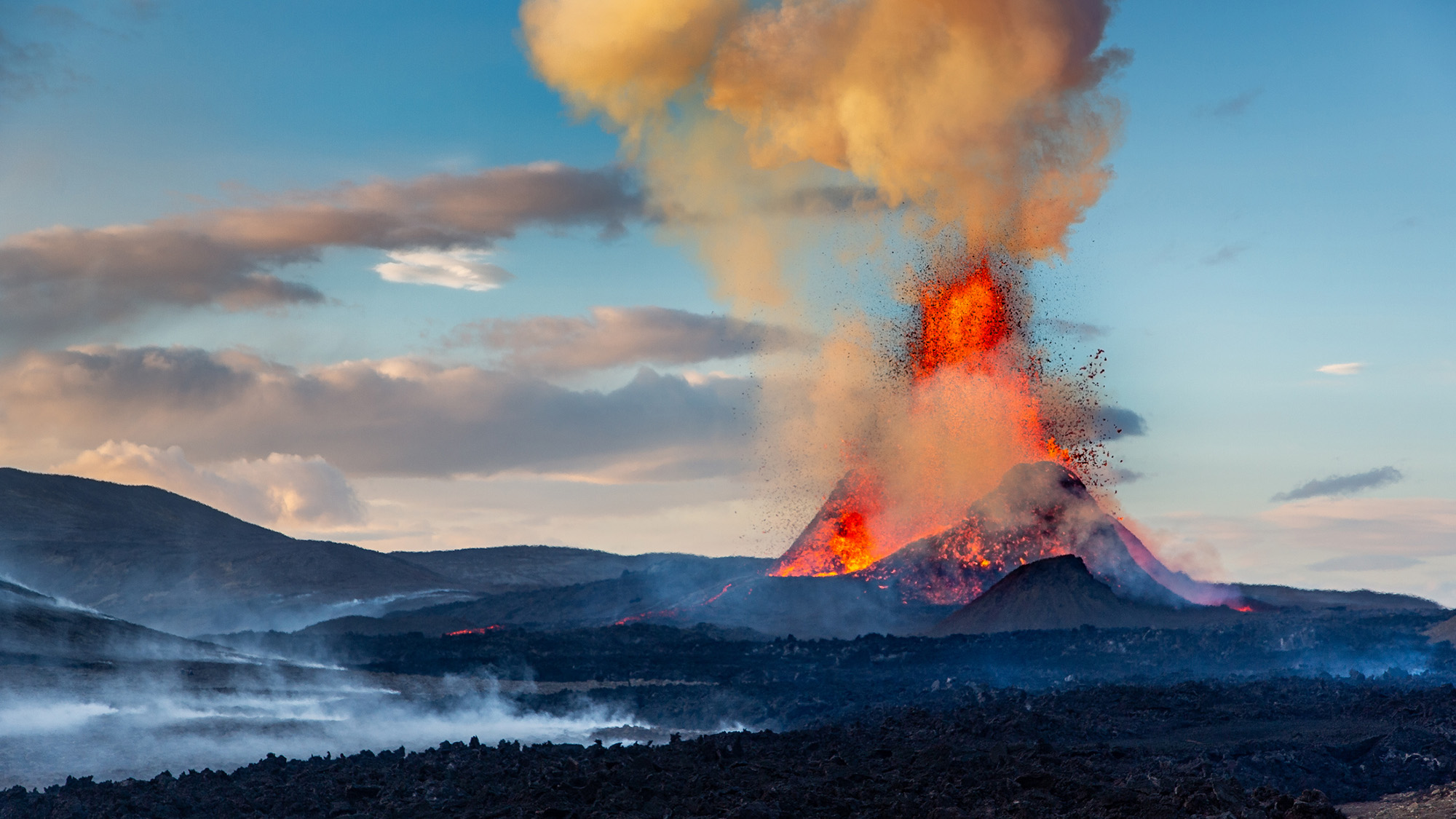
Yellowstone National Park doesn’t just sit on a volcano—it is a volcano. Underneath the park, red-hot magma reservoirs flow, superheating hot springs and geysers like Old Faithful. This vast volcanic system is known as the Yellowstone Caldera, and with one blast it could plunge the world into chaos.
About two million years ago, as sabertooth tigers and mastodons roamed the future United States, Yellowstone was a powder keg. Large amounts of hot magma accumulated beneath the Earth’s crust, building pressure and volcanic gases that triggered a major eruption. It was among the largest volcanic eruptions in our planet’s history, blanketing large parts of North America with ash.
Since then, Yellowstone has seen two more major volcanic eruptions and many smaller ones—earning the name “supervolcano.” The three “super” explosions carved out giant craters (or calderas), which contain much of the park and give the Yellowstone Caldera its name.
Though Yellowstone hasn’t had a supereruption in millennia, it’s impossible not to wonder: Will Yellowstone’s so-called supervolcano ever explode again?
Yellowstone’s supervolcano isn’t erupting anytime soon—we think
Experts studying the Yellowstone volcano say it probably will erupt again—it’s just a matter of time, a lot of time. A major Yellowstone eruption likely won’t happen for thousands, and potentially millions, of years.
Scientists say that the magma underneath Yellowstone is mostly solid and not eruptible. One study that identified magma hotspots underneath the Yellowstone Caldera suggests the magma is more concentrated underneath the northeast section, and that magma is shifting in that direction.
It’s possible that Yellowstone’s magma, as it draws heat from Earth’s mantle and potentially concentrates in the northeast, may one day become liquid enough to erupt. But Poland says the shifting magma could also lose heat and stall as it hits thick, continental rock within the Earth’s crust.
“We know there’s a magma chamber beneath Yellowstone,” Michael Poland, the scientist-in-charge of the Yellowstone Volcano Observatory, tells Popular Science. “But we know that it’s mostly solid, so it’s not really capable of feeding a large eruption. It’s like the odds of being struck by lightning are one in a million, but if you’re standing in a field, not a cloud in the sky, the odds you’re going to be struck in the next five minutes are basically zero.”
Yellowstone might see other volcanic activity sooner
The next volcanic incident in the Yellowstone Caldera likely won’t be a volcanic explosion. A powerful hydrothermal eruption from a geyser, activity that can create impressive craters but has limited impact outside the park, is more likely.
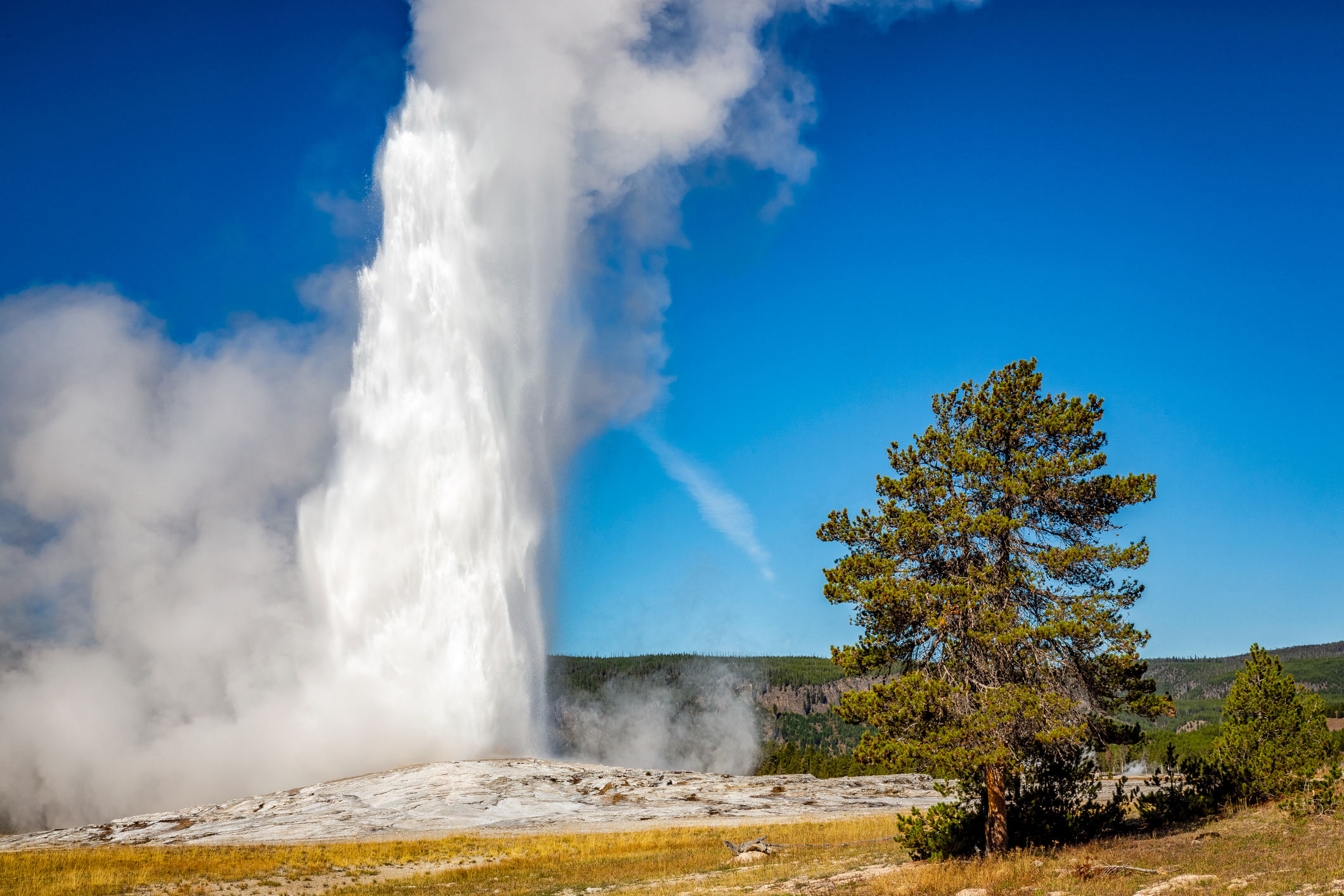
Another possibility is a lava flow, which occurs when slow-moving, thick lava erupts and forms rock piles that creep across the landscape over months or years.
The Caldera has already caused a massive bulge in the ground the size of 279 football fields, but Poland says that change isn’t surprising due to the magma flowing beneath the park.
The term supervolcano can be misleading
Poland isn’t a big fan of the term “supervolcano,” which refers to volcanic systems that have experienced eruptions emitting more than 1,000 cubic kilometers of magma, ash, and other volcanic deposits.
Poland says using the term “supervolcano” for Yellowstone can be misleading, because it implies the system experiences only supereruptions, when lava flow eruptions are far more common. Still, the last lava flow incident was about 70,000 years ago.
These days, Poland worries more about hazards from hydrothermal eruptions or earthquakes, many unrelated to volcanic activity, in the park.
Related 'Ask Us Anything' Stories
At the Yellowstone Volcano Observatory, a consortium of scientists from the U.S. Geological Survey, the National Park Service, and several universities constantly monitor the Yellowstone volcanic system. They tap into a network of seismic stations, which measure earthquake activity, and steam gauging stations, which monitor volcanic heat release.
If Yellowstone’s volcano were to erupt, scientists at the observatory would likely know weeks to months beforehand. As of now, it looks like we’re safe—though experts like Poland are keeping a close watch.
But what if Yellowstone’s supervolcano did erupt?
Poland says the chances of a major eruption in the Yellowstone Caldera within the human timeline are as close to zero as it gets. But what if Yellowstone did erupt while billions of humans still walked this planet?
Yellowstone National Park covers nearly 3,500 square miles, mostly in Wyoming. Every year, the national park welcomes roughly 5 million visitors.
If the supervolcano erupted tomorrow, it would happen like this: hot magma would have already accumulated in the Earth’s mantle, building more and more pressure—until cracks formed in the Earth’s crust. Then, magma would finally burst forth in a massive explosion.
Upon eruption, the immediate radius, including parts of Montana, Wyoming, and Idaho, would be swept clean—as huge eruption columns, pillars of superheated volcanic ash and gas, collapse under their own weight and incinerate the land.
These avalanches of ash, gas, and rock, known as pyroclastic flows, would wipe out trees, homes, and infrastructure in their path. Any remaining ash would settle over the landscape.
Using models, scientists at the Yellowstone Volcano Observatory predict that a supereruption would drop thousands of feet of ash within the park radius, and coat communities stretching from Missoula, Montana, to Albuquerque, New Mexico.
The explosion heard around the world
Poland says that a Yellowstone supereruption would drop at least a few millimeters of ash over much of the U.S. and parts of Canada, devastating agriculture, water supplies, and electrical grids. Huge amounts of ash and gas launched into the stratosphere would act as aerosols, blocking sunlight and plunging the Earth into a long period of cold and dark.
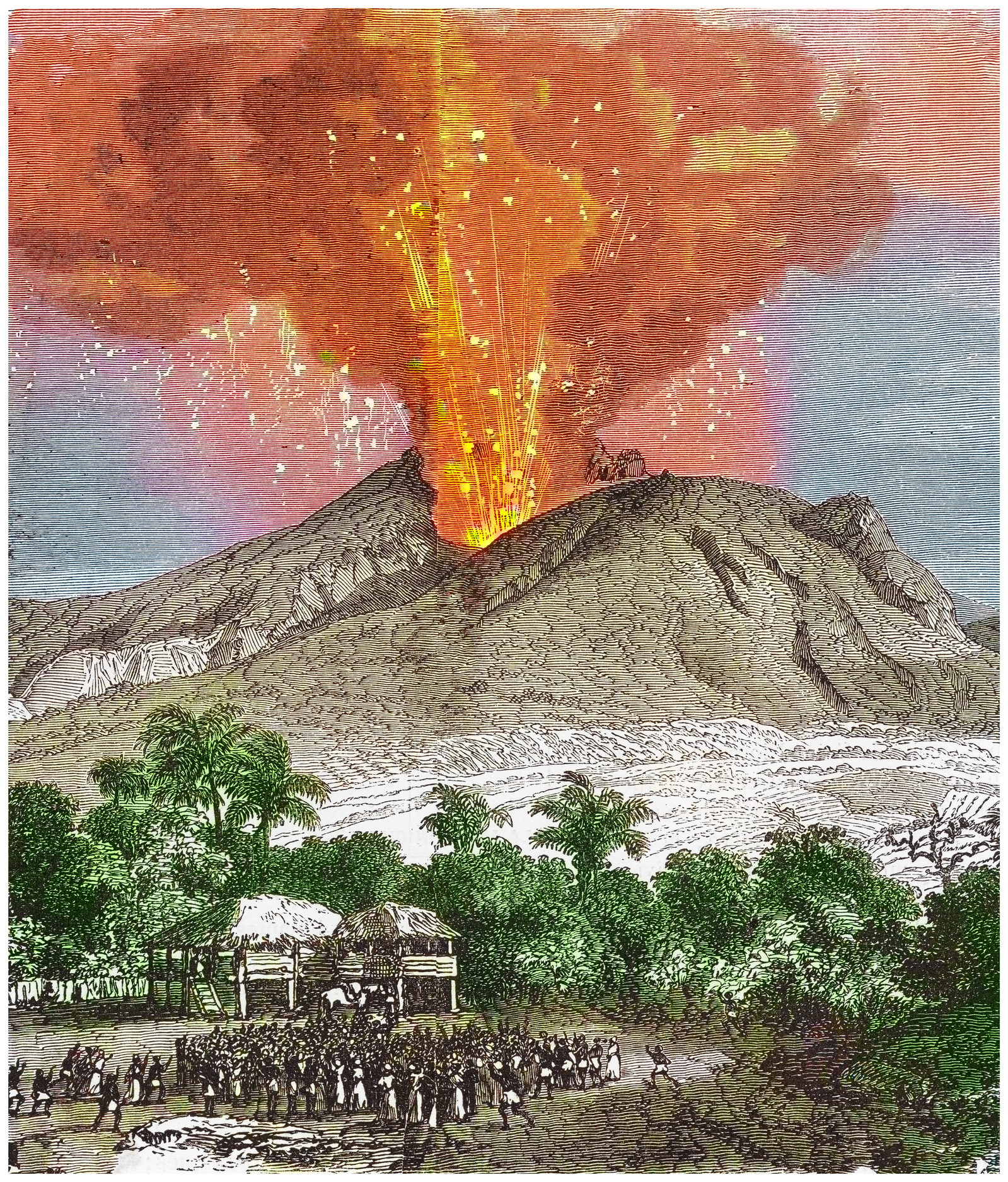
A common example cited by volcanologists modeling the global impact of large volcanic eruptions is the 1815 Mount Tambora eruption in present-day Indonesia. Widely considered the largest eruption in recorded human history, this catastrophic explosion claimed tens of thousands of lives and plunged Earth into the “Year Without Summer”—a prolonged period of low temperatures that ravaged crops and caused widespread famine and disease epidemics around the world.
Based on evidence from past volcanic eruptions and climate models, Poland says scientists believe the effects of a supereruption like Yellowstone could last five to 10 years—though he is confident that Earth would recover.
“A lot of people would die, but it would not wipe out humanity,” Poland says. “No explosive volcanic eruption has ever been associated with a mass extinction on Earth. We’d make it, but it definitely wouldn’t be fun.”
In Ask Us Anything, Popular Science answers your most outlandish, mind-burning questions, from the everyday things you’ve always wondered to the bizarre things you never thought to ask. Have something you’ve always wanted to know? Ask us.