
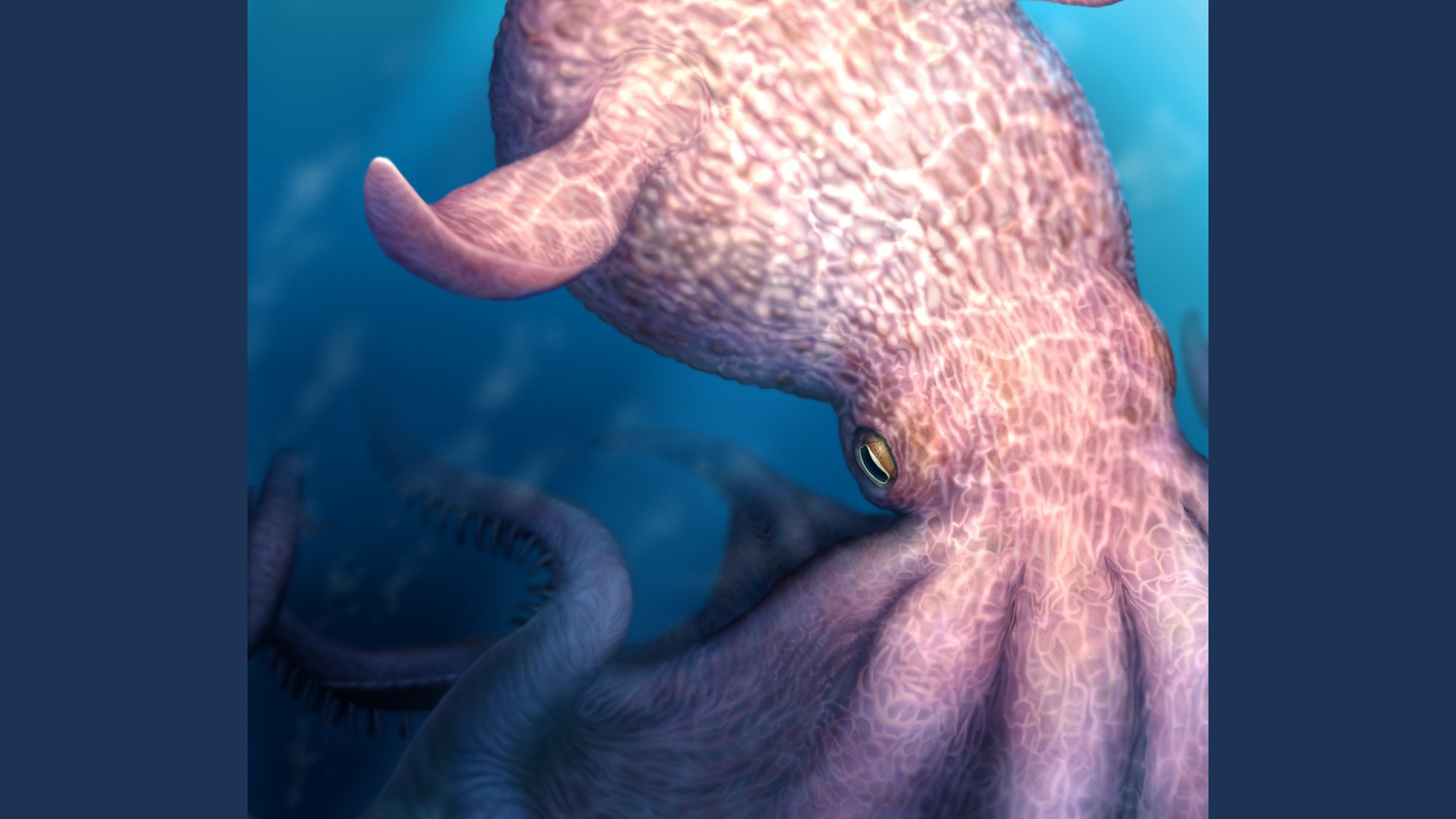
Around 100 million years ago, real kraken-like creatures stalked Earth’s prehistoric oceans. According to a study published today in the journal Science, some of the planet’s oldest known octopuses measured nearly 65-feet-long and ruled their underwater domains.
“Our findings suggest that the earliest octopuses were gigantic predators that occupied the top of the marine food chain in the Cretaceous,” Yasuhiro Iba, a study co-author and marine paleontologist at Hokkaido University in Japan, explained in a statement, adding that they “may have surpassed the size of large marine reptiles of the same age.”
Invertebrates like these are notorious for leaving little trace of their existence. Without bones, there simply isn’t much material to fossilize or preserve for millions of years. But as with today’s cephalopods, the huge octopuses of the Cretaceous Period featured powerful, beak-like jaws used to devour their prey. Unlike the rest of their bodies, these appendages frequently become excellent fossil specimens after coming to rest on the calm ocean seafloor.
Iba’s team examined prehistoric jaws from octopuses belonging to members from the still-living Ciratta subgroup found in rock samples in Japan and on Vancouver Island in Canada. They then used an imaging technique known as high-resolution grinding tomography to scan each sample before using a machine learning program to build a rough anatomical sketch of the creatures.
The results were startling. Dating estimates on the jaws push back the fossil record for giant, finned octopuses by around 15 million years, as well as the wider octopus timeline by 5 million years. This means the invertebrates first arrived around 100 million years ago during the Late Cretaceous.
The state of the jaws revealed another surprise. In both examined species, one side of the jaw was often more eroded than the other. This implies the octopuses displayed lateralization—a behavioral asymmetry tied to living animals with highly evolved neural processing abilities. If true, octopuses have been especially smart for a very long time.
Overall wear-and-tear on the jaws indicates that the invertebrates didn’t choose the easiest prey, either. Some adult specimens had even lost around 10 percent of their jaw tips relative to their total length.
“This indicates repeated, forceful interactions with their prey, revealing an unexpectedly aggressive feeding strategy,” said Iba.
Taken altogether, the discoveries contradict a longstanding evolutionary theory that vertebrates were designed to become the oceans’ apex predators. In actuality, these ancient kraken proved they didn’t need a backbone to be terrifying.
“Our findings show that powerful jaws and the loss of superficial skeletons, common characteristics of octopuses and marine vertebrates, were essential to becoming huge, intelligent marine predators” added Iba.
