
Feature
To take advantage of the strong winds that blow over the ocean, this gearless turbine uses a giant ring of magnets and 176-foot blades

Next-Gen Wind Turbine GE OFFSHORE TURBINE Rotor Diameter:360 ft. Tower Height: 300 ft. Maximum Power: 4 Megawatts | See It Bigger Here Nick Kaloterakis

There’s enough wind energy along our coastlines to power the country four times over, and the race is on to build the best offshore turbines to capture it. Manufacturers worldwide are experimenting with two techniques: ever-longer blades to harness more gusts, and simplified drivetrains (including new generators) that slash the need for costly repairs at sea. GE’s upcoming machine, slated to go online in 2012, will combine both into one package.
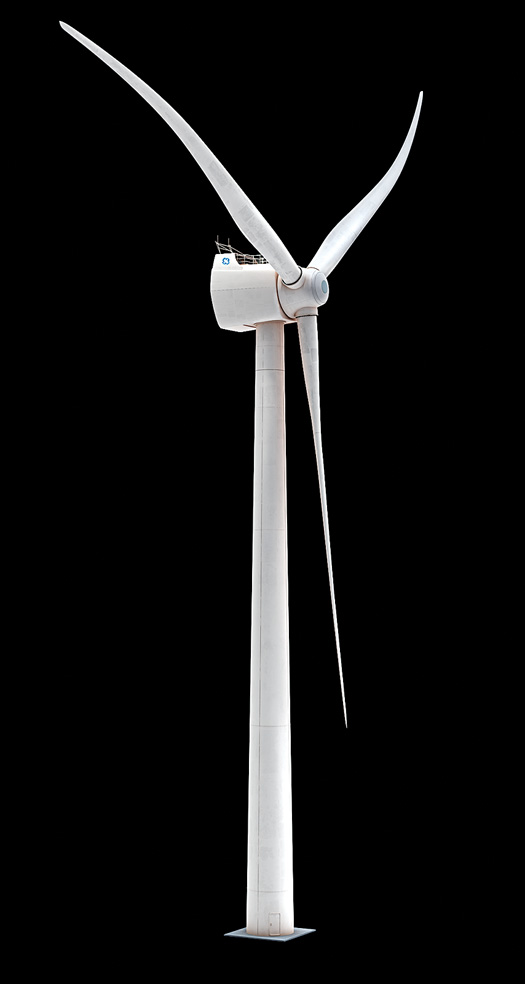
A Twist on Blades: The longer a turbine’s blades, the more wind it captures and the more electricity it creates. “If we could, we would just build infinitely longer blades,” Mercer says. “The problem is, blades get heavy and flexible.” That flexibility, coupled with the force from very high winds, can bend blades so much that they burden the machine or even smack the tower. So GE designed a blade that twists as it bends. It’s curved backward about eight feet, instead of extending straight out. When a gust pushes the tip up, the blade twists slightly around its curve—instantly angling itself so that it bears less of the gust’s brunt yet still captures a large part of its energy.  Nick Kaloterakis
GE created lightweight 176-foot blades—about 40 percent longer than the average—with a more aerodynamic shape. The blades will attach to a drivetrain that does away with many of the moving parts, including the gearbox, that are prone to breakage and energy loss. A direct-drive mechanism replaces gears, and permanent magnets replace the electromagnets that require starter brushes, coils and power from the grid every time they fire up. The blades are now being tested in the Netherlands, and the drivetrain in Norway. Combining the two should result in a turbine that captures 25 percent more wind power than conventional models, so it can operate more often at its full four-megawatt potential—enough to power 1,000 homes.

Design Highlights on the Windmill

Generator: The 90-ton generator consists of a nearly 20-foot ring of magnets that spins to produce current. Its large diameter lets it create a lot of power when turning slowly, at the same 8 to 20 rpm as the blades, so it doesn’t need a gearbox to speed it up to the thousands of rpm most megawatt generators require. “Get rid of the gearbox, and now you don’t have to change the oil,” says GE engineer Gary Mercer.

Electrical Circuitry: Converters stabilize the current’s varying frequencies. Transformers boost voltage from 690 volts to more than 22,000, so current travels efficiently over long-distance lines.

Pitch Controller: To maximize lift as the wind speed changes, a controller can automatically rotate each blade anywhere from a fraction of a degree to multiple degrees per second. It can also turn the blades away from dangerously high winds to avoid power overloads or hardware damage.

Blades: Light, stiff carbon fiber replaces fiberglass at critical points in the blades, so they lose pounds and gain strength. A flat (rather than tapered) edge gives them a shape that increases lift.

How to Spin Power

1. Position the Blades
Based on data from wind-direction sensors, a yaw-drive motor turns the nacelle to face the wind. A pitch controller rotates each blade around a bearing, setting it to the best angle for the wind speed.

2. Capture the Wind
The three-bladed rotor spins in winds from 7 to 70 mph, sweeping twice the area of a football field. A 23-foot-long steel rotor shaft and two roller bearings transfer the mechanical energy to the generator.

3. Turn it into Electricity
The shaft spins the generator’s neodymium magnets inside stationary copper coils, inducing current in the coils. Circuitry adjusts the frequencies and voltage of the current and sends it off to the grid.

Click here for more How It Works

40 Comments

I think windmills are a great source of electrical energy. I live near a wind farm in southern California. One issue I know will be thrown at prospective builders is the danger to birds. The tip speeds on this design will be rather high. At 8 RPMs (with 360 ft rotor diameter) the tips will be moving at about 103 MPH. At 20 RPMs, that will increase to about 257 MPH. At that speed, what effect would it have on the blade to connect with a bird? (The effect on the bird is obvious.)

As this design is being put forward for an offshore site, I wonder if they couldn't situate these atop wave capture devices and get energy from dual sources with only a single access point needing to be plugged into the grid. Surely coupling the technologies into a hybrid device would allow a more stable overall energy output as well as increasing the max output. Does anyone know if any work in hybrid wind/wave technology has been done?

Matt: I don't think we need to worry about birds flying into one of these. The blades are meant to be struck by rather large forces from wind so a small bird crashing into one wouldn't be a problem. Think about the momentum: heavy blade at high velocity vs light and slow bird. As a side note, I know one of the engineers from the Ellensburg, WA wind-farm and he said that more birds die each year from crashing into the visitor center than from striking the wind turbines.

Does anybody know what the efficiency of one of these is? I know current wind turbines have a maximum efficiency of 20%. The article states that it could produce 25% more than current ones. Does that mean these could be 25% efficient?

Daze: I'm not saying you're wrong because I don't know about this material they are using, but one would think a jet plane or high speed train encounters high winds (which they do), but birds flying into them is still a major problem. My school has a lab that shoots cockpit windshields with geese to see how they perform and some catastrophically fail. It'd at least be a question I would think for these blades.

Stupid retarded americans producing stupid technology. I doubt you can export this.

Cool: That is a good point. However, I would think a plane hitting a bird would be much different. When a plane, traveling at 500mph in the X-Direction, hits a bird, traveling at lets say 10mph (sorry I don't know the actual average air speed velocity of a swallow) in the X-Direction the net speed in the x-Direction is 510mph.

But the turbines spin vertically so their speed in the x-direction is roughly 0mph so the net speed is the 10mph (~.5m/s). Take in that the bird weighs about 1kg and the collision takes 1/10 of a second the total force on the turbine would be
F=ma=m*v/t
F=1[kg]*.5[m/s]/(1/10[s])
F=5N

Maybe I'm doing something completely wrong and if so please enlighten me, but it seems to me that a bird shouldn't do much damage.

Honestly though I don't know what would happen but I would love to perform this test.

divideatimprea - Americans already have exported it to Norway and the Netherlands. We just happen to be combining the technology for the first time. Read much or are you just one of those ignorant, self aggrandizing foreigners?

Daze, you're forgetting that there's movement in the y-direction as well. The blade is coming up to meet the bird at over 250 mph...that's ~112 m/s. By your equation, that's 1120 N, acting over a distance of 53m... That's almost 60,000 N/m of torque at the rotor... I'm pretty sure that simplistic calculations like this aren't even close to what would happen in reality though. I imagine that the inertia of the blade would be enough to just bat the bird aside.

Thumbs up for GE, we really need to push for more technology like this....

Ivan Malagurski

Regarding possible bird damage- we shouldn't have to rely just on calculations. There are existing wind farms. At the one near me (on Campo Indian Reservation), I have seen at least one blade damaged by something, and all the blades were recently removed and replaced. I would hope the engineers working on this have communicated with farm operators to learn from their experience. The article suggests this is focused on OFFSHORE wind resources- any reason why they could not be built on land where they would be more accessible, and possibly better protected? Dealing with a tsunami would be a lot different than a bird strike.

Ba ia mai taceti! Idioti americani! Cretinilor. Stati acasa.
Imbecililor. Da sunt strain care e problema? Mai bine va sinucideti. Toti 307,006,550.
O sa va placa.

Cool, I want one.

Most off shore wind farms are far enough out that they see very little bird tragic. Also carbon fiber can be as strong as steel. Bird vs blade is similar to bug verse windshield.

If these turbine can produce power at an affordable rate then lets start building them by the boat load. The first patch should be set up off Martha's Vineyard MA.

A few birds will die, but they aren't stupid. They'll adapt like all the other animals we've affected. I mean, birds fly into things, moving or not. I wouldn't worry about it.

I am personally not real concerned about the risks to animal life here. But the people that attempt to build these will have to prepare an environmental impact statement. And people who DON'T want them built will attack with anything they can think of. This is what I saw when the local wind farm was being planned. So the issue will need to be examined. As far as possible damage to blades, I am influenced by pictures of bird damage to aircraft. Regardless, there should be some sort of sensor or observation system in place so if there is blade failure for ANY REASON, the windmill can be shut down before it tears itself apart. These windmills will each cost millions of dollars.

I'm a big advocate of hydrogen fuel cells and would think that wind turbine technology, not the exact design above, could be developed to form hydrogen fuel producers by taking in the see water ( removing the salt ) and produce fuel.

These giant wind turbine blades seem archaic...if there is to be such a large foot print at 300' high and rotor diameter of 360', wouldn't a vertical axis turbine built at such a scale be worth throwing some investment at?

"We split open an advanced next-gen wind turbine to see what makes its 176-foot blades spin" (which is the caption under image on the index page)

I know what you mean. But it still seems a pretty stupid headline. What makes the blades spin is the wind. And the wind is not "inside" the thing. No need to split anything open!

You guys try so hard to come up with "cool" sounding headlines, or in this case, teasers. And it often fails. Too often.

Damage from a bird hitting a cockpit windshield.. not as much as many are led to believe, the bigger issues arise when they are ingested by the jet engines themselves ;)

They create issues yes, anything obstructing the path of a plane traveling that speed causes at least some trouble... wind sheer, turbulence, birds, wind, rain, hail... nothing new.

These turbines are a football field+ in diameter, they deal with a lot more than birds who happen to be in their way and I really doubt they care much when they contact one... it'll be a glancing blow regardless.
Fan blades are bent, these even bend themselves, you cant use solid numbers and say its hitting it head on unless the bird flies straight into the end of the blade and gets hit upwards/downwards. (Freekin i think has the idea, bat/swat)

Affect a bird has on a carbonfiber wind turbine?
NONE, if not minimal... plus birds roost around things like this all the time, they tend to actually like them and, well they know how to fly around corners ;P
___________End explanation for the non-googlers____

___Not going to mention the trolls____

Now with that said, not a terrible idea GE but I would like more of your time/money/resources spent on energy alternatives with a higher yield than 20-25%. Even a vertical turbine would be better than this (QuantumQuantum). This is just a bigger, smarter turbine that you dont have the change the oil in?...well it's neat to see a bit of the mechanics I guess anyhow, thanx popsci.

The biggest problem I can find with wind power is beauty. People want to be inspired and uplifted by the power, and variety of the architecture. If the windmills are to sterile, consistent, and in machinery rows, then wind power will fail. Put them in odd groupings threes and fives. Make them into trees and with flower like pedals, with whimsy and charm. If people love them they will put them up and maintain them. If not, they will repel them and the green movement that cam with it. Even this design can be dressed up with streamers or kites. Dressing up the windmills could even pay for them. LED lights at night could display messages and advertisements. Mimic fireworks along the wind farm etc. We should and could love these if we use a little imagination.

tmarti69- Beauty is in the eye of the beholder. It is just as applicable here as anywhere else. When I pass by the local wind farm, I see beauty in its function- I know the farm's output is reducing the amount of hydrocarbon fuels used. If you have ever stood at the base of one of these, it is hard not to be impressed with their presence and power. And BTW, they ARE talking about an offshore farm where most people won't see them anyway. Each to his own, but I don't see that adding unnecessary lighting would be an improvement.

I gotta agree with Matt here, I saw beauty and awe when I used to pass a wind farm where I used to live. Yea, lets put LED lights on them and make them look as cheesy and Las Vegas like as possible, that'll make them better.....not really.

And to any person complaining about birds, you are clueless. Why don't you just hop on another anti-progression bandwagon once I put you in your place about them. You all must be so uneducated and lacking in any ability to educate yourself that you refuse to use a search engine to see if what you say isn't complete BS. Since I cant post links, Google 'bird death by wind turbine' and click the second one, and attempt to read.

Just the first one I found, I'm sure there are 1000s more. It's a well known fact that over a BILLION birds die a year from crashing into windows and buildings, are you going to argue to ban those too? Where as death from wind turbines is around what? 10,000? You're laughable. And if you try to argue that it's in the way of rare birds migratory paths, studies have been done that find under a hundreth of a percent of birds in a group migrating are killed. That'll really devastate populations, lets not even bring up the fact that these are offshore and the already waning seagull populations lol....

You now there is a helix wind turbine that takes wind from nearly all directions and runs at 10 mph or higher wind speed.

Nothing new here

ABB posted this technology in 2000 (look for Windform ABB Windscan)

GE took over Scanwind in 2009 and voilà new from old

Serious, hopefully it will work

The biggest concern about bird strikes on blades is for the birds and the impact that is has on bird populations and how it affects public opinion of wind farms. I work as a Blade Repair Technician and our biggest concern is lightning strikes and Yayhoo's with shotguns not bird damage.

Unfortunately, as another poster here already pointed out, "beauty is in the eye of the beholder" and some folks with terminal cases of NIMBY will *never* accept these large turbines anywhere visible, not even on the far horizon.

But I'm in the camp that finds them graceful, even considering them in purely visual terms, without reference to their green aspects. I grew up on a small ranch in Texas, and we had a couple old-fashioned windmills, like those you see in photos of the Midwest from decades ago, and even as utilitarian as those are, I enjoyed watch them turn in the wind, and swivel to come about facing directly into the wind as the wind's direction changed.

The bird-kill problem is overstated, with perhaps one kind of exception: the rare species that travels on an identical, narrow, low-level migratory route every year. But how many species are going to fall into that category? Besides, I assume that in most, if perhaps not all, such cases, the wind farm owners could shift the farm slightly sideways to allow unhindered passage to the migrating birds. Also, some turbine designs (though not this one) are designed with a thought foremost in mind to be readily visible to birds so they can easily avoid the turbines.

If just one of this particular windmill can power 1,000 typical homes, that means only 10,000 of them could power 10 million homes -- which is pretty significant, however we cut-and-dice it. Even those who dispute or deny human-caused global climate change have to admit clean air, water, and dirt are *far* preferable to dirty air, water, and dirt. Plus, cleaner stuff around us means better health for us, as well as animals and plants around us. Pretty important benefits, even if climate change is a myth, a hoax! (Which I don't for a second think it is, but that's an argument for another day.)

did you here me double helix wind turbine look it up.

I never did under stand why there is not any research into vertical wind turbines that do not need to turn to face the wind. All the vertical wind turbines I have seen are small. It could be that the people who have the money for research are fixated on this one design concept.

The first time I saw a vertical wind mill as a concept was on Star Trek TV show. The first time I saw a working vertical wind mill was a few years ago. It could be that the people with the money go with what they grew up looking at (The Dutch are rich from oil and South African mining).

As far as I know, the vertical wind mill concept has been around only for three or four decades. The Dutch Wind mill design has been around and in use for hundreds of years.

GE's wind "technology" all came from Europe (German and now Norway).
Tache designed the 1.5MW; ScanWind the 4MW.
Their own 3.6MW turbine design failed.

I would just like to clear up some misconceptions that are in the comments section. Vertical shaft windmills have been around for years and work very well. However they have a stability problem when they get really big. The turbulence from the blades passes through the middle of the structure and strikes the blades at the back, downwind side. This can be designed out for specific wind speeds but not for all wind speeds. This is not a problem for the "propeller" style because the turbulence moves downwind before the next blade travels through it.
Next point is the bird problem. It isn't usually the damage that the bird does physically to the blade that is the problem. The major damage comes from the blade being thrown out of balance and creating a resonance. In this case the bigger the blade the better because the more massive the weight difference is the less chance there is of blade deflection.
I truely believe that man-kind has to find new energy sources that don't pollute our world. I also believe that this kind of giant, one unit, all our eggs in one basket mentality is going to create as many problems as it solves.
In response to "taking". Excellent design but still has some bugs.

There goes all our valuable rare earth magnets, with Peak Neodymium coming. It is vastly more important to save the magnets for use in permanent magnet motors for Hybrid & Electric Vehicles and E-bikes - the most efficient transportation ever built.

Whereas Wind Energy is an idiotic waste of money.

#1 Wind Energy country, Denmark has the highest power rates in Europe and produces the highest CO2 emissions of 881 gm CO2 per kwh of electricity, #2 Wind Power Germany produces 601 gm CO2 per kwh, while Nuclear France produces 83 gm CO2 per kwh. The real truth about Wind Energy:

www.aweo.org/ProblemWithWind.html

To learn why the inherent intermittency of Wind Energy makes it a fossil fuel gobbler, see:

www.youtube.com/watch?v=tUbGZHXD7fM

www.youtube.com/watch?v=Gvg0NNr8Xdo

Denmark is going to have to start PAYING other countries to take it's Wind Energy.

Wind Turbines - 80% of the jobs are overseas. And a recent Spanish study determined that 2.2 high paying industrial jobs were lost for every low paying renewables job created by gov't subsidies.

The ridiculously high cost of carbon abatement from Wind Energy:

bravenewclimate.com/2010/01/09/emission-cuts-realities/

Wind power integration in the grid may INCREASE CO2 emissions:

www.masterresource.org/2009/11/wind-integration-incremental-emissions-from-back-up-generation-cycling-part-i-a-framework-and-calculator/

Peter Lang shows that the CO2 AVOIDANCE COSTS OF WIND, including necessary backup are $830 to $1149 per tonne CO2 avoided, vs Nuclear at $22 per tonne CO2 avoided, compared with a standard Black Coal Power plant:

www.wind-watch.org/documents/wp-content/uploads/lang-wind-power-co2-emissions.pdf

Finally a rational voice on wind power. YCSTS has a very informed and accurate breakdown on wind power.
The one thing that he fails to mention is the incredible possibilities. Take a 1500 watt wind generator, install it on the roof of every house in North America, hook it up to a heating element in your household water heater. When the wind blows you don't use as much natural gas or electricity depending on your type of heater. The load variance is not as noticeable as when a wind farm with 100 big windmills is becalmed because the wind varies all across the country. But most importantly, you are not dependent on the distribution lines. Use the power where you produce it.
Put another small wind mill on your garage, hook it up to your electric car or a spare bank of batteries for charging your electric car. the government is so enamoured with mega projects that they won't promote the cure.

It is not true that birds are killed by windfarms it is a myth, they can see the blades and fly arround them. However bats do have problems as they effect their sonar.

"...It is not true that birds are killed by windfarms it is a myth, they can see the blades and fly arround them..."

www.youtube.com/watch?v=1RcTjdY1aN4&feature=player_embedded

5thclassengineer the problem with that idea is that small wind turbines are about as good as useless. From David Mackay's Energy Sustainability without the Hot Air:

"...In a typical urban location in England, microturbines deliver 0.2 kWh per day. Source: Third Interim Report, www.warwickwindtrials.org.uk/2.html.

Among the best results in the Warwick Wind Trials study is a Windsave WS1000 (a 1-kW machine) in Daventry mounted at a height of 15m above the ground, generating 0.6 kWh/d on average.

But some microturbines deliver only 0.05 kWh per day – Source: Donnachadh McCarthy: “My carbonfree year,” The Independent, December 2007

The Windsave WS1000 wind turbine, sold across England in B&Q’s shops, won an Eco-Bollocks award from Housebuilder’s Bible author Mark Brinkley: “Come on, it’s time to admit that the roof-mounted wind turbine industry is a complete fiasco. Good money is being thrown at an invention that doesn’t work. This is the Sinclair C5 of the Noughties.”

The Met Office and Carbon Trust published a report in July 2008 which estimates that, if small-scale turbines were installed at all houses where economical in the UK, they would generate in total roughly 0.7 kWh/d/p. They advise that roof-mounted turbines in towns are usually worse than useless: “in many urban situations, roof-mounted turbines may not pay back the carbon emitted during their production, installation and operation.”..."

All Americans are retarded

The effectiveness of wind turbines , large or small is not really in question. Every kilowatt generated by wind is one that is not created through the use of fossil fuels or nuclear reaction, the by products which have and will continue to have an effect on all that live .
I know I sound like a "greeny" but even micro mills save on the power demand. We have only started , in comparison to the larger power producers(coal and nuclear), to realise the the benefits of research on wind generation. This article has opened the eyes of many and no doubt some of the micro or mini mill guys will be adapting their blade shapes for example or trying to enlarge there generators so that they can be more effective.
So try not to give negative comments but support these guys.
I personally dislike when we get "watered down" power from the power companies when the lakes are low or the current producers are running at max out-put.

Aries31 and divideatimpera (although you're probably the same person) why do you even both posting? Nobody really wants to argue with you and it's just a distraction.

Mechanically this is almost identical to Enercon's turbines except GE added a shaft and placed the annular generator at the rear of the nacelle whereas Enercon's design has the generator in front.

GE's real optimizations are in the blades and it's only a matter of time before those scimitar shaped blades from NASA scale up. See the Skystream 3.7 blades for reference.

divideatimprea - cam prost un tsaran esti. Ai vrea si tu sa fi un American. Si technologia asta ye exportata prin touate lume. Puoate nu in tsara nostra unde na bea mai traim da in restu de lume. Nu mai fi asia de un dobitoc daca pots.


June 2013: American Energy Independence

Five amazing, clean technologies that will set us free, in this month's energy-focused issue. Also: how to build a better bomb detector, the robotic toys that are raising your children, a human catapult, the world's smallest arcade, and much more.


Online Content Director: Suzanne LaBarre | Email
Senior Editor: Paul Adams | Email
Associate Editor: Dan Nosowitz | Email
Assistant Editor: Colin Lecher | Email
Assistant Editor: Rose Pastore | Email

Contributing Writers:
Rebecca Boyle | Email
Kelsey D. Atherton | Email
Francie Diep | Email
Shaunacy Ferro | Email

circ-top-header.gif
circ-cover.gif