
Neanderthals (Homo neanderthalensis) were once considered to have been extremely primitive and unsophisticated compared to us humans (Homo sapiens). However, continued research into our long-lost cousins has revealed that these extinct hominids were not quite as archaic as they seemed to early anthropologists.
While archeologists have found that Neanderthals pulled out food from their teeth with toothpicks and may have even used medicinal plants as antibiotics, researchers still aren’t sure about the extent of their medical care abilities. Now, new research published in the journal PLOS One indicates that they were capable of complex dental interventions, which adds a series of cognitive and physical updates to the Neanderthal story.
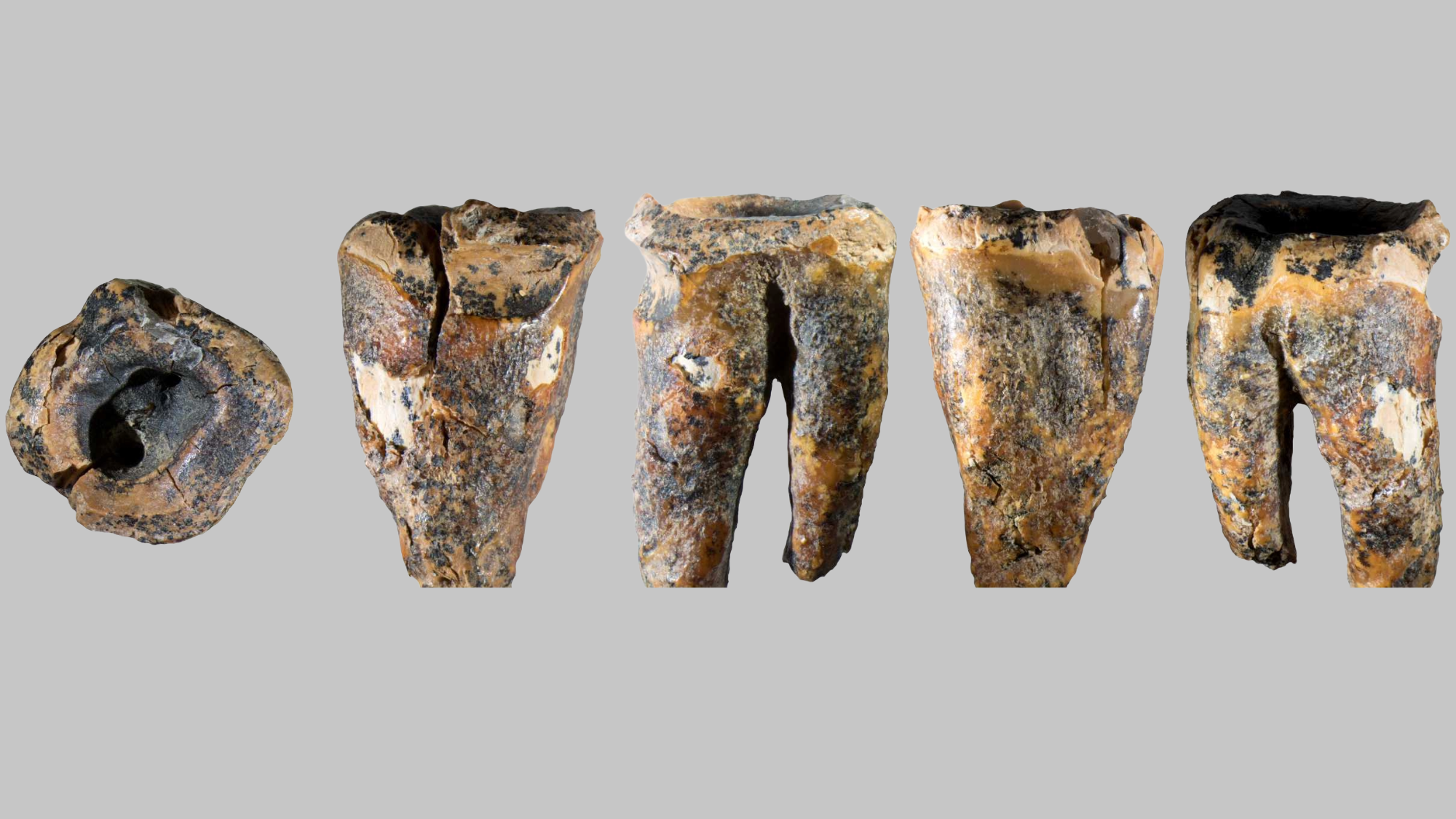
A team digging in Chagyrskaya Cave in southern Russia’s Altai region found a single Neanderthal molar that is approximately 59,000-years-old. The tooth features toothpick grooves along its sides, and a deep hole in its center that reaches into the pulp cavity. Tooth pulp is the jelly-like material that holds blood vessels, nerves, and connective tissue.
Using three modern human teeth, the team showed that it’s possible to make a hole of the same shape and same patterns of microscopic grooves by drilling with a stone point similar to tools that were previously discovered in Chagyrskaya Cave. Andrey Krivoshapkin, a co-author of the study and a researcher at the Institute of Archaeology and Ethnography at the Siberian branch of the Russian Academy of Sciences, tells Popular Science that the team eliminated all other interpretations.
For example, “natural wear from chewing could expose a pulp chamber over time, but it would not widen the chamber or create a deep, irregular concavity with smooth, rounded edges. Dental trauma, such as a fracture, would leave sharp, irregular margins and crackings, not the polished, rounded contours we see,” he explains.
They also ruled out taphonomic, geological, and chemical processes. “So while we always remain open to new interpretations, the evidence overwhelmingly supports deliberate human intervention,” he says.
Related Neanderthal Stories
Krivoshapkin and his colleagues also identified ante-mortem (before death) wear on the concavity walls and edges, showing that after the hole was made, the tooth continued to be used. In other words, the Neanderthal continued to chew and process materials with this tooth. According to Krivoshapkin, if the drilling had happened after the individual had died, the edges of the hole would be sharp and fresh and not polished in the slightest.
“So the wear proves two things: first, the procedure was performed on a living person, and second, the intervention was successful enough that the tooth continued to function. That is what makes this a medical treatment rather than just a curious modification,” he explains.
The team also found changes in dentin mineralization in the tooth that aligns with serious cavities. Ultimately, Krivoshapkin and his colleagues argue that the hole in the tooth represents a Neanderthal dental operation that dug out the infection. And yes, it would have been painful—they didn’t have laughing gas 59,000 years ago. But as with dental surgery today, getting rid of the damaged part of the tooth lessens the pain from the infection.
This intervention carries a whole set of implications about Neanderthal cognitive abilities.The tooth suggests that Neanderthals potentially could identify the source of pain, decide how to treat it, use the necessary manual dexterity to execute the operation, and withstand the intervention’s pain to diminish future pain. It represents the first time such behavior has been shown in non Homo sapiens, and it predates the earliest-known human example by over 40,000 years.
This abstract causal reasoning in Neanderthals “goes far beyond the instinctive self‑medication seen in other primates,” Krivoshapkin explains. “Along with other recent discoveries this finding challenges the old stereotype of Neanderthals as cognitively inferior to us, showing that they were not failed humans but successful, innovative people in their own right. And on a deeply human level, it reminds us that the impulse to treat disease and relieve suffering is not uniquely modern, it is ancient and part of our shared hominin heritage.”
