
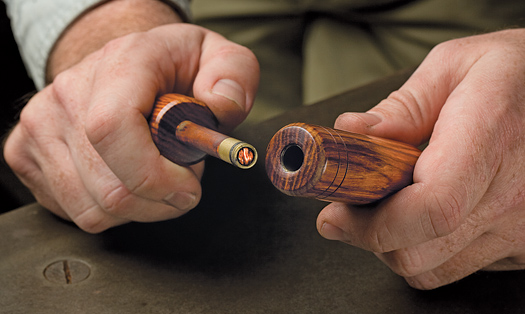
You’ve probably seen contestants on Survivor trying to make fire by rubbing sticks together or concentrating sunlight with their eyeglasses. But among preindustrial fire-starting methods, it’s hard to beat the portable convenience of fire pistons, used in Southeast Asia since prehistoric times.
Almost all gases heat up when compressed. The harder and the faster the compression, the hotter the gas gets, hot enough even to ignite cotton wool or other flammable materials. Diesel engines work the same way: They have no spark plugs; instead the fuel/air mixture is ignited by compression as the cylinder closes up.
Perhaps most surprising is that this same principle also explains how many high explosives work. They are called “high” because their explosive reaction expands through a supersonic pressure wave that travels much faster than ordinary burning, making them far more powerful than low explosives like gunpowder. Each successive bit of material in a high explosive ignites when the pressure wave compresses and heats trapped microscopic bubbles of gas. When manufactured without bubbles, even extremely powerful high explosives can be impossible to detonate. Without gas to compress, there is no way for the detonation wave to heat up neighboring areas.
For example, ANFO (ammonium nitrate/fuel oil) explosive mixtures, commonly used in mining, don’t always naturally contain enough trapped gas, and require a “sensitizer” to render them reliably explosive—often just a slurry containing hollow glass microspheres.
Some high explosives also create heat through the friction of microscopic crystals rubbing against each other, but in many cases the difference between bang and no bang is just hot air.

Five amazing, clean technologies that will set us free, in this month's energy-focused issue. Also: how to build a better bomb detector, the robotic toys that are raising your children, a human catapult, the world's smallest arcade, and much more.


Online Content Director: Suzanne LaBarre | Email
Senior Editor: Paul Adams | Email
Associate Editor: Dan Nosowitz | Email
Assistant Editor: Colin Lecher | Email
Assistant Editor: Rose Pastore | Email
Contributing Writers:
Kelsey D. Atherton | Email
Francie Diep | Email
Shaunacy Ferro | Email
i definitely want one these.
i also plan on getting flint,
and a magnesium fire starter
Sweet. Beats starting a fire with steel wool and batteries, but not at the level of a pop can and a chocolate bar.
We sell these at www.firepoppers.com. No shameless advertising, just offering if people want another option.
"it’s hard to beat the portable convenience of fire pistons, used in Southeast Asia since prehistoric times."
Examples?
"Almost all gases heat up when compressed."
Please tell one that doesn't.
"Diesel engines work the same way: They have no spark plugs;"
No, but they do have glow plugs.
"Almost all gases heat up when compressed."
BCas,
You said: "Please tell one that doesn't."
Under certain conditions, Hydrogen and Helium. They exhibit a Joule-Thomson effect that is opposite from most gases, within certain ranges of pressure or temperature.
"Diesel engines work the same way: They have no spark plugs;"
DfromSD,
You said: "No, but they do have glow plugs."
Actually not all Diesel engines, or more correctly, compression ignition engines, have glow plugs. Most modern car and truck engines do, as an aid in starting. Many older engines used other means as a starting aid. I used to have an old tractor that had a small burner in the intake manifold that consumed some Diesel fuel to heat up the intake air charge, to help get the engine started in cold temps. No glow plugs, though.
The author's point is that the heat of compression is what ignites the air/fuel charge in normal operation (hence compression ignition,) instead of the spark plug used in a spark ignited engine.
Heat from the compression of the air is not the only reason that fuel ignites under sudden compression. In air under higher that atmospheric presser the air molecules are much closer together. This has the same effect as enriching it with oxygen. This is why fire is such a hazard when working in caissons and tunnels that are under compression while working under water.
>>"Diesel engines work the same way: They have no spark
>> plugs;"
>>No, but they do have glow plugs.
The glow plugs only operate for a few seconds to assist the initial start of a cold engine, then they shut down. They are not necessary for a diesel engine, commonly referred to as a "compression-ignition engine," to run.
Sorry, tstaples already made that point. Note to self, newest posts are at the BOTTOM on PopSci...
This is most likely the reason why people who are in a sitting position will roll over to one side of their bottoms when suffering from an unexpected eruption of flatulence...If they didn't move at all,the pressure created by the full weight of their body on this exiting gas might increase it's heat sufficiently to set fire to their underpants.....
We learn of this dangerous possibility as babies and it is becomes a reflex action throughout our lives....well if we ever develop a kinship with our nether ends that is.
Please excuse me.....I have to go now...!
Food for thought...
If you are hoping to be able to provide a fire in a survival situation you must consider two starting points: having "something" with which to start a fire, and having "nothing" with which to start a fire.
If you can always remember to have "something" it could just as easily be something that actually produces FIRE, like matches, a lighter, etc., unlike fire pistons, ferrocerium rods, magnesium starters, etc. which all produce either hot sparks or an ember and require dry tinder.
The ability to fashion primitive fire-starting tools, such as a bowdrill, from available materials can prove invaluable for when you have "nothing." (Although even that will prove difficult without a knife. You don't actually leave the house without at least a knife do you?)
Of course I must state for the record that fire pistons are perhaps the "coolest" method yet, and I'd love to have one to add to my pile of fire-starting gizmos.
nice www.credittcarddeals.in thanks
Just search 'fire piston' to see primitive examples
There is always something new to learn, thank-you PopSci
Commercial ANFO-emulsion explosives are increasingly being sensitized using expanded thermoplastic beads, or microspheres, made of plastic rather than glass. See expancel.com. Glass microspheres are too expensive to ship, and the plastic beads can be expanded onsite as needed.
nortonpc (your comment with your sale is completely acceptable)
home insurance(take your fucking advertisements out of you dam messages if they dont relate)
Hey LAWSONRW, you sound like a racist ignoramus to me, as if you believe those people are idiots incapable of this invention...
Go to the Wikipedia and read if you can get off the 6-pack & recreational drugs...
"
A fire piston, which in the Philippines is known as a sumpak,[1] and sometimes called a fire syringe, is a device of ancient origin which is used to kindle fire. It uses the principle of the heating of a gas (in this case air) by its rapid (adiabatic) compression to ignite a piece of tinder, which is then used to set light to kindling.
Fire pistons have been used by native peoples of South East Asia and the Pacific Islands as a means of kindling fire since prehistory. They are found in cultures where the blow pipe is used as a weapon and this suggests they may have developed out of blow pipe construction. Their use has been reported from Burma, the Malay Peninsula, Indo-China, Borneo, Sumatra, Java, Kalimantan, Sulawesi, the Philippines, Madagascar [2] and South India. [3]
An 1876 New York Times article reported the discovery of the earliest date of its use in the west. It reports an address by a Professor Govi that claimed a book written by Father Boscovich, of Rome in 1755, De Litteraria Expeditione per Pontifican Ditionem, (The Clever Mechanism) makes the claim that the fire piston was invented in 1745 by Abbe Augustin Ruffo. This report also claims that the modern fire piston was reinvented independently in the west through experiments with the air gun and not modelled after native designs.
But can you put your weed in there?
Used disposable lighters (out of butane) will still generate a good spark. One just needs to know how to ignite kindling with a spark.
Wow, nvpacific that's quite a leap to call LAWSONRW a racist.
I think he was mearly curious to learn about the examples, as was I.