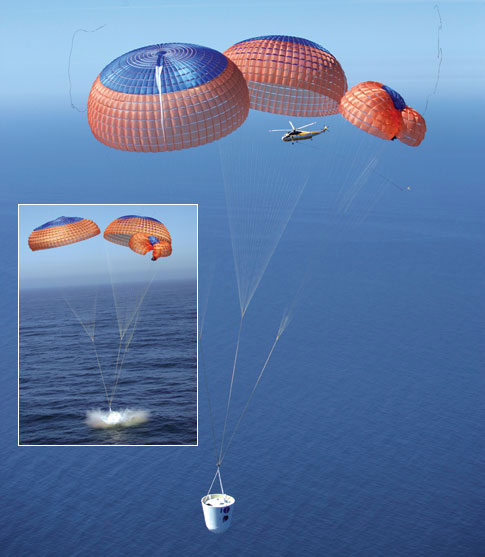
It’s a scene reminiscent of NASA’s glory days, back when men still walked on the moon. A space capsule descends under a canopy of three orange-and-blue parachutes, swaying gently in the breeze. The spacecraft splashes down in the Pacific at a leisurely 15 miles an hour, and the chutes settle into the water beside it. A recovery boat rumbles into position beside the spacecraft, and divers hit the water.
But it’s not astronauts they’re after, it’s the chutes; except for ballast, the capsule is empty, a mock-up created to test the landing of a familiar-looking but actually all-new spaceship design. The divers are racing to rescue the chutes before they sink, so that they can be reused in another test. The capsule, too, will go again, after recovery by a cargo helicopter. This is space travel on a budget.
The test, conducted off the northern California coast on August 3 by a com-pany called, appropriately enough, Transformational Space Corporation, or t/Space, could signal a whole new direction for NASA, one with the potential to put the agency’s manned space program back on track more quickly and affordably than its primary plan can do alone [see sidebar, page 48]. NASA grounded its space-shuttle fleet in July following Discovery’s near miss with foam insulation flying off its external fuel tank. Discovery’s launch this year was to be NASA’s triumphant return to flight after the Columbia disaster. Instead it seemed to highlight, yet again, the shuttle’s numerous design flaws and NASA’s chronic inability to fix them.
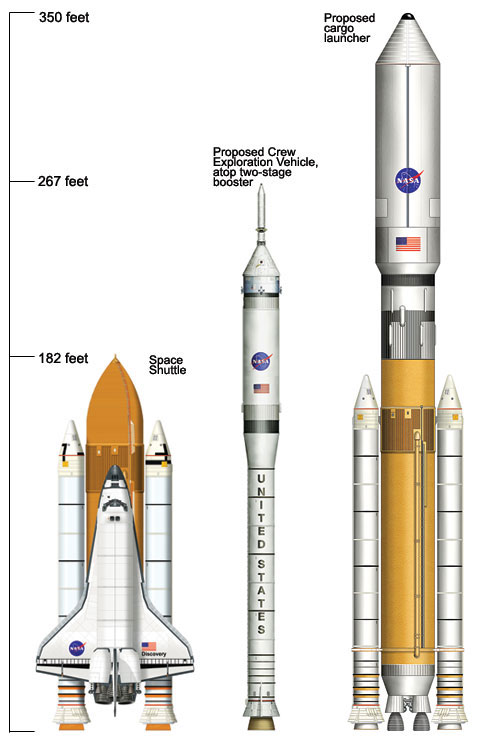
It is unclear when the shuttles will launch again, but ultimately NASA plans to replace the system with a multibillion-dollar craft called the Crew Exploration Vehicle (CEV), which will travel to the moon as well as to the low-Earth-orbit domain of the shuttle. But that ship won’t be ready until at least 2011, and as long as NASA continues to pour money into the aging shuttles, it may have trouble scraping up the cash necessary to build it at all. What many think NASA needs is something it has never had: a no-frills, backup spaceship it could field quickly to keep U.S. astronauts flying to the International Space Station (ISS) or on other low-Earth-orbit missions if a primary system encountered trouble in development or operation.
Enter t/Space, which has been pushing exactly that strategy and which-in light of the trouble with Discovery’s mission this summer and a sudden shift in NASA’s previous all-eggs-in-one-basket approach to manned spaceflight-is now emerging as a dark horse near-term candidate to replace the shuttle.
In the spring of 2004, the Space was little more than two guys with a vision of economical spaceflight-one of many plans that have been floated in recent years. But founders David Gump and Gary Hudson’s approach, in addition to their technology, was different. They proposed a radical idea to NASA: Use contracts that NASA was offering for mere paper studies on next-generation spaceships to instead build actual, working hardware. In Gump’s plan, incremental progress toward a fully functional vehicle would be rewarded with additional funding, allowing the project to move forward. “You’re crazy,” Hudson had told Gump when the latter first broached the idea. “NASA will never give us any business. And even if they did, it would be agony to work with them.”
Nevertheless, Gump had sensed that change was in the air at the beleaguered space agency. The traditional NASA system of awarding expensive “cost-plus” contracts to a few big aerospace firms for its development work-contracts that stick the space agency with the bill even when the technologies prove unsuccessful-was showing cracks, and Gump saw an opening for himself and Hudson.
Both men were veterans of space start-ups: Hudson was running AirLaunch, which is developing rockets under an $11.3-million Department of Defense contract, and Gump had headed LunaCorp, which brokered the first TV-
commercial shot on the ISS, a spot for Radio Shack. They knew how to put together a good proposal, but Hudson still didn’t think much of their chances at NASA. In fact, he initially didn’t even bother to formally incorporate t/Space as a company; he just sent in the proposal and assumed that would be the end of it.
He didn’t count on Michael Lembeck, head of the Requirements Division of NASA’s Exploration Systems Mission Directorate. The directorate was tasked with developing systems both for sustaining the ISS and returning to the moon, and Lembeck and his colleagues had been looking for ways to start working with entrepreneurs with fresh ideas as well as the usual big aerospace contractors. T/Space fit the bill perfectly. He and Exploration Systems chief engineer Garry Lyles sent Hudson and Gump’s proposal straight to Craig Steidle, head of the Directorate, and talked him into signing off on an initial $3-million study, with an option for another $3 million that was later also approved. “Within Exploration Systems, we have been pushing for new, innovative ideas,” Lembeck says, “and we cut t/Space loose to get out of the realm of theory and into the practical.”
Some of what t/Space
built with its $6 million in initial funding dominated an exhibit hall in
Washington, D.C., at this past spring’s
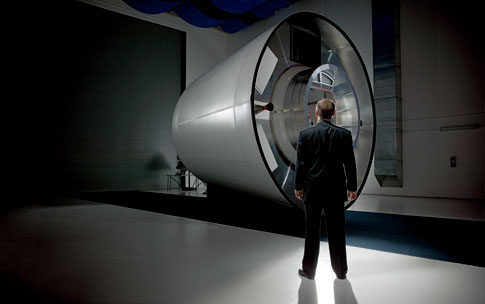
International Space Development Conference, a gathering of scientists, engineers and entrepreneurs from both the private and public sectors. A full-scale mock-up of the company’s proposed Crew Transfer Vehicle, or CXV, filled the room, crowding the booksellers, space artists and other exhibitors to the edges. Attendees climbed through a rear hatch for tours guided by former NASA astronaut Jim Voss. Now t/Space’s engineering manager, Voss flew on the space shuttle five times, lived on the ISS for five and a half months, and holds two aerospace engineering degrees. His experience with the shuttle, Soyuz (the Russian capsule NASA has relied on since the Columbia disaster) and space-station systems make him ideally suited to overseeing the building of the CXV.
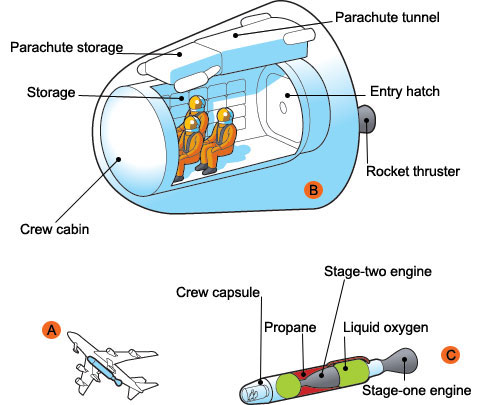
The CXV comprises three systems: the crew capsule; a two-stage booster rocket powered by propane and liquid oxygen; and a carrier plane the size of a Boeing 747, called, in typically understated t/Space fashion, the Very Large Aircraft (VLA), which will haul the capsule and the attached rocket to a launch altitude of up to 50,000 feet. The capsule’s struc-
tural components and the VLA are to be built by entrepreneur and designer Burt Rutan’s company Scaled Composites, which last year sent the first commercial astronauts into space on board its SpaceShipOne. The booster, QuickReach, will be a larger version of those under development for the Department of Defense by Hudson’s AirLaunch. Neither of the rocket’s stages is reusable, but after parachuting to a nose-first landing in any convenient large body of water, the capsule will be refitted and flown again.
The CXV has controls for a single pilot and seating for up to three additional crew members. It has compartments for supplies and equipment, and a zero-G commode. Innovative fabric seats, designed by Voss and a team of engineering students at Auburn University, can take loads of up to eight Gs, are as comfortable as hammocks, and can be easily stowed to create more space after the craft reaches orbit. The seats have one other unique design feature: They swivel 180 degrees. That’s because the capsule will leave the atmosphere and reenter it nose-first, using a
modernized ceramic/silicone-tile heat-
shielding system. The swiveling seats will allow the crew to take the G-forces of both launch and reentry in the most comfortable way-through their chests.
Gump was also on hand at the conference to show off the technology and explain his unconventional development strategy. “What we’re proposing to NASA,” Gump said, “is a type of incremental side bet” to the big aerospace effort to build America’s next spaceship-that is, a scaled-down backup and supplement to the CEV. “Every 6 to 12 months we have performed a set of hardware milestones, and NASA has had a chance to say, “Well, have you actually performed what you promised?’ So they never are betting the entire amount of money.” The big
aerospace effort to build the next-
generation CEV, which will be led by either Lockheed Martin or the team of Northrop Grumman and Boeing, will have no such requirement. But t/Space won’t compete with those companies for the contract to build NASA’s primary space-launch system; it will just quietly build a backup machine more quickly and at a fraction of the cost. “We are trying hard not to claim to be a space-shuttle replacement; we are a Soyuz replacement,” Gump said, “a simple craft to ferry people up and back rather than a self-propelled space station like the shuttle.”
A series of three test
flights over Mojave, California, in June put key elements of the CXV launch process through their paces. Scaled Composites pilot Chuck Coleman took a Rutan-designed research jet called Proteus up to altitude with a 23-percent-scale mock-up of the capsule and booster hooked to its belly. When released, the mock-up deployed a drogue parachute and tipped its tail toward the ground as it dropped. The drogue slowed the mock-up’s rotation to the vertical and stabilized it until it fell, tail-first, perfectly straight. The actual CXV would have fired its first-stage motor at this point, powering through the upper atmosphere behind the carrier craft and into space. The mock-up simply plummeted, as planned, until it slammed into the desert floor with a puff of dust. But it proved the viability of a new method for air-launching spacecraft that was developed under the direction of t/Space engineer Marti Sarigul-Klijn, a former Navy test pilot.
In a conventional air launch, the
rocket separates from the mother ship and fires while still horizontal, pitching up under full power. But the launch loads are more severe, requiring heavier structures, and the wings add weight. Sarigul-Klijn’s Trapeze-Lanyard Air Drop, or t/LAD, rotates the ship to the vertical by keeping its nose attached to the carrier plane with a tether and a trapeze-like mechanism for a second after the drop. “I was astounded that you could get this booster to do a 90-degree turn and just kind of hang there in space,” Coleman said after the tests. “I mean, this thing just dropped straight off. It didn’t roll, yaw, anything. It was like it was elevating straight down. I was very surprised at how stable the whole system was.”
Raymond Sedwick, associate director of the Space Systems Laboratory at MIT’s Department of Aeronautics and Astronautics and a consultant to NASA on spacecraft design, thinks t/Space has the right stuff. “I have to agree with their
capsule approach, based on heritage and simplicity,” he says. In other words,
good old-fashioned space capsules have been flying since the early 1960s with few problems. Sedwick also likes t/Space’s air-launch scenario because it allows NASA to move the launch point above or around bad weather or to pursue a more ideal launch trajectory, and it gives astronauts a fighting chance to survive a
rocket misfire or other launch emergency-they’ll just separate the capsule from the booster and land with their parachutes as they would for reentry. Overall, Sedwick says, “I would say that they are thinking about all the right issues. It’s just a matter of whether or not, at the end of the day, things will pan out as they expect” in terms of NASA’s interest.
Getting things to pan
out may be less dependent on overcoming the technical challenges, which t/Space seems to have well in hand, than on a far more capricious endeavor: winning continued support from NASA. But the company’s prospects brightened considerably this summer, when, without fanfare or formal announcement, NASA created a set of programs within Exploration Systems called Innovative Procurements. Program executive Brant Sponberg explains that the direction has come directly from NASA chief Michael Griffin to “try to bring new actors into what we do,” to open NASA’s manned space program to entrepreneurs, who will be paid fixed fees for building working hardware. Whereas companies like t/Space were once pursuing contracts to design and build NASA-owned-and-
operated vehicles, they now have the option of being the owners and operators themselves. “The idea,” Sponberg says, “is we can enter into a contract where we pay for milestones, so someone has to do such-and-such demonstration or such-and-such test. They have to do it on their own nickel, but if they’re successful, then we’ll pay for the milestone. Ultimately, the last milestone is getting to orbit or doing the final demonstration.”
Gump estimates that t/Space needs $500 million to complete its CXV by 2009 in a cost-conscious program. That’s about what a single space-shuttle launch costs, and it’s a bargain compared with the billions NASA plans to pay big aerospace for a ship that won’t be ready for at least another six years. The company has already accomplished a lot on just its first $6 million. It’s gathered a crack team of engineers and contractors, including Scaled Composites, built a full-scale mock-up of its proposed space capsule, conducted a series of drop tests to demonstrate an innovative method for air-launching spacecraft, and tested splashdown techniques with another full-size mock-up.
That first $6 million will run out by this fall. To take the next step, t/Space will have to win more money from NASA-a good bet, given the space agency’s new direction-and also attract it from private investors. One investor in particular has a pressing need for a commercial orbital spaceship: Robert Bigelow, whose Bigelow Aerospace is aiming to launch the first commercial space station by 2010. Bigelow says he’s prepared to buy an orbital spaceship and that he’s started talks with several companies, although he won’t yet say whether he favors t/Space.
Gump says t/Space will always be “commercial to our core” and that it will pursue private space-tourism flights as aggressively as it does governmental work. But as NASA struggles under a mandate from President Bush to keep the space shuttles on life support until 2010, complete the half-built International Space Station, and somehow send people back to the moon and then on to Mars at the same time-all without significant additional funding from Congress-it faces a hard road. T/Space just might provide a solution to some of its problems.
Michael Belfiore wrote about the Bigelow space hotel in the March PopSci.