

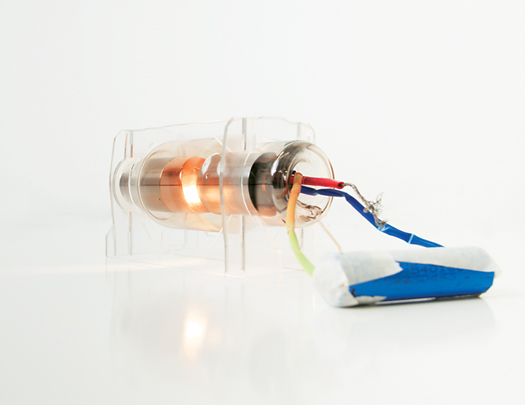
Late one night two years ago, Adam Munich found himself talking with two new acquaintances in a chatroom. One, a Pakistani guy, was complaining about rolling electricity blackouts in his country. The other had broken his leg in a motocross accident in Mexico and said his local hospital couldn’t find a working x-ray machine. The two situations fused in Munich’s mind; he wondered if a cheap, reliable, battery-powered x-ray machine existed—something that could be used in remote areas and function without being plugged in during blackouts. After discovering that the answer was no, he spent two years building one himself out of Nixie tubes, old art suitcases, chainsaw oil, and electronics from across the globe. It was an incredibly ambitious project for anyone, let alone a 15-year-old.
Munich started by reading online about the science of Coolidge tubes, the essential radiation-emitting core of most commercial machines, and eventually found one for sale from a manufacturer in China. “The rest was puzzle-solving,” Munich says. “For something like this, there’s no guide.”

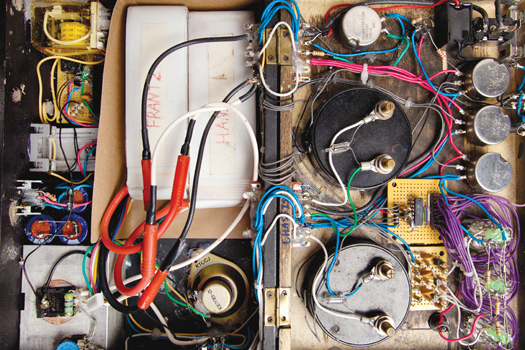
He split the machine into two connected pieces: a control box that houses the electronics and a second case containing the x-ray tube and the high-voltage components that drive it. Batteries alone wouldn’t provide enough power. He needed a voltage multiplier, so he borrowed a design originally used in particle accelerators. When alternating current is applied, it flows into a charge-storing capacitor at its peak and then rushes through a charge-relaying diode when the polarity of the current reverses. This second burst of charge combines with the power stored in the capacitor, doubling the voltage. Using money he earned as a freelance Web designer, Munich bought enough capacitors and ultrafast diodes on eBay to link together four such setups. The voltage increases with each one until it reaches the 75,000 volts required to spark a decent beam of x-rays.
Munich, now 18, has used the machine to x-ray some household items, including a pen and a computer hard drive. Theoretically, he says, it could be used for hands or limbs. Now he is focused on getting the cost under $200 and making the device sturdy enough to help his friends from the late-night chat. But the current version is sure to help with a more immediate concern—impressing college admissions offices.
Time 2 years
Cost $700
See how Munich's x-ray machine works on the next page.
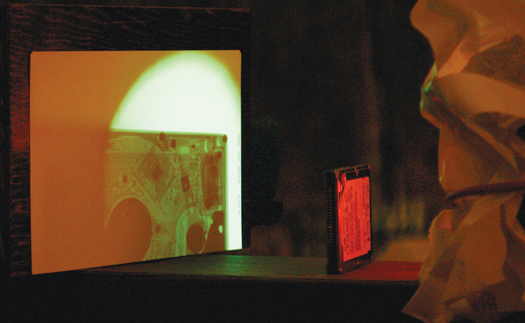
Imaging: Inside the x-ray tube, a high-voltage current sends electrons to a tungsten target. The electrons slam into atoms inside the target, lose energy, and emit x-rays. The x-rays then flash ahead and create a shadow image of the subject. Most machines use flat-panel radiation detectors to get these pictures, but they cost about $65,000. Instead Munich bought a scintillation screen, a plastic sheet that turns fluorescent green when it’s hit with ionizing radiation.
Safety: Munich built his own Geiger counter to measure the radiation. The volume of x-rays coming out of the tube was in line with his estimates, and he found that the backscatter, or amount of radiation elsewhere, was very low. Still, he only uses it outside, aiming it at the woods behind his house. Otherwise some of the x-rays could bounce off an interior wall. He also added a speaker that emits a warning buzz when the machine is generating x-rays.
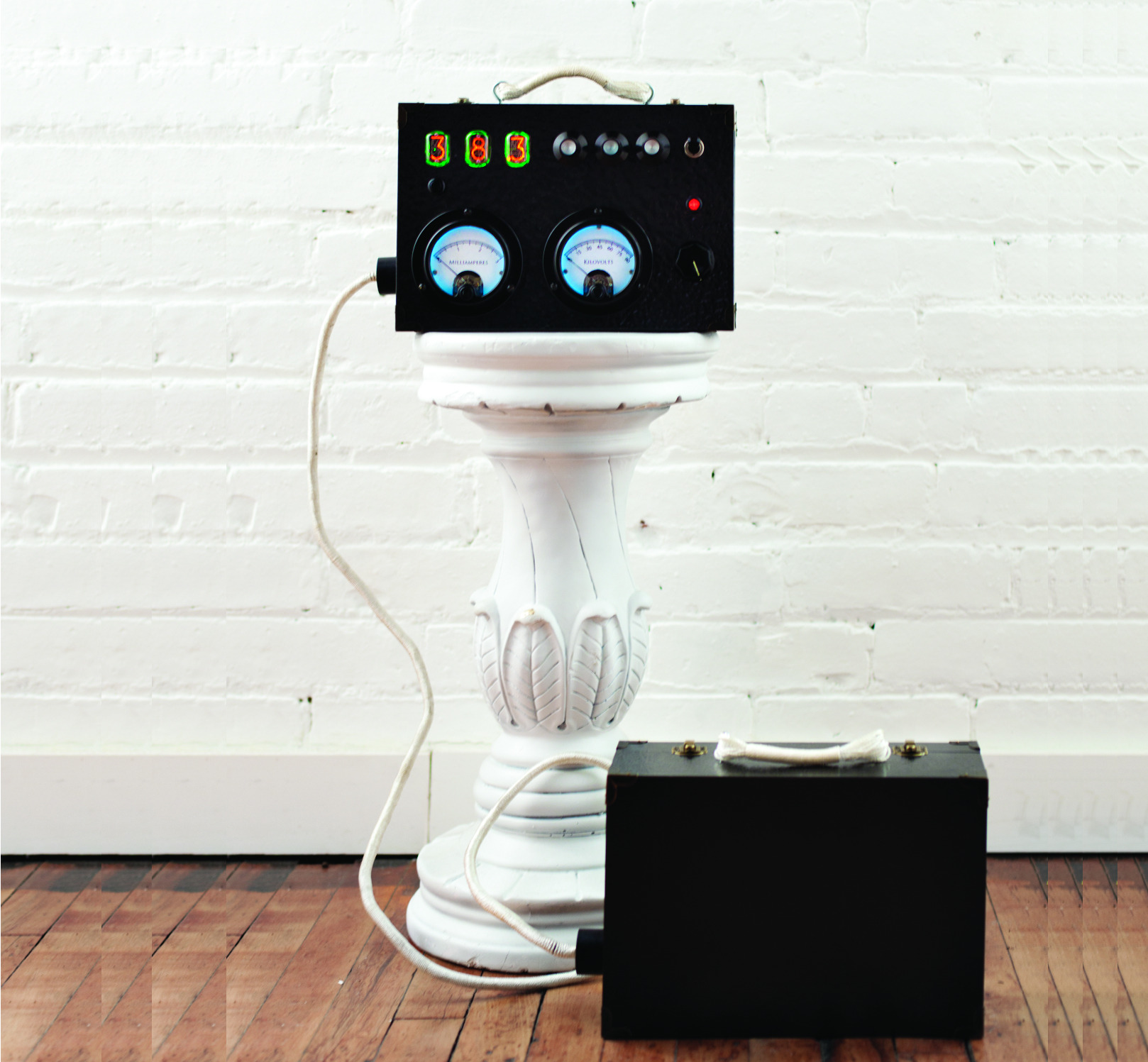
Design: Matching art suitcases, linked by cable, enclose the two pieces of the machine. Munich cut holes in the lid for an on/off switch, meters that monitor current and voltage, dials to set the exposure time, and a Nixie-tube display from a Ukrainian supplier that counts the exposure time down to the tenth of a second.

Five amazing, clean technologies that will set us free, in this month's energy-focused issue. Also: how to build a better bomb detector, the robotic toys that are raising your children, a human catapult, the world's smallest arcade, and much more.


Online Content Director: Suzanne LaBarre | Email
Senior Editor: Paul Adams | Email
Associate Editor: Dan Nosowitz | Email
Assistant Editor: Colin Lecher | Email
Assistant Editor: Rose Pastore | Email
Contributing Writers:
Rebecca Boyle | Email
Kelsey D. Atherton | Email
Francie Diep | Email
Shaunacy Ferro | Email
I,ve seen a lot of "You built what" from Popsci and this is by far the best of the best, It will server to help so many and and looks to be coming soon. Congrats young man, such a cool and helpful thing to be into. Go fella!.
It all started in 3rd or 4th grade when I got a call from Adam's Principal stating, "Adam's drawing pictures of Hydrogen bombs" ! So when I saw the picture it was obvious that it was a "Hydrogen Powered Squirt Gun" ! It even had a heading on the schematic, they still could not comprehend, LOL.
Regards,
Adam's Dad
COOL! Lets say a person was looking to acquire an x-ray machine for some experiments they were doing on different materials and such. Can this machine "tune" the Ev frequencies it operates at? If so/not what is it set and and what does it typically operate at? Also, contact info?
@moonunit21
What an outstanding young man is your son! My boss had an article about a patent of her's on POPSCI last week and I joked to her that "you know you've made it big time when you're on POPSCI". Awesome accomplishment to make at 18!
An outstanding research and design effort. This guy has a very promising future.
Unfortunately, regulatory requirements would make it difficult for this device to ever actually be used. However, it's pretty impressive that he considered safety aspects and implemented some pretty good testing.
The nixie tubes are kind of a hoot, but I can see a few reasons why they might be a good choice.
That is a nice job making it. I have used battery powered X-ray machines for some time. All ways wounder what go in to them. You may what to get it checked. We need radiation safety certs to even use it. You may be braking state laws.
There are a lot of other applications where a portable x-ray source is useful. We recently had access to a desktop device called the GoldXpert from Olympus Innov-X:
http://www.rainydaymagazine.com/RDM2012/Home/February/Week3/RDMHomeFeb1612.htm#TheGoldXpert
Using X-ray Fluorescence, it can tell you in a few seconds whether that "gold jewelry" you have is really what you think it is.
There is also a portable version call the Delta which looks like a beefy Star Trek phaser:
http://www.rainydaymagazine.com/RDM2011/Home/February/Week4/RDMHomeFeb2211.htm#XRFDeltaFirstLook
This unit will let you zap things around the house and look at its elemental composition...like is there lead in the paint there on the wall?
Click on any of the images in the articles for a larger version.
http://www.rainydaymagazine.com
"We Entertain When It Rains"
oh man he should take that to next year's science fair....he'd be sure to make it to internationals
@moonunit21
Your son is incredibly smart and focused! Although this kind of device can have a lot of dangerous consequences, he did not let that deter him from trying, and was careful in going about it. I think he would make a great design engineer (something this world needs in HUGE abundance!!).
The device might be illegal to use on humans here if he gets it tested and can prove its safe a lot of 3rd world country's could use something like it. They wouldn't have to have power at the site its portable and can work when other things can't. I wonder how many X-Rays it can take per charge. The price hes trying to get to is also very neat I've never priced an X-Ray machine but I would imagine plug in models wouldn't be cheap. Congratulations to him already for accomplishing this if he manages to make it cheaper and gets it to where it can be used on humans in country's that need it that will be astonishing. I hope hes been and continues to be careful X-Rays can be damaging enough exposure can be lethal and they can also make you sterile
I dont look busy because I did it right the first time
I hope you have a lead schroud/shield around the Xray tube container.Just be carefull and although you have a gieger counter and you have measured scatter you still need to protect yourself a Lead apron ,lead glasses, lead gloves, or a lead shield in addition to the tube shielding
Most tubes are in lead housings and remember only a small portion of the xrays emit from the target
the rest you might say fly everywhere around the tube hence putting tube in a lead housing. The radiation is cumilative for life......You actually could buy a Nixie Tube counter awesome Great Job
we have portable xray machines at the hospital. we wheel them to the patients' rooms. am i missing something? the one we just got rid of was built in the '80s.
@tyler_w6 Yes, but how much do those cost? How big are they? The whole point is to be cheap, light, and efficient.
We've had portable X-ray machines for a long time, but even a $700 one is too expensive for a 3rd world hospital.
This is lightweight, efficient, and looks to be pretty robust; those tubes can take quite a beating.
You could just walk up to the person running a campaign against you and zap 'em a few times. Better than getting them hooked on cigarettes or dumping isotopes in the coffee.
Wow, does no one realize how dangerous this is. The Nuclear Regulatory Commission is there for a reason. Thats why exisiting portable x-ray machines are so expensive, they have to be tested, and anyone using them has to take radiation saftey classes and pass a state exam. And yes, portable xray is nothing new. We have battery powered xray equipment that will remotly crawl though a pipe and make exposures automatically from the late 70s. Its all down to providing reliable battery power to the machine. But letting someone buide their own machine is very scary to me. These machines are heavly regulated with advanced access controls to keep the public safe. I can't imagine what i would do if I found out the kid next door was playing with a home built xray machine. Xray radiation is ionizing radiation at the same energy lvls of radioactive isotopes. So someone down the street leaves the thing plugged in overnight, and exposes your family to harmful radiation. Yea, great...
hi , i am Interesting , i think we can work together ,
make and sell to me .
do you have email ?
my email : qianji820108(at)126(dot)com
i wait for your reply
Nice idea - good luck with the development.