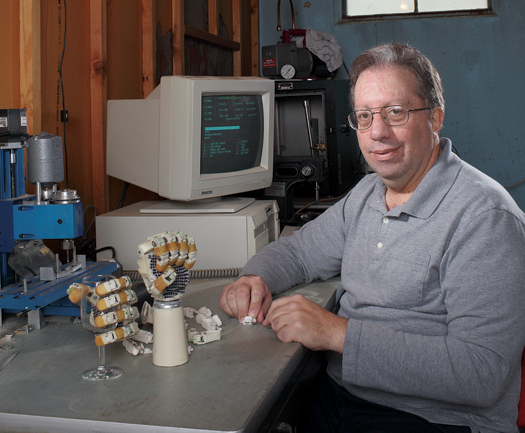
Prosthetic hands typically come in three varieties: purely cosmetic models; hooks and other low-cost mechanical appendages that provide a limited range of motion; and electronic versions that better mimic natural hand movements yet can cost tens of thousands of dollars. Mark Stark’s prosthetic incorporates the best elements of each. Although its minimalist plastic assembly is nearly as light and inexpensive as a common steel hook, it looks and moves like a high-end electronic hand.
Stark, who makes his living designing valves for dryers and other appliances, got into prosthetics in part to help his friend, Dave Vogt, who was born without a left hand. Stark’s creation is electronics-free, but its fingers each have three knuckles (two on the thumb) that bend separately to conform to anything the wearer grasps, including irregularly shaped objects that a hook can’t hold.
Hooks attach to a socket at the end of an amputee’s arm and are operated by a cable that runs up to a shoulder harness. When the wearer shrugs his shoulders, the cable pulls the hook open; when he relaxes, the cable slackens and the hook closes. The Stark Hand screws into the same socket-and-cable system but adds a lever on the palm that connects to five more cables, each running up the back of a finger. A shoulder movement triggers the lever to tug all five fingers open at once, and the individual cables let each finger rebound on its own. Springs in each joint contract until each finger comes to rest on an object, so some fingertips can curl around, say, a wineglass stem while others grasp the cup. The springs exert a level of pressure gentle enough to hold an egg but strong enough that you can lift a chair.

Vogt now wears the hand everywhere except to his job as a machinist, where he has to do heavy lifting for which a hook still works better. A more durable production version, which will use tougher plastics and sleeker parts, could be on the way as early as this winter. Edison Nation, a company that helps inventors develop their ideas, recently selected Stark’s hand for commercial development and is now in talks to license it to a major prosthetics manufacturer.
Name: The Stark Hand
Inventor: Mark Stark
Time: 7 years
Cost: $17,000–$18,000
Five amazing, clean technologies that will set us free, in this month's energy-focused issue. Also: how to build a better bomb detector, the robotic toys that are raising your children, a human catapult, the world's smallest arcade, and much more.


Online Content Director: Suzanne LaBarre | Email
Senior Editor: Paul Adams | Email
Associate Editor: Dan Nosowitz | Email
Assistant Editor: Colin Lecher | Email
Assistant Editor: Rose Pastore | Email
Contributing Writers:
Kelsey D. Atherton | Email
Francie Diep | Email
Shaunacy Ferro | Email
That's my younger brother that invented this new prosthetic hand. He has parents in their 80's & 9 siblings & we're all so very proud of him. It's a wonderful thing he's done for the amputee community, including his friend Dave & our solders' who have lost limbs from IEDs, etc. Congratulations Mark!!!
Excuse me - soldiers
Congratulations, Mark! Everyone at Edisonnation.com couldn't be more proud of you!! You've created something that is going to positively impact the lives of many!
nice computer.
I was hoping it would take longer before some idiot like eregorn8 above mentioned the beige CRT. I didn't even ask Mark about it as I know he has updated computers & likely the one is his basement workshop is adequate for the job. Other inventors highlighted range from MIT to backing by Kevin Costner & some spent millions.
Ticked at first, I actually now appreciate the ignorant comment. It brings up possibly the most important point about the Stark Hand - appearances are everything to shallow people. Before now most amputees could not afford an electronic hand that both looked normal & functioned. Their choice was a passive hand that looked normal & was useless, or 1700's style embarrassing hook, that at least functioned.
I am so Extremely Proud of our friend, Mark, and of course my brother, Dave! This is so exciting to me, I can't imagine how you must feel! Kudos! Now the Whole World will know how Amazing you both are! I have been lucky enough to witness some of the develomental process before now, and I was Blown away even then! Great Job! and much more success in the future! Love, L
Awesome. Congratulation. Hope you make wads of dough!
I also applaud his development of the artificial hand. That is so cool. Personally, I love DOS. My friends often ask me how to make their own computers much faster. I tell them load DOS. Each task is instantly fast and the operating system is so forgiving. Of course they look at me kind of cross-eyed. Everyone is addicted to GUI. I think his computer is awesome, too.
Next he'll be founding a company called Stark Enterprises and in two generations his grandson Tony will be flying around in a full body suit saving the world.
Ironman the prophecy.
Here is a little story about old computers and DOS: When the Space Shuttle Columbia crashed back on February 01, 2003, most experts believed that little computer data could be salvaged because of the fiery crash and the miles of free fall from space such computer hard drives would be required to survive. In the end, the one piece of computer equipment that survived the the Columbia tragedy was a science experiment that used the old DOS operating system to store information onto a hard drive. Modern computer operating system scatter saved data all over the hard drive, but back in the beginning days of computer technology, DOS started from the beginning of the hard drive and worked outward. The reason this story is making news is because the huge hard drive that was storing research experiment information was damaged on it outer edges, but since the hard drive was only half full - 99% of the data was recoverable by some really smart people at NASA.
He needs to get on making that suit now
Well done Sir. Your family and friends have good reason to be proud of you. Hope to see more great ideas from you in the future.
First, as a fellow mechanical engineer and an inventor - Kudos!
A guy in a basement does what million dollars companies scratch their heads and cannot figure out.
Note: I have a friend whose son needs hand AND feet prostheses so I am very interested in this article.
BUT: the article says this prosthesis is way cheaper than electronic versions that cost tens of thousands of dollars. Then the article says Stark's hand cost $17,000-$18,000 dollars! Hello! That's a couple tens of thousands in my book (maybe electronic cost $50k?, what do I know?)
Anyway, kudos Mark Stark!
bisky1@juno.com,
The cost $17,000-$18,000 is how much he spent to create the hand you see, not how much it will cost someone buying one when they are available.
Congratulations Mark, That is very good design! It should help a lot of people. I'm really glad you are finding people that will help bring it to the market.
Hi, This is Mark Stark. Thank you everyone for all the kind comments. Even about my DOS computer, which is there precisely because it runs DOS to drive my milling machine.
I want to use this space to thank the wonderful people at Popular Science. Writer Lauren Aaronson, Photographer John B. Carnett, and Video Editor Jennie Walters. They did a great job of promoting my invention. Their friendliness and professionalism are a credit to journalism.
By the way, what I'm throwing and Dave is catching in the film clip is a Rubik's Cube (TM).
Great job Mark! You've really been a big help to the disabled community! So many handicapped devices and medical devices in general are outrageously priced and serve really as just wish items. This is a big step in changing all of that!
Your work is humanitarian, it is great, I congratulate you and wish success in all steps.
hosseini from Iran, Tehran
But can it give someone the finger? ;)
Tell Mark his next project is to give the hand sensation. It's easy. Embed off-the-shelf temp and pressure sensors wherever desired, and wire to analog buzzer patches that vary in intensity with the incoming signal. Place in a convenient pattern on "live" skin. With a minimal amount of 'training' (watching, cross-verifying heat and pressure with another body part, etc.) the signals will be translated into subjective sensation by the brain. The appropriate idled cortical areas are "starved" for coherent input, and glom onto the new data feeds.
It incidentally stops "phantom pain" and sensations, which are basically those same idled areas responding to random nearby neural activity, once they have something real to do.
Don't have the refs to hand, but all this has been demonstrated on other prosthetics. All with cheap, common electrical items.
I'm sorry if I sound a little ignorant or naive, but why did it took so long to create such a prosthetic?
I mean, it's a rather simple design and the components don't seem to be that sophisticated.
Has no one in the history of prosthetics thought of this design, or were there problems that could've been overcome only with modern tools?
cool. i'm glad that this invention is finally on the market. took a while. well done Mr. Stark. maybe in the future we will have something even more advanced thanks to people like Mr. Stark. Keep up the excellent work.
Well done indeed, Mr. Stark. My favorite stories on PopSci are ones like this. A regular person tackling a real problem with astonishing simplicity. Wrap a skin on that prosthetic, and get ready to change millions of lives!
This is exciting news but we need more information. Like when will this be available on the market and will we be able to order it customized?
Pretty amazing stuff, and I was impressed at the cost of the whole process. Driven home by seeing your friend light up and be able to do things he never has. Thank you!
Brilliant. I applaud your inventive mind and your selfless effort to help a friend. I wish you all the success you deserve.
Good work! Bravo!
Popfuture - for updates on the Stark Hand go to MarkesLLC.com.
BeatPeet - you're not being ignorant, when asked in an interview for a local St. Louis newspaper why such a relatively simple and useful devise had not yet been invented Stark responded "That's a good question, the basic concept could have been whittled from wood 100 years ago."
My responce would be - the best inventions are the ones where one of your hands tends to raise up and lightly hit your own forehead while thinking "Why didn't I think of that!!!"
The domain STARKHAND.COM and THESTARKHAND.COM is selling.
Who want to buy please go to goddady to buy, or contact with me via email: ntuanhndhcmuns@gmail.com
I signed up only to tell you, ntuanhnd, that you're despicable. You've registered those domains with the sole aim of selling them on. The only good news is that if Mr Stark took you to court to get those domain names he would probably win.
You disgust me.
The hand is fantastic, by the way.
Jstark and Beetpeek,
It's astonishing to think of all the things that have been true presumably forever but unthought of until recently. One example: E=MC2 is presumably true from the beginning of time but understood and expressed only relatively recently.
Why, other than that some insights grow, sometimes still quite slowly, on the shoulders of earlier ones, are we so slow at the switch?
Stark constructed a proof-of-concept from hardware-store supplies and gave it to Vogt to try out. Within an hour, Vogt caught a ball left-handed for the first time in his life. Since then, he has helped Stark test and improve four more prototypes.www.thaicartrick.com