
Gray Matter
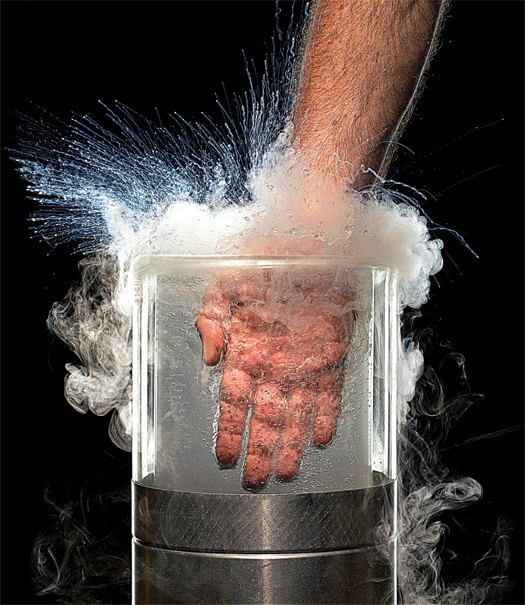
A layer of bubbles protects the flesh from liquid nitrogen, though only for a split second. Need proof? Watch the video

Protected By Science My hand is like a red-hot poker to the liquid nitrogen, but an insulating layer of nitrogen gas forms- a phenomenon known as the Leiden-frost effect- keeping my hand safe and warm for a fraction of a second. Mike Walker

When I first saw this photograph of a man’s hand submerged in liquid nitrogen at somewhere below -320° F, my immediate thought was, “That guy must be crazy! One second in that stuff, and you’re shopping for new skin!” My shock was tempered only slightly by the fact that it was my hand, and we’d taken the picture just a minute earlier.


I hadn’t realized that my hand was quite so deep into the liquid. Amazingly, I barely felt the cold at all. My skin didn’t get hurt for the same reason that water droplets dance on a hot skillet. An insulating layer of steam forms almost instantly between the water and the metal, keeping the droplets relatively cool as they float for several seconds without actually touching the hot surface. To liquid nitrogen, flesh is like that skillet—a surface hundreds of degrees above its boiling point. So the moment my hand touched the liquid, it created a protective layer of evaporated nitrogen gas, just as the skillet created a layer of steam. That gave me just enough time to put my hand in and pull it out again. Any longer than that, and frostbite would have set in.
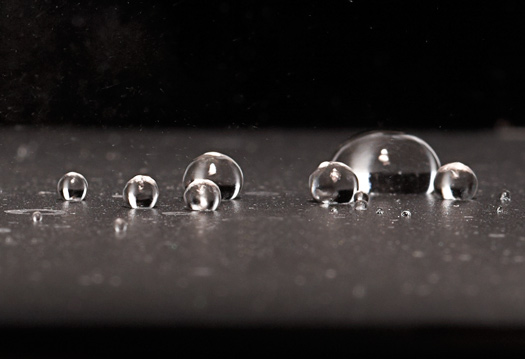
Hot Water: Droplets on a very hot skillet take longer to evaporate than they would on a less-hot surface where no insulating gas layer forms.  Mike Walker

The phenomenon is called the Leidenfrost effect (after Johann Gottlob Leidenfrost, the doctor who first studied it in 1756). I’d known about it for years, but when it came time to test it in real life, I have to admit that I used my left hand, the one I’d miss less.

I drew the line at another classic example of the effect. According to the books, it’s possible to stick a damp finger directly into molten lead without getting burned, if you do it fast enough. After some consideration, and remembering the times I’ve been burned by molten lead, I decided that it probably wouldn’t make a very good picture anyway.

ACHTUNG! Do not try this. If liquid nitrogen soaks into your clothes, you will not be protected by the Leidenfrost effect, and you can get frostbite very quickly.

ようこそ日本からの皆さん!他の動画はこちらから

Want to read more articles like this, plus tips and tricks, home hacks, DIY projects, and more? Subscribe to Popular Science today, for less than $1 per issue!

27 Comments

Great show, but I still think you're crazy Theo...cheers!

Mythbusters did the molten lead thing.

@RougeSquirrel

You can't just say mythbusters did it... was it busted or not?

Totally confirmed

My uncle works with this stuff and this used to be his mates party trick. However, you know when you lick an icy pole and your tongue gets stuck? Same happened to his hand, and when he pulled it out, his frozen finger snapped off. O.o

Adam and Jamie both dipped their fingers in molten lead, and both of them were fine. Here's a quick link if you want to see for yourself:
www.youtube.com/watch?v=UZio0f7fP04

i'm 20 years old and have been playing, not working, with liquid nitrogen for ten years now, no joke. my dad has access to it despite the fact he doesnt use for anything other than tricks for kids at picnics. ive been doing crap with it forever and even tried this earlier this year before the article came out. ive actually never used gloves working with it and only burnt myself once and it was on the sole of my foot

I have stuck my (wet) finger in molten solder before. Its not bad at all, but your right that it might not make the best picture.

Haha, your crazy. Good that your hand is still ok and very interesting way to prove a theory/concept :).

My random blog: www.newbrianblog.wordpress.com

thats really cool. and yeah I saw the myth busters where they did the lead thing. I remember the molten lead wasn't hot ENOUGH at first to get it to work right.

Is it ok to just dump liquid nitrogen into fresh water?

After many years of working with cryogens, I would advise against trying this with liquid Oxygen. Even though it boils only 13 deg Celsius higher than N2, it is quite a bit more dense, and it appears to have much better wetting properties. It is much easier to get frostbit with it.

I have to remember to take my hand out right away too when sticking it into a vat of liquid nitro, although I think there are better ways to train kung fu. Do you think the neighbors would mind if I throw my excess N2 into their pool?

It'd be great if the stuff was cheaper you know. I'd have it in a jar with a pressure release valve ready so that when my beer's warm, all I have to do is release the pressure and drop the beer in or any thing els that need's some chilling.

Wow, pretty dangerous experiment, don't you think?

Check out my blog at: www.dietALT.com

Putting liquid nitrogen in water will result in instant ice cubes, that's all.

I once spilled LN2 all over my pants (sturdy jeans, luckily) – they became a little cold and stiff, no burns.

Wouldn't put my hand in it, though.

I just wonder who the first nutjob was to try this......

Uh, no -- liquid nitrogen into water would be VERY dangerous, I think, because the water would heat the nitrogen, boiling it and causing a gas explosion, splattering water and l.n. drops everywhere.

The reverse (water into l.n) would be safe, because the water would cool and freeze, though there would be a lot of nitrogen bubbles while it was happening.

crazy!

I did this experiment once in a lab class. I did it four times to show off. On the 4th time I was a little less careful and my index finger touched the bottom of the insulated container. I pulled out my hand instantly but my finger was frozen 1 cm from the tip. It gradually thawed and all is well, no harm done. But I could see it going very badly in a hurry.

No issues pouring liquid nitrogen into water. No explosion...

http://www.youtube.com/watch?v=w2mj-Sq2oeo

As a child, I thought my mother had magic, heat-resistant fingertips. When it was time to do the ironing, she would plug in the iron, set up the board, and grab the basket of laundry. Then, she'd lick her finger, tap it on the face of the iron. If it sizzled, it was time to iron. Not magic, SCIENCE!

I'd have it in a jar with a pressure release valve ready so that when my beer's warm, all I have to do is release the pressure and drop the beer in or any thing els that need's some chilling.
http://www.torrentfreakz.com

Neat trick, but extremely dangerous to encourage.

Mistakes happen and the consequences can be severe.

www.articlegeek.net

Did anyone notice that the photo shows a right hand, but the audio and video discuss and show a left hand being submerged? I'm guessing the picture was either a reverse image or a Photoshop job.

weird. especially how someone would be stupid enough to do that. i would never do it, even on a bet because i still want two good hands for the rest of my life, not just one.

Popular Tags

Regular Features


138 years of Popular Science at your fingertips.

Innovation Challenges


Popular Science+ For iPad

Each issue has been completely reimagined for your iPad. See our amazing new vision for magazines that goes far beyond the printed page


Download Our App

Stay up to date on the latest news of the future of science and technology from your iPhone or Android phone with full articles, images and offline viewing


Follow Us On Twitter

Featuring every article from the magazine and website, plus links from around the Web. Also see our PopSci DIY feed


January 2012: The New Science of Stealth

The first issue of 2012 is a great one: we've got stories on how to make planes, tanks, subs, and soldiers invisible. Also, how the U.S. is reengineering homeland security at the southern border, inside the deepest mine in the world, and our predictions for the year to come.


circ-top-header.gif
circ-cover.gif
bmxmag-ps
