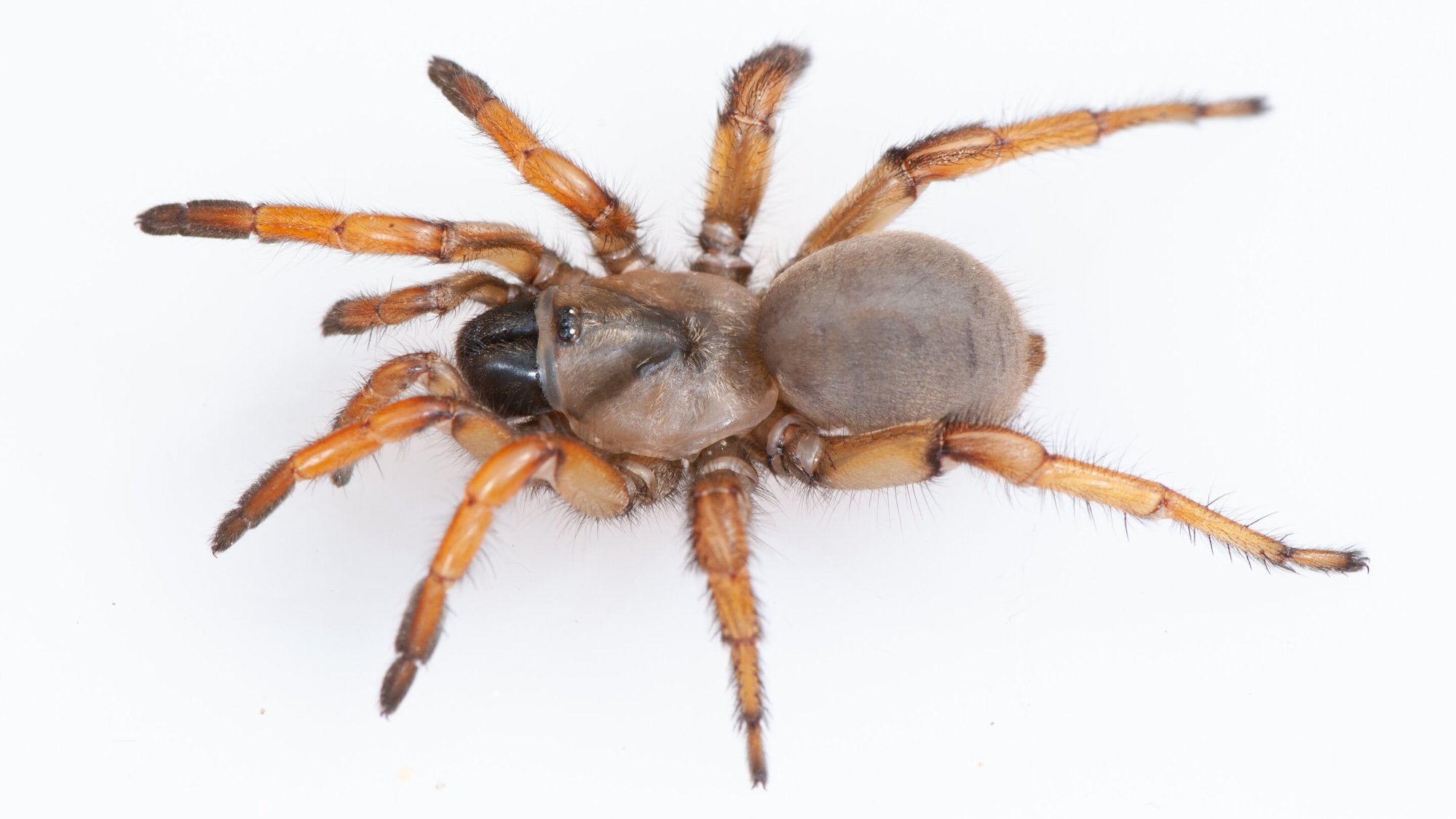
Stephen Colbert’s tenure as host of The Late Show sadly ended when CBS cancelled the historic series in May, but his 11-season run was only possible thanks to a prior gig. From 2005 to 2014, former The Daily Show alum played a larger-than-life, egotistical caricature of himself for Comedy Central’s The Colbert Report. In 2008, a team of entomologists even named newly discovered species of trapdoor spider after him: Aptostichus stephencolberti. And yes, the “t” in “stephencolberti” is silent.
It’s taken nearly 20 years, but researchers finally sequenced the arachnid’s entire genome. As they detailed in a study recently published in the Journal of Heredity, A. stephencolberti also boasts a biological detail that would make Colbert’s Comedy Central character proud. Even though it is only the size of a quarter, the northern Californian spider’s genetic sequence is about 50 percent larger than the genome of a human.
“At 4.6 gigabases, or 4.6 billion DNA base pairs, it’s not the largest genome among the spiders, but it’s significant,” said Jason Bond, a University of California Davis entomologist and study co-author.

The Colbert Report – David Letterman's Retirement
Compared to the measly 23 in a human, A. stephencolberti features 53 chromosomes.. Over three-quarters of those are repetitive sequences instead of additional genes, but like all other spiders, it lacks telomere repeats. Telomere genes serve as the protective ends for chromosomes, and biologists theorize this may partially explain why spider chromosomes evolve so much faster than vertebrates.
“It lends itself to broadening our understanding of spider genome composition and consequently how genomes have evolved across the animal tree of life,” explained Bond.
A. stephencolberti lives along dunes that stretch from Monterey to the San Francisco Bay, with the females residing in silk-lined burrows. Vibrations alert them to nearby prey, which they ambush by springing from a hidden, hinged door. Although technically venomous, A. stephencolberti’s bite isn’t dangerous to humans. Like many animals, rising sea levels threaten to eradicate the spider’s current West Coast habitat, while invasive species pose additional dangers.
Bond and his colleagues weren’t aware of A. stephencolberti’s impressive genome when they first discovered and named it.. Instead, they were simply responding to Colbert’s self-parodying Comedy Central character. In 2008, the host specifically called out Bond on national television during his “Who’s Not Honoring Me Now?” segment after learning the researcher named a different trapdoor spider species after the rock musician Neil Young.
“And all I had to do was shamelessly beg on national television,” Colbert said at the time.