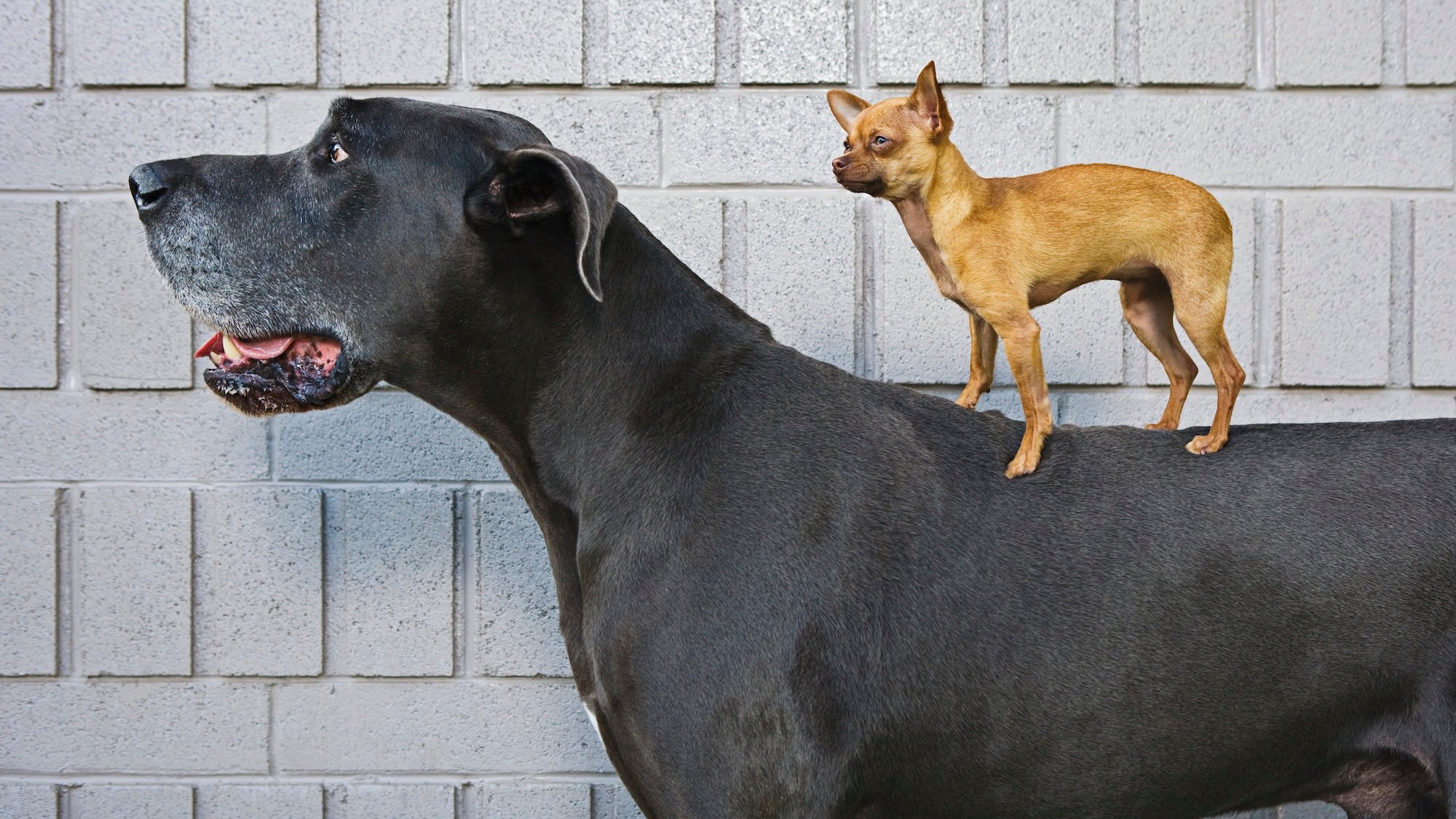
A first-of-its-kind genetic analysis of dog breeds presents the clearest insights into why larger dogs rarely outlive their smaller relatives. According to a team of biologists writing in the journal Science, the longstanding size–age correlation is likely due to “jumping genes” that inevitably begin sowing chaos inside canine DNA as dogs get older.
Most dog owners are aware of an unfortunate rule of thumb—the bigger the pooch, the shorter the lifespan. While this trend isn’t always the case, breeds like the Great Dane generally don’t stick around as long as smaller relatives like golden retrievers or even pugs. Larger dogs are also much more prone to age-related health issues and diseases. These canine traits starkly contrast with what biologists often see in other mammals, where larger species like whales frequently live much longer than tiny animals such as rodents. But these mysteries make your favorite furry friend’s genetics incredibly intriguing to researchers.
“Dogs provide an extraordinary model for understanding aging because they show dramatic variation in lifespan within a single species,” explained study co-author and Arizona State University (ASU) evolutionary biologist Noah Snyder-Mackler.
Dogs’ longstanding 30,000 plus years of companionship with humans also poses a unique opportunity for scientists. Pets and their owners share many of the same day-to-day experiences, environments, and physical habits, so it stands to reason that a better understanding of canine genes could guide future studies of human biology. Knowing this, Snyder-Mackler and his colleagues recently examined genetic data from 864 dogs stored in the Dog Aging Project. They specifically focused on mapping genome-wide DNA methylation, which allows genes to express themselves without altering their DNA sequence. DNA methylation is part of the larger epigenome influenced by external factors like stress and diet, and it’s also a widely known indicator of aging and DNA regulation.
Snyder-Mackler’s team discovered a dog breed’s aging is specifically tied to losing regulation in a class of transposable elements, or “jumping genes,” called LINE1s. These genes copy and intersperse throughout the genome by leaping between chromosomes, which damages DNA. This initially isn’t too problematic thanks to the regulation from DNA methylation, but that ability decreases with age. Less regulation means more damage in the form of genetic instability, diseases, and cancer.
“What we found is that the epigenetic regulation of transposable elements—especially LINE1s—appears to be a major factor shaping how quickly different dogs age,” Snyder-Mackler said.
Over 40 percent of LINE1-related portions of the genome lose DNA methylation as a dog ages, but the speed of decline is much faster in bigger breeds. The team’s findings showed larger dogs lost an average of 35 percent more LINE1 methylation than smaller canines.
“It suggests that faster aging in larger dogs may be driven, at least in part, by reduced control over these ‘jumping genes,’” concluded ASU genomicist and study co-author Blaise Mariner.
It’s still unclear if LINE1 behavior causes species to age, but the recent work emphasizes these genetic areas are focal points in biological aging. Beyond understanding aging differences among dog breeds, the discoveries may guide research into similar genetic changes in humans.
“If that’s the case, targeting these elements or the mechanisms that regulate them could be a promising avenue for future therapies to extend the health span in humans,” said Snyder-Mackler.