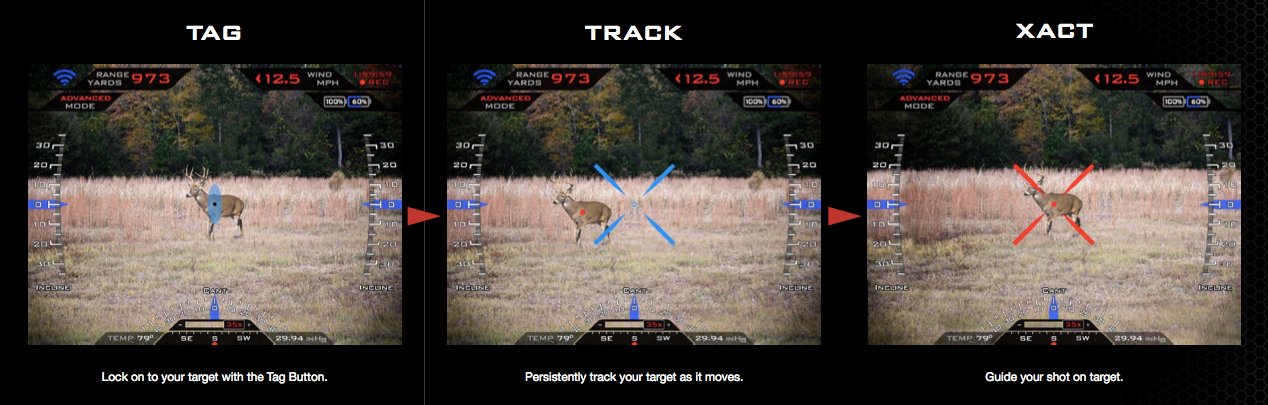
CES isn’t usually the venue for checking out the latest in firearm technologies, but this week the public got its first (as far as we know) really good look at Austin-based TrackingPoint’s “Precision Guided Firearms.” When we first heard about TrackingPoint back in November, details were pretty scarce; a YouTube clip offered a quick primer on how the computerized scope allows shooters to “tag” their targets and call their shot before they actually pull the trigger, ensuring that they hit the target right where it is marked. Now we’re learning a lot more about the technology, and it turns out it’s pretty deep.
TrackingPoint’s “Precision Guided Firearms” aren’t really guided, but they do allow the human shooter to mitigate shaking or flinching that might occur at the moment of trigger pull, movements that could send a shot off target (and when a target is, say, 200 yards downrange even a slight movement of the rifle can pull a round many inches off target). The entire rig is all one system–scope, rifle, and even the ammunition, which must be of a specific type manufactured to very narrow tolerances so that the guidance computer is working within known constraints.
And so it works like this: The integrated scope and rifle system doesn’t employ a traditional telescoping optic. Rather, looking into the scope offers the shooter a magnified downrange view streamed as video to a Linux-powered computerized display overlaid with a head-up display. The shooter then zeroes in on the target and uses a button near the trigger to “tag” the place he or she wishes the bullet to make contact. In this way, the shooter can pre-define the shot to his or her liking before discharging the firearm.
The computer then takes into account a bunch of other data–the target’s range, air temperature, humidity, incline of the firearm, even the age of the barrel–in the blink of an eye, adjusting the crosshairs to account for all of these data points. All the while a computer vision system keeps the tag in the same place on the target, even if the target or firearm moves some in the interim. The shooter then has to simply apply pressure to the trigger as he or she attempts to line up the crosshairs with the tag. The firearm will not discharge until the crosshairs and the tag are in perfect alignment. At which point: boom. This not only ensures that the round finds its mark, but it forces the shooter to apply constant pressure to the trigger–to squeeze the trigger–rather than pull it (Shooting 101 for those uninitiated: always squeeze the trigger, never pull it–trigger pulling is a bad habit that encourages inaccuracy).
We knew (or could infer) most of that already, save the number of data points the onboard computer crunches prior to firing (The age of the barrel? Really?). But there are some other intriguing aspects to these firearms–even some the ardently anti-firearm crowd might find interesting or appealing. For instance, an on-board computer means data storage, and data storage means these firearms possess something like the data recorders the FAA requires on commercial aircraft. It constantly records the visual feed from the optic and can even feed it to an iPad or iPhone app over a short-range Wi-Fi hub, allowing a person sitting next to the shooter to act as a spotter or simply observe or advise on the shot. And of course the videos can later be uploaded to the Web. Mom will be proud.
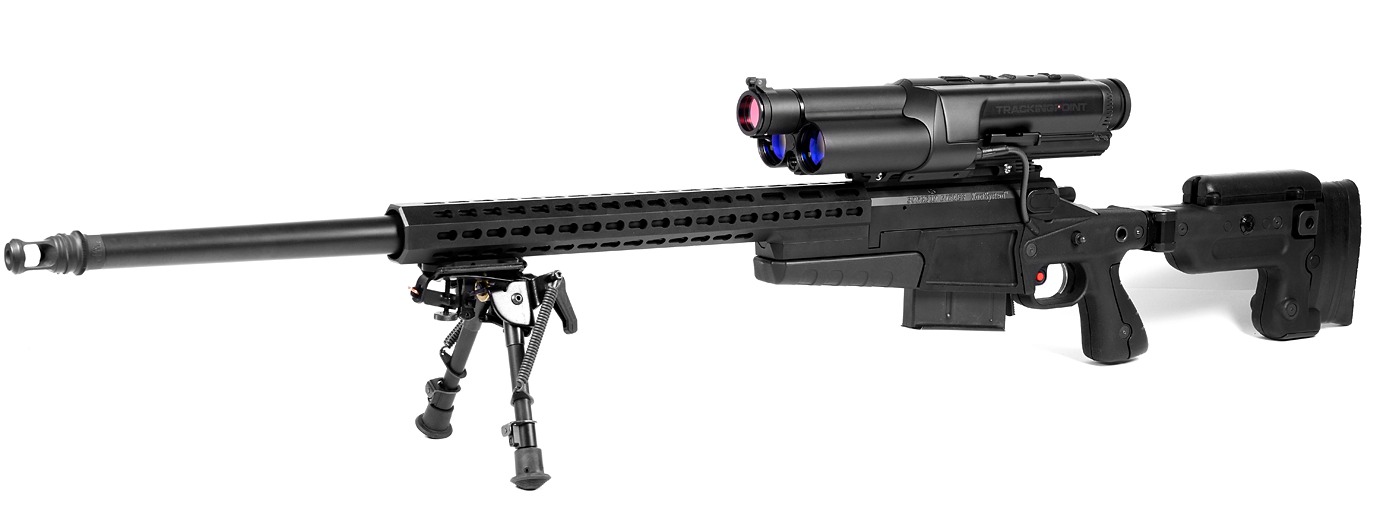
TrackingPoint currently offers three rifles packing its Precision Guided Firearm tech, all bolt-action hunting rifles (though pistol-style grips are often associate with tactical rifle design–just saying) designed with sport rather than combat or law enforcement in mind. That being said, firearms and firearm ownership are hot-button issues, especially in the wake of recent events. But by computerizing the firearm, TrackingPoint has raised some interesting notions for the gun industry at large. For one, if guns go the way of the automobile and become increasingly computerized and connected, could that make them easier to track and regulate? And by ensuring the perfect shot every time, can hunters ensure that they take their game in the most humane way possible? The answer to the second question would on its face seem to be yes. The first, well, that’s up for debate.
Anyhow, for the time being TrackingPoint’s tech is probably going to stay in the hands of only the most serious sportsmen and sportswomen. At $17,000 per rifle, the barrier to entry is a little steep for any but the most dedicated shooters.