
In the 1930s, U.S. Navy researchers stumbled upon the concept of radar when they noticed that a plane flying past a radio tower reflected radio waves. Scientists have now applied that same principle to make the first device that tracks existing Wi-Fi signals to spy on people through walls.

Wi-Fi radio signals are found in 61 percent of homes in the U.S. and 25 percent worldwide, so Karl Woodbridge and Kevin Chetty, researchers at University College London, designed their detector to use these ubiquitous signals. When a radio wave reflects off a moving object, its frequency changes—a phenomenon called the Doppler effect. Their radar prototype identifies frequency changes to detect moving objects. It’s about the size of a suitcase and contains a radio receiver composed of two antennas ­and a signal-processing unit. In tests, they have used it to determine a person’s location, speed and direction—even through a one-foot-thick brick wall. Because the device itself doesn’t emit any radio waves, it can’t be detected.

Wi-Fi radar could have domestic applications ranging from spotting intruders to unobtrusively monitoring children or the elderly. It could also have military uses: The U.K. Ministry of Defence has funded a study to determine whether it could be used to scan buildings during urban warfare. With improvements, Woodbridge says, the device could become sensitive enough to pick up on subtle motions the ribcage makes during breathing, which would allow the radar to detect people who are standing or sitting still.

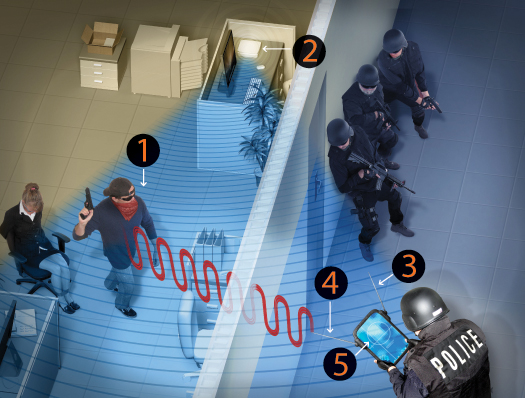
See image above for how it'll work.

1. MOVING SUBJECT
When Wi-Fi radio waves bounce off a moving object, their frequency changes. If, for example, a person is moving toward the Wi-Fi source, the reflected waves’ frequency increases. If a person is moving away from the source, the frequency decreases.

2. REGULAR OL' ROUTER
A Wi-Fi Internet router already in the room fills the area with radio waves of a specific frequency, usually 2.4 or 5 gigahertz.

3. BASELINE SIGNAL
One antenna of the radar system tracks the baseline radio signal in the room.

4. SHIFTED SIGNAL
A second antenna detects radio waves that have reflected off of moving objects, which changes their frequency.

5. PERP, SPOTTED
By comparing the two antennas’ signals, the computer calculates the object’s location to within a few feet as well as its speed and direction.

BREATHE EASY
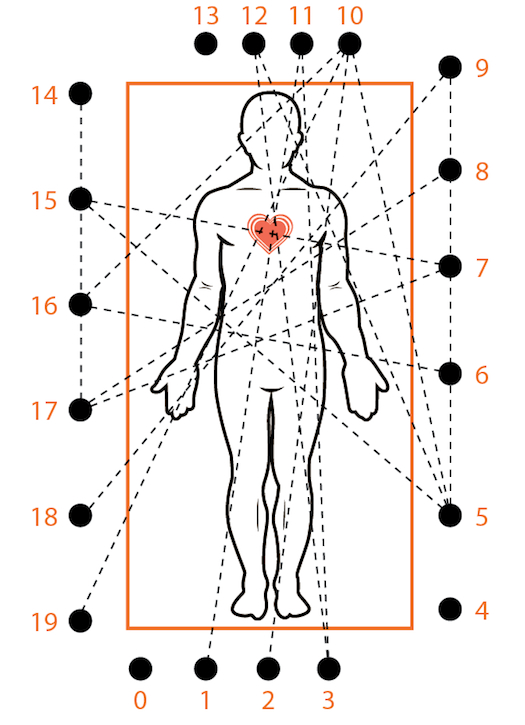
Breathe Easy:

It’s possible to detect a person’s breathing rate by surrounding him with radio waves. Neal Patwari’s wireless engineering group at the University of Utah designed a network of 20 inexpensive radio transmitters that are placed around a patient’s bed. Then they created an algorithm that detects a stationary person’s breaths better than current detectors do. Patwari plans to upgrade the algorithm by the end of the year to filter out body movements too. The system could someday be used in hospitals in place of tubes and masks.

—Elbert Chu

13 Comments

An interesting article, but it leaves me with two concerns.

First, the inference that in the 1930's US Navy researchers were the first in the world to "stumble upon the concept of radar". That is totally untrue. The concept of radar had been stumbled upon long before that, and in many countries, some of whom had explored and developed applications for the phenomenon in far greater depth than had the USA. Indeed, by 1940, Great Britain had a functioning homeland defense / detection radar system in operation, that greatly assisted the Royal Air Force in defeating the Luftwaffe in the Battle of Britain. The US, by comparison, lagged quite far behind in radar technology in that era.

Second, specific to the new "domestic security" application for radar being researched at University College London (Britain again, unless I'm mistaken!), it appears that detection through thick walls of movement is stimulated by the presence of a wireless router. All well and good. Except that, in my home at least, there is only one wireless router; and distance and wall / floor level interference greatly impede the waves from the wireless router. While I do not doubt that further research should improve the discovery's applicability, I don't think that we should be expecting SWAT teams to be using this to rescue us from hostage takers any time soon ... especially if they are holding us in the basement, and the wireless router is two floors up at the far end of the building.

@ManxJack. The Radar discovery and development is indeed much older and involving many people from across the world. So to say that the US Navy stumbled upon it is kind of disappointing to come from a science and technology website. To use a quick view from wikipedia:

As early as 1886 the German Heinrich Hertz showed that radio waves could be reflected from solid objects. In 1895, the Russian Alexander Popov, developed an apparatus using a coherer tube for detecting distant lightning strikes. In 1897, while testing this equipment for communicating between two ships in the Baltic Sea, he took note of an interference beat caused by the passage of a third vessel. In his report, Popov wrote that this phenomenon might be used for detecting objects, but he did nothing more with this observation.

The German Christian Huelsmeyer was the first to use radio waves to detect "the presence of distant metallic objects". In 1904 he demonstrated the feasibility of detecting a ship in dense fog, but not its distance from the transmitter. He obtained a patent for his detection device in April 1904 and later a patent for a related amendment for determining the distance to the ship. He also got a British patent on September 23, 1904 for the first full radar application, which he called a telemobiloscope.

And it goes on and on with people who contributed to Radar before 1930.

im sorry, but when did they say the us was first to discover radar? they only said "In the 1930s, U.S. Navy researchers stumbled upon.." meaning they stumbled upon the idea, not that it was the first time for the usa even. not saying thats necessarily correct either, but if youre going to correct someone, at least read what they wrote and dont insert your own meanings and wording.

"Stumbled upon" as in a fully functioning radar system was left lying around on the floor and a Navy researcher tripped over it and stumbled.
How could you guys not understand that? LOL

Is the article correct?
It depends on your definition of "is"

Cvore2004, how can claim they stumbled on something if it's already widely known. It gives the impression that they are the first.

That's pretty cool but I could see this used for bad though like on that movie eraser. They could be building a scope to be used to see through walls and get a perfect shot.

to the writer of this article, Nikola Tesla was the first one to explain the concept of a radar. That should have been mentioned in the article and not the U.S. Navy.

OMG a leaf moved. Karl Woodbridge shat his pants.

my roomate's aunt makes $83/hr on the laptop. She has been without work for 8 months but last month her pay was $8682 just working on the laptop for a few hours. Read more on this site...NuttyR|ch.c0m

The wording in the article is a little poor, but "stumbled upon" implies that they discovered it for themselves, not that they were the first to theorize or even develop it.

lern 2 english

The article SAYS that the US Navy 'stumbled upon' the concept of radar in the 1930s, but I know of NO instance what the US were doing ANY work in this field at all, and have NEVER heard this story before.

The story of how Thomas Watson-Watt developed radar in the UK, however, sounds suspiciously like this. Over there they were experimenting in the 1930s with using radio beams to interfere with aircraft engines, and noticed that the beam was reflected. They then changed their research direction and developed the world's first fully-functioning radar defence system. The secrets of this were given free to the US during the Tizard Mission of 1940, when the British provided the Americans with details of some of the greatest scientific advances made during the war: Radar (in particular the greatly improved cavity magnetron and design for the VT fuse), details of Frank Whittle's jet engine and the Frisch-Peierls memorandum, which described the feasibility of an atomic bomb. Though these may be considered the most significant, many other items were also transported, including designs for rockets, superchargers, gyroscopic gunsights, submarine detection devices, self-sealing fuel tanks and plastic explosives.

This article looks suspiciously as if the writer has ignored the fact that the British did all this development, and tried to make it sound as if Radar was an American invention. It is quite common to find that the Americans have taken a British incident and then transposed it to a US setting and pretended that Americans did it - Hollywood does this all the time. For instance, the film 'U-571' has Americans capturing an Enigma device when this was really the Royal Navy, and in the film 'The Ghost and the Darkness', the real-life British big-game hunter is replaced with a completely out-of-character 'heroic' American....

This squabble is ridiculous. In technological advances, it is common for independent discoveries to be made by many. That was the case with radar. Note from Wikipedia:

"In the 1934–1939 period, eight nations developed, independently and in great secrecy, systems of this type: the United States, Great Britain, Germany, the USSR, Japan, the Netherlands, France, and Italy. "

Likewise, the magnetron was invented in the US but the improved (and critically, high power low weight) resonant cavity magnetron was developed in Britain and kept secret among allies throughout the war.

Throughout WW-II, the US and Britain had deep cooperation in military technology fields. They also had independent discoveries. US cryptanalysts did amazing work breaking the Japanese ciphers and codes, while the British, led by Alan Turing, did other amazing work breaking the Ultra/Enigma system. Ultra and the Japanese "Purple" ciphers used similar systems (multiple rotating disks). The British work led to the claim of the first programmable digital computer (Colossus), but the first known digital electronic computer was developed at Iowa State in the US in 1937. Meanwhile the Germans were making great advances in weaponry, including the first jet fighter, the first cruise missile (V1) the first ballistic missile (V2), the first modern tank, etc.

All of which illustrates that a lot of these inventions are the product of the times (current state of science and technology).

The same regarding the current article... for example, a similar technique was demonstrated many years ago using broadcast satellite signal reflections to track aircraft in the LA airport area. Anyone who has driven through cities or mountainous areas while listening to analog radio (especially FM) has experienced flutter as a result of multi-path distortion, i.e. radio reflected off of objects interfering with the direct (or other reflected) signal. This flutter can be used in a RADAR context to image surroundings.

I can't begin to tell you how wrong the comment above this one is....

Colossus WAS the first digitally programmable computer. Do your research.

The Atanasoff–Berry Computer (ABC) was the first electronic digital computing device.[1] Conceived in 1937, the machine was not programmable, being designed only to solve systems of linear equations

NOT programmable.

UK did give USA radar technology, it was not discovered or stumbled-upon by the US Navy. Earlier developments were done in Germany but did not result in a working national system like the UK one.

Germany did not create the first ever Jet Fighter either. They produced the first proven and mass produced one. UK invented the Jet Engine and had many fighters in the prototype stage that actually flew. Germany just produced one ready for deployment.

Likewise, the magnetron was invented in the US .. yes it was, but it was never intended to be used for Radar.

Oh and the US was able to break japanese codes, because the UK gave them the "bombe" a system of rotating dials that were able to break Jap codes. After taking the designs from Bletchley park, the US army and US navy developed their own "bombe" systems to crack Japanese codes... oh and thanks for sharing.. just like with the Tube Alloys.


July 2013: The Future Of Flight

The incredible innovations, like drone swarms and perpetual flight, bringing aviation into the world of tomorrow. Plus: today's greatest sci-fi writers predict the future, the science behind the summer's biggest blockbusters, a Doctor Who-themed DIY 'bot, the organs you can do without, and much more.


Online Content Director: Suzanne LaBarre | Email
Senior Editor: Paul Adams | Email
Associate Editor: Dan Nosowitz | Email
Assistant Editor: Colin Lecher | Email
Assistant Editor: Rose Pastore | Email

Contributing Writers:

Kelsey D. Atherton | Email
Francie Diep | Email
Shaunacy Ferro | Email

circ-top-header.gif
circ-cover.gif