How It Works 2012
Harvesting thermal energy from the oceans takes some powerful engineering

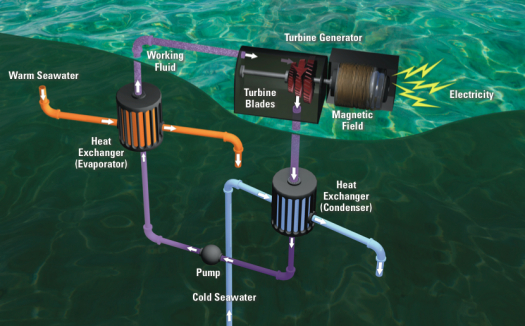
Ocean Thermal Energy Conversion This schematic shows how the heat exchange works in an ocean thermal energy conversion plant. The heat differential between surface water and deep water in the ocean is used to generate steam and drive a turbine. Lockheed Martin

One possibility for future energy production involves harvesting the warmth of Earth’s tropical oceans, using the natural heat differentials in the water to drive turbines. It would be relatively simple if you didn’t need a ludicrously large piece of pipe, 33 feet in diameter and stretching a kilometer beneath the water. To put that in context, that’s a New York subway tunnel wide and two and a half Empire State Buildings high.

“To produce sizable amounts of power, ocean thermal energy conversion plants have to move rivers of water,” said Laurie Meyer, chief technologist for OTEC at Lockheed Martin, which is building the pipe for a new 10-megawatt pilot plant. This structure also needs to withstand the constant rocking pressure of ocean currents, atmospheric pressures at 3,200 feet deep and the variable temperature of the water it’s designed to harvest — so building the pipe has been a challenge. Here’s how Lockheed is doing it.

The oceans are huge reservoirs of warmth, especially in the tropics, where the temperature differential between warm surface water and cool deep water can reach 40 or more degrees Fahrenheit. This differential can be harnessed to run a heat engine, using some principles from utility plants, plus some from refrigeration. Warm surface water goes into a heat exchanger, which vaporizes an ammonia solution; the resulting steam drives a turbine, and the ammonia is re-condensed using cold ocean water. The water is then pumped back into the ocean, a few degrees warmer than when it came in. But to reach the energy production scales of a traditional fossil fuel-fired power plant, 100 megawatts or more, you need a whole lot of water.

Lockheed first explored OTEC in the 1970s, and it’s resurrecting the concept now in the face of rising energy prices. A 10-MW plant is expected to be operational within a couple years. Under a U.S. Navy grant, Lockheed designed a new composite material for the pipe, and engineers have been building prototypes at the company’s plant in Sunnyvale, Calif. Full-scale OTEC pipes will be made right at the site of the power plant by extruding them right into the water.

A 3,200-foot-long, 33-foot wide pipe is not something you could build in a factory, haul out to sea and drop into the water, Meyer explained. Aside from the logistical challenges of moving it along railways or barges, it would probably be impossible to raise it to the right angle and drop it down to the proper depth. Instead, Lockheed will build it in place, using techniques the company first developed for spacecraft construction.

The manufacturing process is called vacuum-assisted resin transfer moulding, and it's the same basic process Boeing uses to build its 787 Dreamliner. VARTM typically consists of a polyester or vinyl resin reinforced by fiberglass, and Lockheed settled on a customized ratio (which they wouldn’t disclose for competitive reasons) that meets all the flexibility and stability requirements for a cold water pipe.
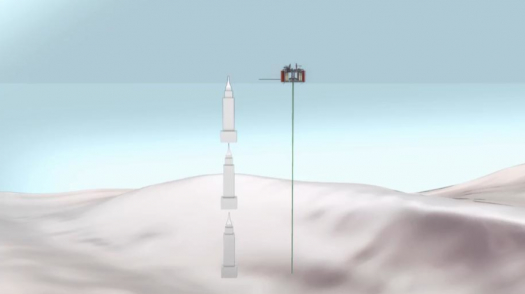
OTEC Size Comparison: The cold water intake pipe for an ocean thermal energy conversion plant would need to be at least 1 kilometer long — just about as tall as three Empire State Buildings.  Lockheed Martin
“We designed a system to take that process and turn it vertical, which allows us to pump out sections of the pipe,” Meyer said. To make a section, the fabric and resin poured into a mould and allowed to cure, just as concrete would. A vacuum removes any imperfections and bubbles, leaving a perfectly formed tube in place. Lockheed will do this in sections, the sizes of which are still to be determined, Meyer said.

"The longer you can make a section, the faster you can finish building the whole length of pipe, but there will be some practical limit in terms of handling the finished section," she said.

The platform where these sections will be formed have to be built to withstand winds, storms, currents and other phenomena, and Lockheed will use techniques pioneered by the offshore drilling industry, she added.

For the 10-MW plant, Lockheed is building a 4-meter diameter pipe (about 13 feet). For a full-scale, 100-MW plant, the pipes would be 10 meters, or 33 feet. The length of the pipe will be determined by the depth of the cold water — in some potential OTEC sites, chilled water may lurk around 1,000 meters deep, and in others, it may be shallower. The world has plenty of areas where OTEC could work, mostly around the equator.

By the way, the pipe will also have to be built to avoid sucking in marine life. Cold deep water is nutrient-rich, but doesn’t harbor dense populations of marine life because it’s so dark — yet many mammals, squid and other creatures of the deep might swim past the intake. The U.S. Environmental Protection Agency is working with Lockheed to determine maximum intake velocities, so animals could safely swim away rather than being sucked into the pipe.

Ultimately, OTEC plants will be useful for tropical communities — like Hawaii, the Philippines, and so on — or for Navy bases, which currently rely on imported fossil fuels. It could replace or supplement traditional power plants for large-scale, baseload electricity, according to Lockheed. But it couldn't work without gigantic pipes.

17 Comments

Your better off tapping the immense energy density of the magma plume under Yellowstone. It could conceivably power the entire United States.

it may just be me and my meager intellect but couldnt a few dozen smaller diameter pipes that join near top before the plant be just as effective and cheaper?

We can land on the moon and build nuclear powered subs and aircraft carriers but a 33 foot diameter kilometer long pipe is a challenge?

How is it anymore difficult than building a coal fired plant, railroad infrastructure to transport coal, coal mines and mining then transporting coal 24/7?

I agree with both above comments, why not build many smaller tubes and generators and the US definitely needs to be building more Hydro, Magma whatever powered alternative power plants!

That 700 Billion that went to bail out wall street could have built quite a few of these!

These are good questions. There are a few reasons why not to use many smaller diameter pipes instead of one large one, but the primary reason is simply due to head loss (pressure drop or loss due to the pipes).

With many pipes instead of the single large one, you would end up increasing total surface shear area that the fluid (in this case, seawater) would be in contact with while moving through the pipe. With the added shear, you get an increase in the total pressure drop through the pipes while trying to maintain the appropriate flow to cool, or condense, the working fluid (ammonia).

To counter this increased pressure drop requires a larger pump, which uses more power to maintain the proper flow for cooling. This power isn't free. It comes from the plant itself. The more power the plant has to use to generate power reduces it's efficiency, and in turn reduces the amount of power it can provide.

That's just one reason...

Another reason could very well be the amount of pressure that far under the sea. Small pipes would need to be made thick to resist the movement of the ocean along with the pressure around it, where one big pipe would be much more resistant to these two factors.

Doubling the diameter of the pipe quadruples the flow rate
of the water. Thus one large pipe is better than several, or even two, smaller ones.

ah good to know....still not a fan of putting all my eggs in one basket. plus theres no telling what will swim into that pipe lol

This article leaves out the most exciting OTEC news in the world right now. Caribbean nations are pursuing commercial OTEC power TODAY. They know it's proven, it's clean, and the byproducts are arguably more exciting than the energy itself.

The Bahamas is committed to building 2 OTEC plants, and an OTEC based clean air conditioning system. Plus, the only byproduct of an OTEC system is millions of gallons of clean drinking water. OTEC is here today to cut tropical countries off of fossil fuel addiction, and drastically improve the lives of millions of people for generations to come.

Lots more OTEC news, info, and videos at The On Project.
theonproject.org

mstraub,
Thanks for that additional information!

You would be a lot better off building catchment basins to capture tide water and run cubic miles of it through huge slow spinning turbines twice daily--on this scale the turbines could be cast concrete--truly an infinite source of clean, free energy.

Looks like the E-Cat scam is exposed.

Building cities underground would certainly save energy and might outlast the human race.

I was raised in Hot Springs National Park, Arkansas mid 50's/mid 60's. There were "Bath Houses" there from the 1920's.
There was hot(+-100 degrees) water coming from natural springs around west Mountain, free for the taking.

Seems we just have spend Millions of dollars! I am thinking what would happen if they cause releases of gases or what ever and do irepairable damage to Oceans?

"But I'm much better now"

stan0301,

Not to mention the metals and minerals that could be recovered!

"But I'm much better now"

Fresh potable water as a byproduct? It would seem that tidbit alone could tip the balance in this solutions favor. Especially in the arid climes in the middle east, off the coasts of East and West Africa, Central and South America, and the entire area surrounding Southeast Asia. Wow!

Droidx-er,
The Dead Sea is highly salty and extremely hot. What if they sink a deep well through the water, down deep to the cool earth? There they have a wide difference in temperature and perhaps they can work to convert the Dead Sea to be less salty with the fresh water they make and one day bring it back to life.

Unless a deep well below the Dead Sea would not find cool ground temperatures. I am just brain storming a little here....

.............................
Science sees no further than what it can sense, i.e. facts.
Religion sees beyond the senses, i.e. faith.
Open your mind and see!

There are thermal vents at the ocean floor that are 400deg.They are high in minerals and have cold water nearby.The minerals could be extracted while producing electricity.robots might be required to operate the plant.

power plants waste hot water that could be used for a binary plant.Some oil wells are also a good sourse of heat.A temp diff of 100 deg farenheight is sufficient.OTEC probably is too expensive for open water.It can be used on islands like hawaii


June 2013: American Energy Independence

Five amazing, clean technologies that will set us free, in this month's energy-focused issue. Also: how to build a better bomb detector, the robotic toys that are raising your children, a human catapult, the world's smallest arcade, and much more.


Online Content Director: Suzanne LaBarre | Email
Senior Editor: Paul Adams | Email
Associate Editor: Dan Nosowitz | Email
Assistant Editor: Colin Lecher | Email
Assistant Editor: Rose Pastore | Email

Contributing Writers:
Rebecca Boyle | Email
Kelsey D. Atherton | Email
Francie Diep | Email
Shaunacy Ferro | Email

circ-top-header.gif
circ-cover.gif
bmxmag-ps