
But don't worry, it will still be partly a death ray

The Navy Wants a Multipurpose Laser to Eliminate Threats at Sea U.S. Navy

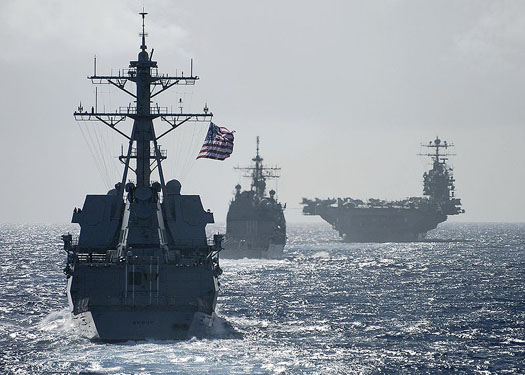
The Navy has been seeking its “Holy Grail” free electron laser (FEL) weapon for a while now, but it would rather you think of it more as a multipurpose laser platform than a death ray. While the Navy’s ship-borne FEL, currently under development at Boeing, will certainly be used to knock incoming threats out of the sky, naval officers really want a platform that can also be used for tracking, communications, target designation, disruption, time-of-flight location, and a variety of other tasks.

Such a multipurpose tool certainly makes the Navy’s laser system seem a more practical use of funding, and a free electron laser is the proper tool for the job(s). All lasers require some kind of medium to turn light into high-energy beams--solid state lasers use crystals, while chemical lasers use (you guessed it) a stew of unfriendly chemicals. Both of those versions have their pros and cons, but neither is extraordinarily versatile; they generally power their lasers up to a certain wavelength and that’s that.

Free electron lasers, on the other hand, use a stream of supercharged electrons to power the laser at varying wavelengths. This versatility is why the Navy has referred to FELs as the Holy Grail of laser tech and why it has embarked on a $163 million quest to develop a working weapons system, $26 million of which is currently facilitating a development program at Boeing that’s due for delivery in 2012.

The ability to shift wavelengths means that unlike other lasers--including the solid-state bad boy Raytheon used to knock a UAV out of the air from the deck of a ship earlier this year--an FEL system can adjust that wavelength for a variety of tasks. Further, it could run off a vessel’s power source rather than requiring its own, so it wouldn’t need to stop and reload.

That’s why, according to Danger Room's Spencer Ackerman (who is reporting from the Office of Naval Research’s science and tech conference this week), naval program managers are excited about their FEL. Those myriad uses for the platform would require much less energy than is required for actually knocking cruise missiles out of the sky, reducing the platform’s energy energy needs.

Of course, the Navy still wants its laser to target and destroy incoming threats, and therein lies the challenge. The lower power threshold for a weaponized laser of this nature is more or less 100 kilowatts; the FEL at the DOE lab where the Navy has been sponsoring research currently runs at about 14 kilowatts. Boeing’s job is to make up the difference so the Navy’s FEL can perform tasks that require 50 watts, 100-plus kilowatts, and everything in between.

Difficult, but certainly not impossible. There’s more background on the ONR’s efforts to this point in the video below.


[Danger Room]

24 Comments

What they don't tell you is it can also shoot down any satellite it wants.

Need an Orbital Rail Gun!!!

Sorry Captain, when you said "send them a message" I thought ...

Why wouldn't they just chrome plate the missles and make them mirrors?

Uhhh, yea. because it can really create a powerful enough beam to blow up a large metal object in geosynchronous orbit at 22,236 miles above the surface of the earth.....

just a little farther away than a ballistic missile headed for the ship itself

Looking forward... the question will be, HOW the heck do you stop a beam of energy from attacking back?

@ mornborn. VERY bad idea. China blew up 1 satellite and in a few seconds all the space junk in orbit that took 60 years to build up just doubled in number. If we wish to get rid of satellites it will be to simply kill them with out blowing them up, or change their orbit to either crash or leave orbit.
@V3RTIGO slightly different technology. and what would we do with an orbital rail gun that we couldnt do with about 1000000 different missiles we already have built? yeah. they are cool in Halo. but we dont have anything in the world that requires that much power.

Some satellites have very sensitive interments, it wouldn't take much to damage those, solar panels can be damaged by overheating and can short if they have too much voltage caused by way more light than they are expecting. So you don't need it to go boom for you to kill a sat, then again there are tanks filled with liquid fuels that can become overpressure and explode. And Lastly these are freeken LASERS they don't spread out much over distance so all you gotta do is point it really well.

@phillinyork who said:
Why wouldn't they just chrome plate the missles and make them mirrors?

Sorry, doesn't work if you pick your wavelength - which this laser can. "mirrors" are only mirrors for certain wavelengths. The back of a cat's eye reflects light but not x-rays - get it?

So that makes it useless against a Free-Electron Laser (FEL). Against the other types (solid-state & chemical), mirrors are also of limited usefulness because:

you can't make a mirror perfect enough that it won't be able to be destroyed by a powerful laser (many lasers in research programs are destroyed catastrophically for their imperfections) IF you fly that mirror through the air.

The outer skin of the missile is bumping into molecules of air and water vapor and often small ice crystals & dust particles etc. etc. @ 500mph minimum, often at supersonic speeds. That perfect mirror you create is going to be pitted and imperfect as soon as you let the missile fly.

Now mirroring CAN make it so you need more laser power to kill it. That means that the ship needs to focus its laser on the target for several seconds rather than a fraction of a second. But so what? The target is still dead.

The only real way it could help is if you were sending hundreds of missiles and were counting on the mirroring to make it take too long to blow up all of them.

But then you get into the other problem with mirroring: Mirroring is the OPPOSITE of stealth. And the missile actually has a much better chance of hitting if it's never detected than if it's detected but it takes the laser a few seconds extra time to burn through the mirror surface.

A mirror surface would guarantee the missile is detected from LONG range - giving the target maximum ability to employ countermeasures, maximum accuracy for the AEGIS platform to use missile-missile counterattacks at longer range than the laser has...and since the AEGIS will be super-effective against mirror-bright radar targets, you'll have a tiny number of missiles get through...so it won't matter that each one takes a little longer to kill.

All in all, polished metal missiles are NOT EVER going to be the counter-measure of choice.

--)->

-

I'll bring the Marshmallows !

-

So when can we expect to be putting these on sharks?

This sounds like the advanced version of the Traveling Wave Tube maser operating at the optical range. If you could lase the inside of a TWT’s plasma as a resonant cavity, you could produce a tunable laser.

Changing frequencies on the fly may cause some arcs and sparks in the tube as the tube resonance changes and lasing dumps between optimal frequencies. I never heard of an optical dummy load, perhaps I just made a verbal one.

The question is, how the hell am I ever going to build one? looks complicated.

Nice! I always wondered when the Navy would put something like this on a ship. "That's no moon, it's a space station." =D

So does it shoot photons or electrons? combo of both? and to the guy that said use chrome, it has a variable wavelength feature that can adjust for that kind of situation... i think. mirrors reflect light only

The future is now. All we need is a flux capacitor.

what the targets need to deter laser weapon systems...

retro reflective surfaces.. not mirrors

that way the weapon system firing the laser beam has 5-20% of the power back in it's face!

destroy the laser using retro reflective coatings

Good mirrored surfaces can be kept clean with clear hardened coatings that are transparent to the laser frequency(s) being utilized.

Multi Layered mirrored coatings can be used also. If one mirrored coating is burned off by say laser x1 frequency then the next mirror just below the mirror that was burned away will reflect frequency x1 and so on.

defeated again....

multilayered mirrored coatings.... just never let the enemy know the frequency that your laser weapons operate on

so never test them in the open... all eyes watch and see these tests and can pick up scattered radiation from the lasers beam to decipher the exact laser frequencies generated

And last but not least.. a missile defense can create a smoke/particle shroud around itself during flight... such as to disperse any laser weapon system.. similar to attempting to see through a burning oil slick SADAM created in the Gulf War years back

...and a DeLorean. Someone invent a DeLorean. It will be fantastical. Like the Unicorn.

@PhilInYork:

Because chrome plating doesn't work against all frequencies, hence the utility of the FEL. In particular, almost all materials look "black" to infrared frequencies, also known as radiant heat.

At the other end of the spectrum, X-rays would also have their uses...

The prototype Free Electron Laser (FEL) is a tunable output frequency directed energy device. In essence, it uses the power of a linear accelerator to generate high voltage electrons that are trapped in a microwave resonance cavity which allows the electrons to "dump" energy as synchronous electromagnetic radiation within a wide range of frequencies. Note: The EM frequency produced does not have to be visible.

Linked to an appropriate feedback system, in theory, the system could quickly ramp through a wide range of frequencies and then lock on a set of output frequencies with the highest resonant response from any target material. By pumping energy into any solid material at resonant frequencies, the target will PHASE change, solid-to-liquid-to-gas-to-plasma, and fail.

Gentle readers, the FEL is a prototype PHoton mASER - a PHASER in Star Trek lingo. Mounted on a battleship with megawatt power from a nuclear reactor, or two, the US Navy would have a directed-energy weapon that could cut through anything solid, including meta-material shielded ships, aircraft, and missiles.

It won't just cut and slice its targets. With active tracking optics, a FEL can vaporize them and leave no visible debris. A FEL is perfect for satellite hunting and keeping near space free of orbital solids.

2 steps forward and 2 steps back.
Decoys, stealth, multiple launch, very high speeds, and some fancy "footwork" will give any targeting system a run for its money, and we will get to a lot of that. Military procurement procedures will never keep up with the movement of these technologies, too broad and too cutting edge. Not at the pinnacle of tech, nor at the bottom.
The Pentagon & the rest of US gov't is afraid that one day soon(?), the Iranian navy will swarm attack an isolated ship, 30-50 speedboats at once. Dedicated men willing to "strike a blow against the non-believer". For them, only one RPG will makes that a "victory".
Perhaps the US Navy should ALSO think about a few low-tech solutions.


June 2013: American Energy Independence

Five amazing, clean technologies that will set us free, in this month's energy-focused issue. Also: how to build a better bomb detector, the robotic toys that are raising your children, a human catapult, the world's smallest arcade, and much more.


Online Content Director: Suzanne LaBarre | Email
Senior Editor: Paul Adams | Email
Associate Editor: Dan Nosowitz | Email
Assistant Editor: Colin Lecher | Email
Assistant Editor: Rose Pastore | Email

Contributing Writers:

Kelsey D. Atherton | Email
Francie Diep | Email
Shaunacy Ferro | Email

circ-top-header.gif
circ-cover.gif