
David Keith never expected to get a summons from the White House. But in September 2001, officials with the President’s Climate Change Technology Program invited him and more than two dozen other scientists to participate in a roundtable discussion called “Response Options to Rapid or Severe Climate Change.” While administration officials were insisting in public that there was no firm proof that the planet was warming, they were quietly exploring potential ways to turn down the heat.
Most of the world’s industrialized nations had already vowed to combat global warming by reining in their emissions of carbon dioxide, the chief “greenhouse gas” blamed for trapping heat in Earth’s atmosphere. But in March 2001 President George W. Bush had withdrawn U.S. support for the Kyoto Protocol, the international treaty mandating limits on CO2 emissions, and asked his administration to begin studying other options.
Keith, a physicist and economist in the chemical and petroleum engineering department at the University of Calgary, had for more than a decade been investigating strategies to curtail global warming. He and the other scientists at the meeting-including physicists from Lawrence Livermore National Laboratory who had spent a chunk of their careers designing nuclear weapons-had come up with some ideas for “geoengineering” Earth´s climate. What they proposed was tinkering on a global scale. “We already are inadvertently changing the climate, so why not advertently try to counterbalance it?” asks retired Lawrence Livermore physicist Michael MacCracken, a former senior scientist at the U.S. Global Change Research Program who helped organize the meeting.
“If they had broadcast that meeting live to people in Europe, there would have been riots,” Keith says. “Here were the bomb guys from Livermore talking about stuff that strikes most greens as being completely wrong and off-the-wall.” But today, a growing number of physicists, oceanographers and climatologists around the world are seriously considering technologies for the deliberate manipulation of Earth´s climate. Some advocate planetary air-conditioning devices such as orbiting space mirrors that deflect sunlight away from Earth, or ships that intensify cloud cover to block the sun´s rays. Others are suggesting that we capture carbon dioxide-from the air, from cars and power plants-and stash it underground or react it with chemicals that turn it to stone.
Carbon dioxide wasn´t always public enemy number one. For the past 400,000 years, the concentration of CO2 in the atmosphere has fluctuated between about 180 and 280 ppm (parts per million, the number of CO2 molecules per million molecules of air). But in the late 1800s, when humans set about burning fossil fuels in earnest, atmospheric CO2 began to increase with alarming speed-from about 280 ppm to the current level of almost 380 ppm, in a scant 100 years. Experts predict that CO2 could climb as high as 500 ppm by 2050 and possibly twice that by the end of the century. As CO2 levels continue to rise, the planet will get hotter. “The question now,” says Ken Caldeira, an atmospheric scientist at Lawrence Livermore and one of the world´s leading authorities on climate change, “is what can we actually do about it?” Here are some of the geoengineering schemes under consideration.
1. Store CO2 Underground
Feasibility: 10
Cost: $$
RISK: 4
In the southeastern corner of Saskatchewan, just outside the town of Weyburn-the “Opportunity City”-a steel pipeline descends 4,000 feet below the prairie at the edge of a 70-square-mile oil field. Into this subterranean cavern, petroleum engineers are pumping 5,000 tons of pressurized, liquefied carbon dioxide every day. The aim is twofold: Use high-pressure CO2 to drive oil from the porous rock in the reservoir to the surface, and trap the carbon dioxide underground.
Welcome to the world´s largest carbon-sequestering operation. Dubbed the Weyburn Project, it began in July 2000 as a partnership between EnCana, a Canadian oil and gas company, and Canada´s Petroleum Technology Research Centre. With $13 million in funding from more than a dozen sponsors, including the U.S. Department of Energy, engineers have already socked away six million tons of carbon dioxide, roughly the amount produced by burning half a billion gallons of gasoline.
The Timeline
Unlike other geoengineering schemes, this one is already happening, with more than half a dozen major projects under way. The problem, says Howard Herzog, a principal research engineer at MIT´s Laboratory for Energy and the Environment, is that concentrated CO2 is in short supply. There´s too much of the gas floating around in the air, but actually capturing, compressing, and transporting it costs money. In the U.S. and most other nations, there are no laws requiring fossil-fuel-burning power plants-the primary source of CO2 emissions-to capture a single molecule of the gas.
The Promise
By 2033, the Weyburn Project will store 25 million tons of carbon dioxide. “That´s like taking 6.8 million cars off the road for one year,” says project manager Mike Monea, “and this is just a pilot test in a small oil reservoir.” Saline aquifers, giant pools of saltwater that have been trapped underground for millions of years, could hold even more CO2. Humans dump about 28 gigatons of CO2 into the atmosphere every year. Geologists estimate that underground reservoirs and saline aquifers could store as much as 200,000 gigatons.
The Perils
Before CO2 is injected into the ground, it´s
compressed into what´s called a supercritical state-it´s extremely dense and viscous, and behaves more like a liquid than a gas. In this form, CO2 should remain trapped underground for thousands of years, if not indefinitely. The danger is if engineers accidentally “depressurize” an aquifer while probing for oil or natural gas. There´s also a risk that carbon dioxide could escape slowly through natural fissures in subterranean rock and pool up in basements or cellars. “If you walked down into a basement [full of CO2],” Keith says, “you wouldn´t smell it or see it, but it would kill you.”
2. Filter CO2 from the air
Feasibility: 4
Cost: $$$
RISK: 4
Klaus Lackner is accustomed to skeptics. They´ve doubted him since he first presented his idea for extracting carbon dioxide from ambient air in March 1999, at an international symposium on coal and fuel technology. “The reaction from everyone there was utter disbelief,” recalls Lackner, a physicist with the Earth Engineering Center at Columbia University.
He called for the construction of giant filters that would act like flypaper, trapping CO2 molecules as they drifted past in the wind. Sodium hydroxide or calcium hydroxide-chemicals that bind with carbon dioxide-would be pumped through the porous filters much the way antifreeze is circulated through a car´s radiator. A secondary process would strip the CO2 from the binding chemical. The chemical would recirculate through the filter, while the CO2 would be set aside for disposal.
The Timeline
Lackner is collaborating with engineer Allen Wright, who founded Global Research Technologies in Tucson, Arizona. Wright is developing a wind-scrubber prototype but remains tight-lipped about the project. He estimates that a completed system is at least two years away.
The Promise
Wind scrubbers can be placed wherever it´s convenient to capture carbon dioxide, so there´s no need to transport it. Lackner calculates that a wind scrubber designed to retain 25 tons of CO2 per year-the average amount each American adds to the atmosphere annually-would require a device about the size of a large plasma-screen television. A single industrial-size wind scrubber about 200 feet high and 165 feet wide would snag about 90,000 tons of CO2 a year.
The Perils
Some experts are dubious about the ease of separating carbon dioxide from the binding chemical, a process that in itself would require energy from fossil fuels. “CO2 is so dilute in the air that to try to scrub from it, you have to pay too much for energy use,” Herzog says. And to capture all the carbon dioxide being added to the atmosphere by humans, you´d need to blanket an area at least the size of Arizona with scrubber towers.
3.Fertilize the ocean
Feasibility: 10
Cost: $
RISK: 9
On January 5, 2002, Revelle, a research vessel operated by the Scripps Institution of Oceanography, left New Zealand for the Southern Ocean-a belt of frigid, stormy seas that separates Antarctica from the rest of the world. There the scientists dumped almost 6,000 pounds of iron powder overboard and unleashed an armada of instruments to gauge the results.
The intent was to test a hypothesis put forth by oceanographer John Martin. At a lecture more than a decade ago, Martin declared: “Give me a half-tanker of iron, and I will give you an ice age.” He was alluding to the fact that the Southern Ocean is packed with minerals and nutrients but strangely devoid of sea life. Martin had concluded that the ocean was anemic-containing very little iron, an essential nutrient for plankton growth. Adding iron, Martin believed, would cool the planet by triggering blooms of CO2-consuming plankton.
Oceanographer Kenneth Coale, who directs the Moss Landing Marine Laboratories near Monterey, California, was a chief scientist on the Southern Ocean cruise. He says the project was a success, proving that relatively small quantities of iron could spawn colossal blooms of plankton.
The Timeline
Scientists are wary, saying that too little is known about the deep-ocean environment to endorse further large-scale experiments. In October, Coale and other scientists will gather in New Zealand for a weeklong meeting sponsored by the National Science Foundation, New Zealand´s National Institute for Water and Atmosphere, and the International Geosphere-Biosphere Programme to decide how to proceed.
The Promise
Iron fertilization is by far the cheapest and easiest way to mitigate carbon dioxide. Coale estimates that just one pound of iron could conceivably hatch enough plankton to sequester 100,000 pounds of CO2. “Even if the process is only 1 percent efficient, you just sequestered half a ton of carbon for a dime.”
The Perils
“What is still a mystery,” Coale says, “is the ripple effect on the rest of the ocean and the food chain.” One fear is that huge plankton blooms, in addition to gorging on CO2, will devour other nutrients. Deep currents carry nutrient-rich water from the Southern Ocean northward to regions where fish rely on the nutrients to survive. Says Coale, “A fertilization event to take care of atmospheric CO2 could have the unintended consequence of turning the oceans sterile. Oops.”
4. Turn CO2 to Stone
Feasibility: 7
Cost: $$
RISK: 3
The Grand Canyon is one of the largest carbon dioxide repositories on Earth. Hundreds of millions of years ago, a vast sea covered the land there. The water, rich in carbon dioxide, slowly reacted with other chemicals to create calcium carbonate, or limestone-the pinkish bands striping the canyon walls today.
Nature´s method for turning CO2 to stone is achingly slow, but researchers at the Goldwater Materials Science Laboratory at Arizona State University are working on a way to speed up the process. Michael McKelvy and Andrew Chizmeshya use serpentine or olivine, widely available and inexpensive minerals, as feedstock to fuel a chemical reaction that transforms CO2 into magnesium carbonate, a cousin of limestone. To initiate the reaction-known as “mineral carbonation”-the CO2 is compressed, heated, and mixed with feedstock and a catalyst, such as sodium bicarbonate (baking soda).
The Timeline
Scaling up the process to handle millions of tons of CO2 would require huge quantities of serpentine or olivine. A single mineral-carbonation plant would carve out a mountain, but, McKelvy says, “You could carbonate [the CO2] and put it right back where the feedstock came from.”
The Promise
Mineral carbonation is simply an accelerated
version of a benign natural process. The limestone in the Grand Canyon is 500 feet thick, McKelvy says, “and it has been sitting there not bothering anybody for millennia.”
The Perils
It costs roughly $70 to eliminate one ton of CO2,
a price that McKelvy says is too high. Also, the feedstock
and CO2 must be heated to high temperatures. “You wind up having to burn fossil fuels in order to provide the energy to activate the mineral to put away the CO2,” he says.
5. Enhance Clouds to Reflect Sunlight
Feasibility: 6
Cost: $$
RISK: 7
Some proposed solutions to global warming don´t involve capturing carbon dioxide. Instead they focus on turning down the heat by deflecting or filtering incoming sunlight.
On any given day, marine stratocumulus clouds blanket about one third of the world´s oceans, mostly around the tropics. Clouds form when water vapor clings to dust or other particles, creating droplets. Seeding clouds with tiny salt particles would enable more droplets to form-making the clouds whiter and therefore more reflective. According to physicist John Latham, a senior research associate at the National Center for Atmospheric Research in Boulder, Colorado, boosting reflectivity, or albedo, in just 3 percent of marine stratocumulus clouds would reflect enough sunlight to curb global warming. “It would be like a mirror for incoming solar radiation,” Latham explains.
Latham is collaborating with Stephen Salter, an emeritus professor of engineering design at the University of Edinburgh, who is making sketches for GPS-steered wind-
powered boats that would cruise the tropical latitudes,
churning up salt spray. “I am planning a flotilla of unmanned yachts sailing backward and forward across the wind,” Salter says. “They would drag propellers through the water to generate electricity, which we´d use to make the spray.”
Salter wants to outfit each boat with four 60-foot-tall
Flettner rotors, which look like smokestacks but act like sails. An electric motor starts each rotor spinning, which, along with the wind, creates a pressure differential (less pressure in front of the rotor, more in back), generating forward thrust. From the top of the rotor, an impeller would blast a fine saltwater mist into the air.
Until the concept is tested, Salter isn´t sure exactly how many ships would be needed to mitigate global warming. “Maybe between 5,000 and 30,000,” he says. That may sound like a lot, but Salter notes that for World War II, the U.S. built nearly 100,000 aircraft in 1944 alone.
The Timeline
Latham initially raised the notion in a 1990 paper. “The article went down like a lead balloon,” he says. But early last year in England, at a geoengineering conference hosted by MIT and the Tyndall Centre for Climate Change Research, he presented the concept again. “The consensus was that a number of ideas originally thought to be outlandish were deemed sufficiently plausible to be supported further. Our work fell into that category.” Latham needs a few million dollars to test his idea. “On the scale of the damage that will be caused by global warming, that is utterly peanuts.”
The Promise
What´s nice about this idea is that it can easily be fine-tuned. “If we tried it and there was some deleterious effect, we could switch it off, and within four or five days all evidence would have disappeared,” Latham says.
The Perils
One worry is that although the tiny salt particles released by evaporating sea mist are perfect for marine
stratocumulus-cloud formation, they are too small to create rain clouds. “You might make it harder for rain to form,” Salter says. “Therefore, you would not want to do this upwind of a place where there is a bad drought.”
6. Deflect Sunlight With A Mirror
Feasibility: 1
Cost: $$$$
RISK: 5
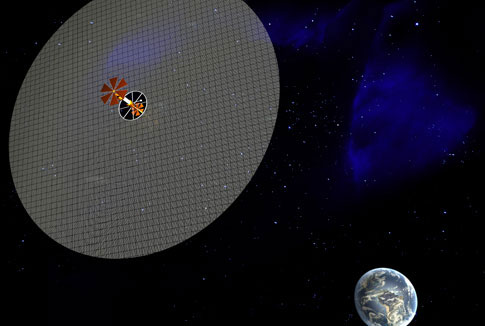
One of the most ambitious schemes is a giant space “mirror” positioned between the Earth and sun to intercept sunlight. To build the mirror, physicist Lowell Wood, a senior staff scientist at Lawrence Livermore, proposes using a mesh of aluminum threads that are only a millionth of an inch in diameter and a thousandth of an inch apart. “It would be like a window screen made of exceedingly fine metal wire,” he explains. The screen wouldn´t actually block the light but would simply filter it so that some of the incoming infrared radiation wouldn´t reach Earth´s atmosphere.
The Timeline
Wood, who has been researching the mirror idea for more than a decade, says it should be considered only as a safety net if all other means of reversing global warming “fail or fall grossly short over the next few decades.”
The Promise
Once in place, the mirror would cost almost nothing to operate. From Earth, it would look like a tiny black spot on the sun. “People really wouldn´t see it,” says Michael MacCracken. And plant photosynthesis isn´t expected to be affected by the slight reduction in sunlight.
The Perils
Wood calculates that deflecting 1 percent of incoming solar radiation would stabilize the climate, but doing so would require a mirror spanning roughly 600,000 square miles-or several smaller ones. Putting something that size in orbit would be a massive challenge, not to mention exorbitantly expensive.
