
You Built What?!
A 50,000-volt stun gun and liquid propane canister lets the flames fly

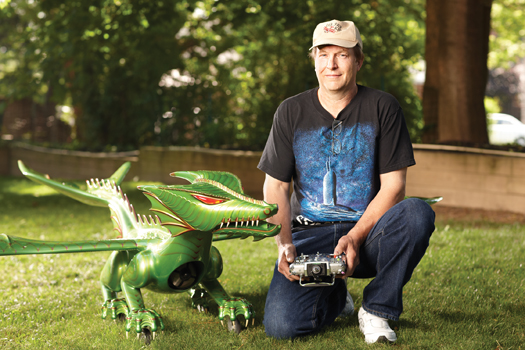
Green Flash The dragon can fly faster than 100mph, but builder Richard Hamel keeps it at a cruising speed closer to 70. Tom Cwenar

Richard Hamel was watching the 2010 animated film How to Train Your Dragon with his grandchildren when he noticed something odd about the tails of the flying beasts. Hamel, a longtime radio-control plane builder, realized that those appendages resembled an unconventional aircraft design feature known as an inverted V-tail. In lieu of a vertical stabilizer and horizontal rudder, some aircraft rely on two fins arranged in a V shape. “I thought, ‘That would actually work,’” he recalls, "and I started wondering if I could make a dragon fly.”

Hamel, a Pittsburgh-area plumbing, heating and air-conditioning contractor, has built all types of R/C aircraft but says he prefers working with jet turbines because of their reliability and the sound they make. He bought a JetCat P80 turbine with 22 pounds of thrust and then designed the creature from the inside out. He estimated that a 2.25-liter fuel tank would be enough for a few good flights and added up the weight of the other components he knew he would need—electronics, batteries and custom exhaust pipe.

Once he had determined that the weight would be about 33 pounds, Hamel was able to figure out that he would need 9-foot-wide wings. He used an off-the-shelf airfoil design template for the wings and built a fiberglass prototype that reached over 100 mph in a test flight. But that was too fast—he wanted people to see it when it banked—so he chose a new wing design that slowed it down a bit. The test flight also revealed that the dragon turned too slowly. Hamel had heard that flying dinosaurs used their heads to turn, so he designed a new skull. Now when the dragon’s V-tail rudder initiates a turn, its head swings around as well.
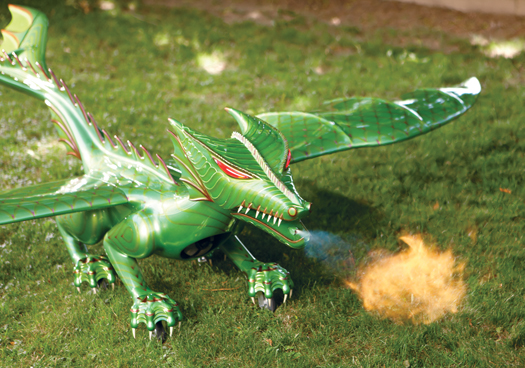
Hot Seconds: For safety reasons, Hamel activates the dragon’s flame breath only in quick bursts.  Tom Cwenar

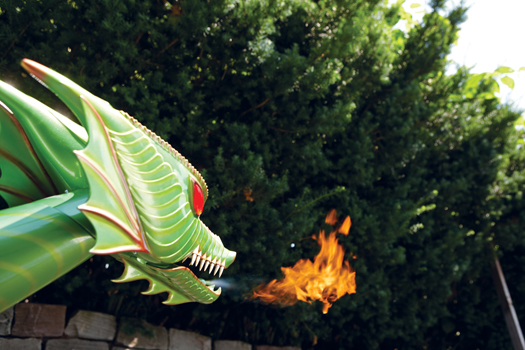
Hamel wanted his dragon to be fearsome too. He spent several months designing and laying on the scales, molding the teeth out of urethane, and designing eyes backlit with red LEDs. Of course, without fire a dragon is just a flying lizard, so he added the circuit from a 50,000-volt stun gun he found in his basement at the edge of the beast’s jaw, set a nozzle into the back of its mouth, and hooked that to a canister of liquid propane. When the nozzle sprays the propane through the activated circuit, a three-foot blast of red and blue flames shoots out.

Hamel plans to fly the dragon at air shows and parks, and although he designed it to be intimidating, he’s also concerned for its safety. “I’m worried somebody is going to take a shot at it.”
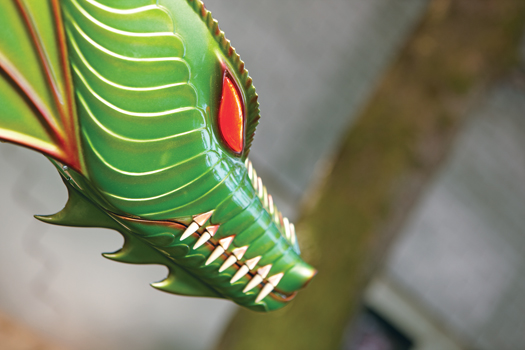
Up Close:  Tom Cwenar

See how Hamel's dragon works (and see it in action) on the next page.

BUILDING A FLYING DRAGON

Cost $8,000
Time 1 year

Breathing Fire:  Tom Cwenar

How It Works

FLIGHT

The jet turbine inhales air through an inlet in the dragon’s chest and thrusts it out the rear at 500 mph. The air coming out of the turbine can exceed 1,400 degrees. To avoid cooking the other components, Hamel designed and custom-welded a double-walled stainless-steel exhaust for insulation.
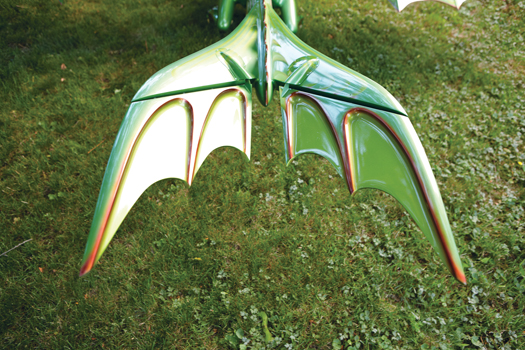
Winging It:  Tom Cwenar

ELECTRONICS

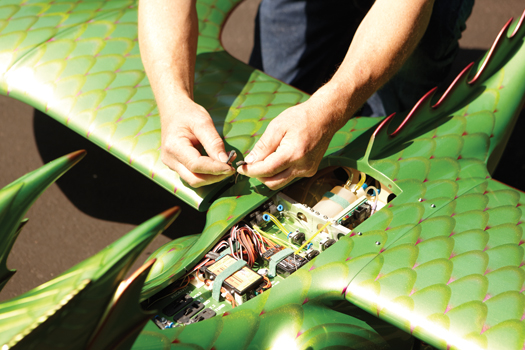
Hamel opted for an off-the-shelf 2.4-gigahertz touchscreen radio controller. Four nickel-cadmium battery packs power the receiver, the servomotors that turn the head and tail, the red LED eyes and stun-gun circuit, and the microprocessor that controls the turbine.
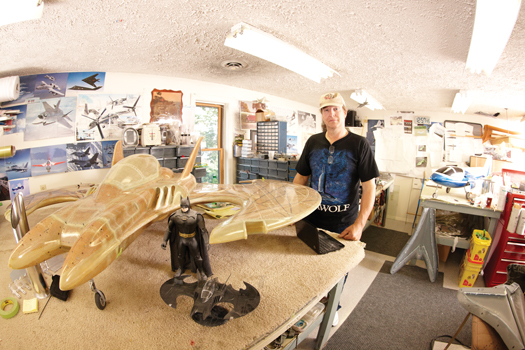
Scaley Model: Hamel says he spent about 100 hours airbrushing the creature’s exterior.  Tom Cwenar

FEAR FACTOR

After carving the head out of foam, Hamel molded two extra copies from which he could cut scales to apply to the dragon’s exterior. To create the creature’s devilish gaze, he cast the eyes out of clear urethane resin and set a bank of red LEDs behind them.
Enter the Dragon:  Tom Cwenar

DRAGON BREATH

Hamel activates the fire breath by flipping a switch on his remote. He wired the receiver to the dragon’s eyes and a servomotor in its head. When he activates the LED eyes, they light up, telling him the fire system is ready. Then he flips another switch that turns on the servomotor to open the mouth. That sets off the stun-gun circuit and opens the propane valve. (His plumbing background came in handy—he built the valve himself.) The gas squirts out and, for a few seconds, the dragon spews flames.

See how Hamel's dragon looks when it's fired up.

Want to read more articles like this, plus tips and tricks, home hacks, DIY projects, and more? Subscribe to Popular Science today, for less than $1 per issue!

12 Comments

I'm glad he built it, 'cause I can admire it without spending the 8000$. Ouch.

I know I'm nitpicking here, but I don't see any inverted V-tails, on this aircraft or in the movie dragons. I only see V-tails of the non inverted variety. A V-tail angles up, while an inverted V-tail angles down.

That episode from the graphic novel serie hasn't been translated in English but there is a story with a flying, fire breathing robotic dragon (albeit bigger than this one) which created havoc after being let loose. Here are the two pages.

http://bdi.dlpdomain.com/album/9782870970164-page4-I400x523.jpg

http://bdi.dlpdomain.com/album/9782870970164-page5-I400x523.jpg

Blake and Mortimer- Professor Sato's three formulae

Dragons and this home creation is very very COOL!

Lots of descussing about this dragon flying and this article even comes with a video. To bad they never actually show it flying.

When you'll show me a video with it flying ill believe it does, until then its a toy on wheels doing rounds on the asfalt.

democedes is right, that's a v tail, not an inverted v tail. still awesome, but please get your facts straight :)

it is cool but it is questionable that he just made it so it looks like it will fly and it doesnt it just rides on the ground like an rc car

here you go- IT flies.... youtu.be/ENebG492V98
you need the . in youtu.be

May i buy it?

coolest thing i've ever seen! I love it!

Well Done Sir...

About 12 years ago my son ask for help with an art project which had to be made from scrap materials.
I have been building flying things since a boy and once worked for an R/C manufacture so scrap materials consisted of bits of balsa and foam from a cooler. the project started after dinner and was finished about 4 am. balsa wings in a bat like shape using a wwI airfoil attached to a foam carved body our little dragon was born. As i looked at it I had to wonder would it fly. It proved tail heavy but a lone screw lay on the work bench and set in the throat of the beast open jaws was exactly the weight required...from the deck in the predawn light it glided to the rear fence landing without damage.
The next few weeks I was besieged with parents wishing to buy the dragon or at least plans...but it was one of a kind and hung for several years on my sons wall. Sadly vandals broke into our home and the dragon was destroyed. For years I thought about building a larger version and never had time to finish one but since retiring have thought it might be fun, the son now a systems annalist has on occasion challenged me to try again ....he should balk at the 8000 dollar price tag however.
Once again well done.

Popular Tags

Regular Features


June 2013: American Energy Independence

Five amazing, clean technologies that will set us free, in this month's energy-focused issue. Also: how to build a better bomb detector, the robotic toys that are raising your children, a human catapult, the world's smallest arcade, and much more.


Online Content Director: Suzanne LaBarre | Email
Senior Editor: Paul Adams | Email
Associate Editor: Dan Nosowitz | Email
Assistant Editor: Colin Lecher | Email
Assistant Editor: Rose Pastore | Email

Contributing Writers:
Rebecca Boyle | Email
Kelsey D. Atherton | Email
Francie Diep | Email
Shaunacy Ferro | Email

circ-top-header.gif
circ-cover.gif
bmxmag-ps
