
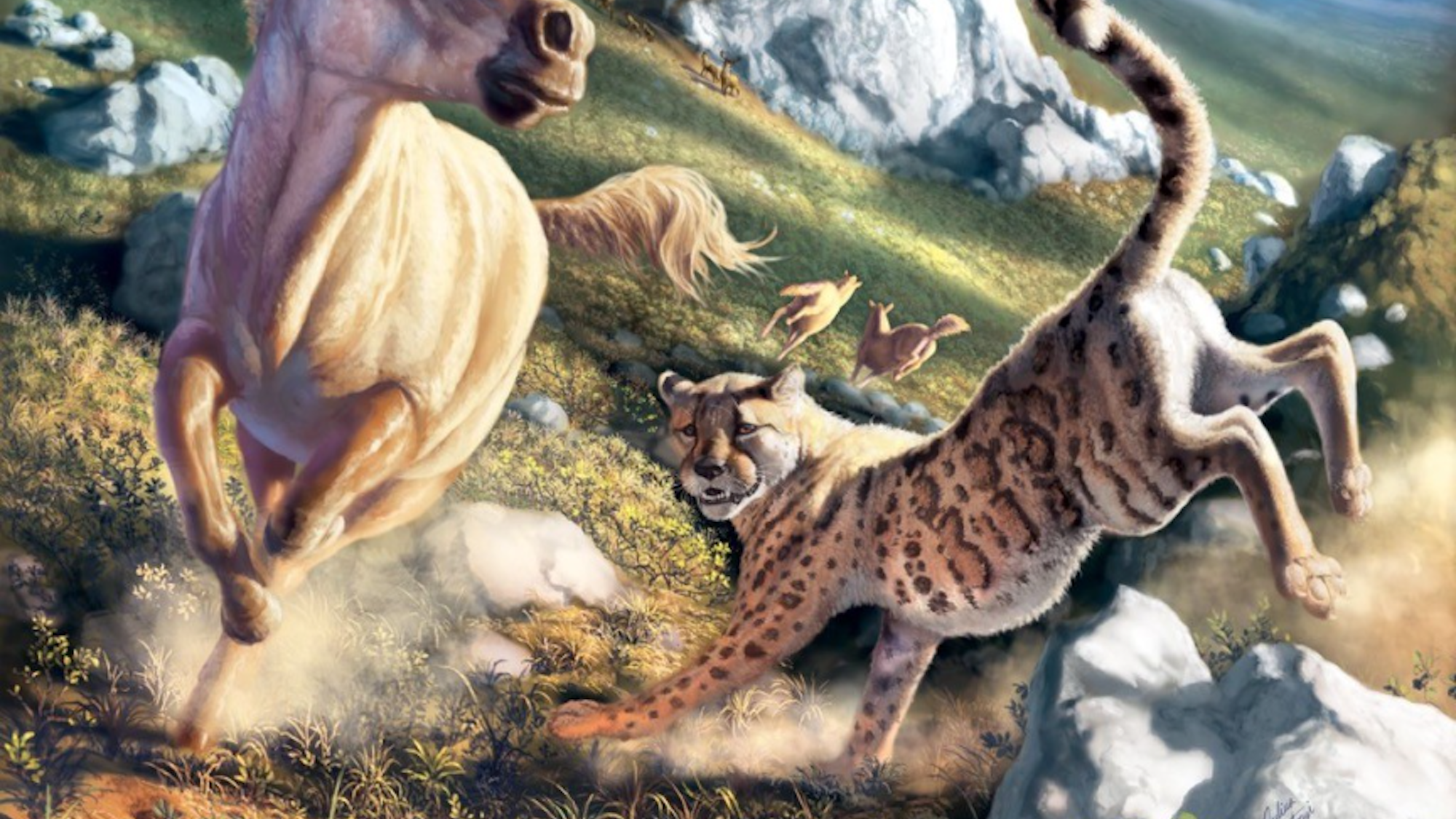
The American cheetah (Miracinonyx trumani) stalked North America’s Pleistocene grasslands for nearly 2.5 million years, but new evidence suggests they likely didn’t resemble their present-day African namesake. After comparing M. trumani DNA to nine other feline species ranging from house cats to lions, it now appears that the ancient predator’s closest relative is an entirely different big cat. What’s more, M. trumani often roamed much farther north than researchers once assumed.
“It’s really surprising and exciting to identify another predator present in Beringia,” Molly Cassatt-Johnstone, an evolutionary biologist at the University of California, Santa Cruz (UCSC), said in a statement.
Berinigia is the ancient stretch of land that once connected northeastern Asia to northwestern North America. While submerged in the Pacific Ocean today, its exposure during the Pleistocene allowed megafauna like the woolly mammoth and other large animals to migrate between continents.
Cassatt-Johnstone and her colleagues presented their findings in a study published today in the journal Current Biology. Their evidence is based on four of the most complete sets of M. trumani DNA found to date. Paleontologists previously discovered one of the specimens in Wyoming, but the other three come from Canada’s Yukon territory. While the latter samples were previously believed to belong to a completely different big cat species, the UCSC team successfully proved that they were actually also American cheetahs. This means M. trumani often lived as much as 20 degrees of latitude farther north than experts thought.
M. trumani fossils exhibit long forelimbs, large nasal cavities, and a slender body, which led paleontologists to theorize the predators resembled the present-day cheetah. The presence of big cat remains near pronghorns (aka the American antelope) further suggested M. trumani chased down fast prey. However, the discovery of American cheetahs so far north into Canada complicates this image—pronghorns didn’t live in the Yukon.
So what did these M. trumani eat? An analysis of the Yukon fossils’ carbon and nitrogen levels revealed the big cats subsisted on a diet almost entirely of fish, while the Wyoming predators mainly ate herbivores. The team also identified two genes in M. trumani tied to circadian rhythm that were nonfunctional. This allowed the animals to handle the extended periods of daylight and darkness experienced in northern latitudes, and perhaps even made them nocturnal.
As for their closest relatives, it now appears that M. trumani was much more similar to today’s pumas, since the two species share a common ancestry about 2.6 million years ago. By comparison, the closest shared relative between M. trumani and cheetahs is 4.7 million years ago. Taken altogether, the latest findings highlight a big cat that was highly adaptable to its environment, as well as regional climates and available prey.
“It’s very hard to imagine a prehistoric species we’ve never seen without comparing it to something we know,” said Cassatt-Johnstone. “But this approach can limit our understanding of ancient animals’ complexity, unique evolutionary histories, and behaviors.”
