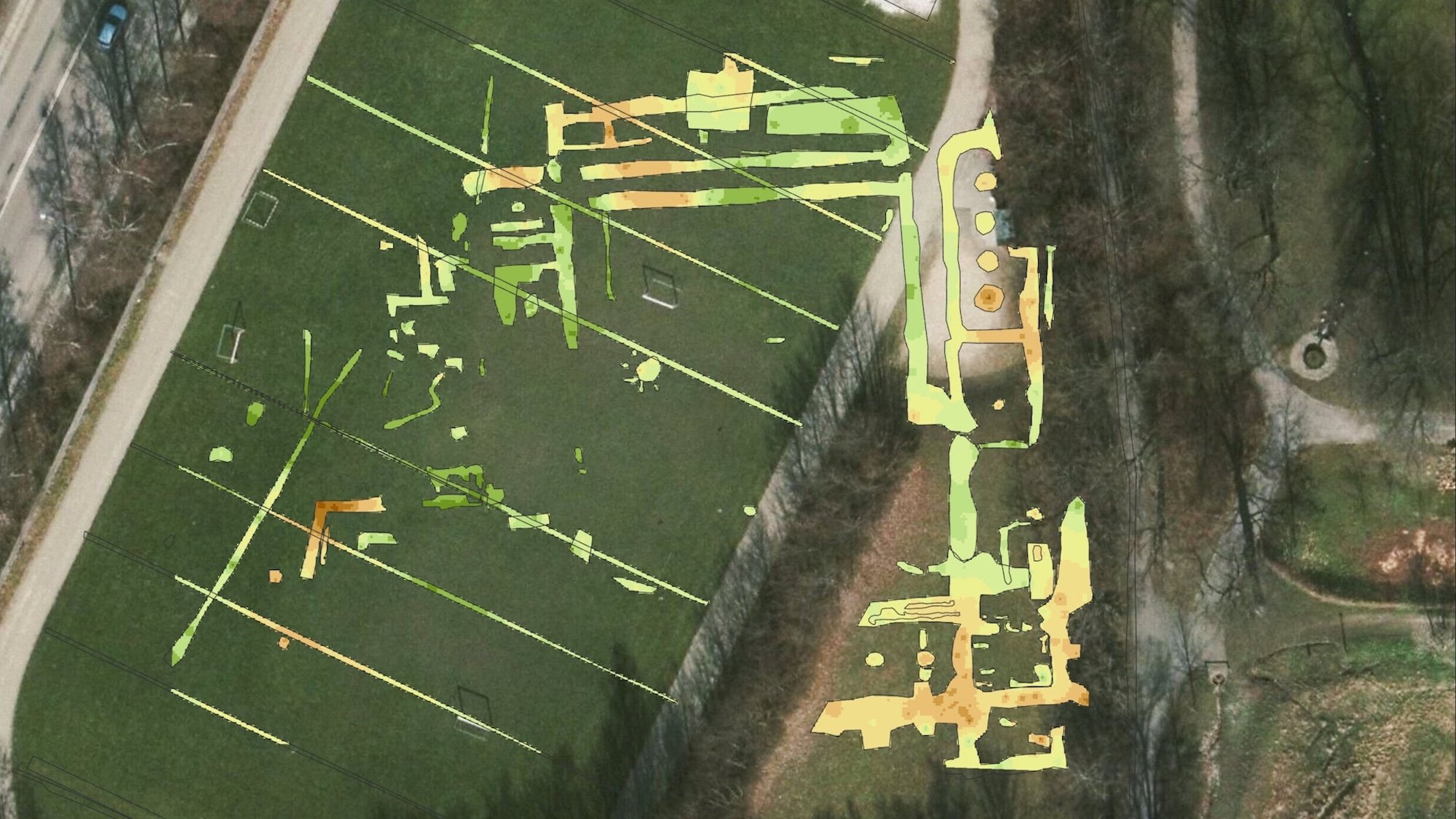
Archaeologists in Denmark have finally pinpointed the remnants of a long lost 13th-century monastery, although its location may dismay local sports fans. With the help of ground-penetrating radar (GPR), researchers confirmed that traces of St. Clare’s Convent still exist roughly six feet beneath a soccer field in the town of Roskilde west of Copenhagen.
“We knew that St. Clare’s Convent had been located here, but not how much of the complex from 1256 [CE] had been preserved,” Jesper Langkilde, an archeologist at the Roskilde Museum (ROMU) recently told the Norwegian Institute for Cultural Heritage Research.
Roskilde served as a religious and royal power hub during the Middle Ages. By the 16th century, the Protestant Reformation ushered in the dissolution of many local Catholic institutions, and St. Clare itself was demolished. As a result, over half a million bricks from the convent were used in construction projects at the nearby Selsø Castle. Many historians long assumed that little—if any—of the convent still existed, leaving a major gap in researchers’ understanding of the era’s monastic architecture.
That may soon change due to local plans for an underground parking garage. Although the initial goal was to construct the facility beneath Roksilde’s soccer field, Danish officials and preservationists first wanted to complete a subterranean survey to ensure that any undocumented historical remnants were not disturbed. Langkilde and colleagues at ROMU collaborated with the National Museum of Denmark and the Norwegian Institute for Cultural Heritage Research (NIKU) to oversee underground scans of the surrounding land.
GPR emits electromagnetic waves capable of penetrating the soil beneath it. These waves then bounce off any objects or structures containing different materials like stone, brickwork, or other human remnants. This data is then processed into visual maps. Although GPR often offers striking details, archaeologists were particularly surprised by what it could detect in Roksilde.
“The results are simply impressive. GPR data do not always provide such clear images, and often the interpretation requires extensive analytical work,” explained NIKU archaeologist Arne Abel Stamnes.
He recalled being able to discern structures in real-time while driving across the soccer field.
“In my assessment these are among the clearest GPR results from a monastery complex in Scandinavia,” he added.
GPR mapping highlighted parts of the building including cloisters, room dividers, a church, and a particularly well-preserved eastern wing featuring more walls and vaulting pillars. The data also suggests the existence of multiple external buildings and structures outside the main monastery square.
The discoveries complicate municipal matters, however. Roskilde’s four other medieval monasteries are mapped and legally protected, but the soccer field above St. Clare’s is not due to the assumption that nothing of the convent remained. Moving forward, archaeologists will begin preliminary excavation work to further assess the centuries’ old structures. From there, it will be up to both historians and local authorities to determine the best path forward—although it’s safe to assume parking garage plans are currently on hold.