
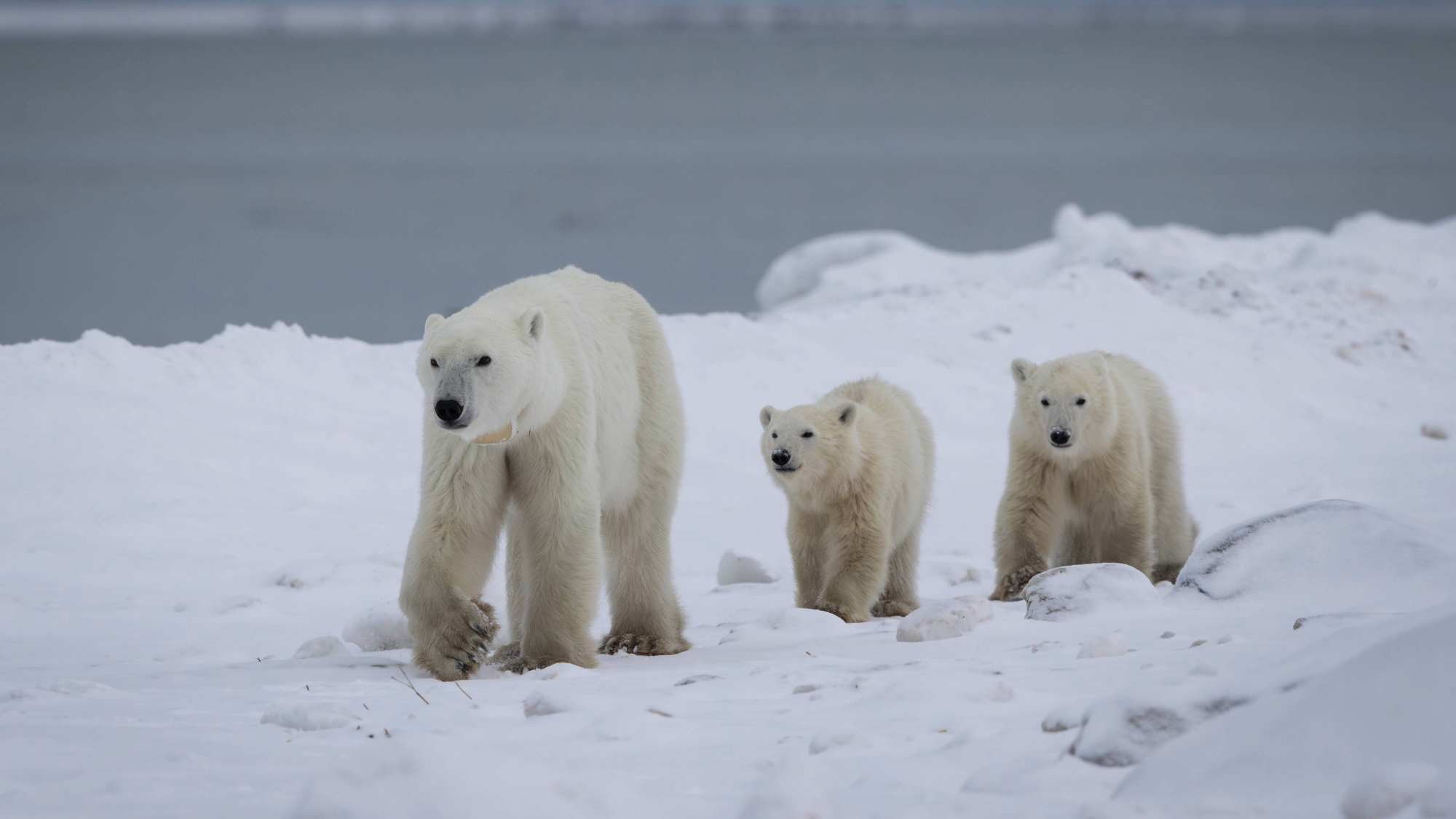
Scientists in Churchill, Manitoba, Canada (aka the polar bear capital of the world) have confirmed that a wild female polar bear has adopted a cub that is not her own. This rare behavior was captured on cameras during the polar bear’s annual migration along Western Hudson Bay.
Researchers from Environment and Climate Change Canada and Polar Bears International spotted the mother bear (designated as bear X33991) during spring 2025, when she came out of her maternity den. At the time, she only had one tagged cub. When she was spotted again in the fall, the bear had two cubs. One had a tag and one did not, indicating that the cub was not hers.
The cubs are about 10- to 11-months-old and are known as Cubs of the Year (COYS). According to Polar Bears International, both cubs appear to be healthy. They will generally stay with their mother for another year and a half and will be weaned when they are around 2.5 years old.
The survival rate for a polar bear cub into adulthood is about 50 percent. However, having a mother provides a better chance at survival for the adopted cub. Researchers also do not believe that cub adoption is related to climate change. Instead, it is more likely a strong maternal behavior that causes female polar bears to take care of other offspring.
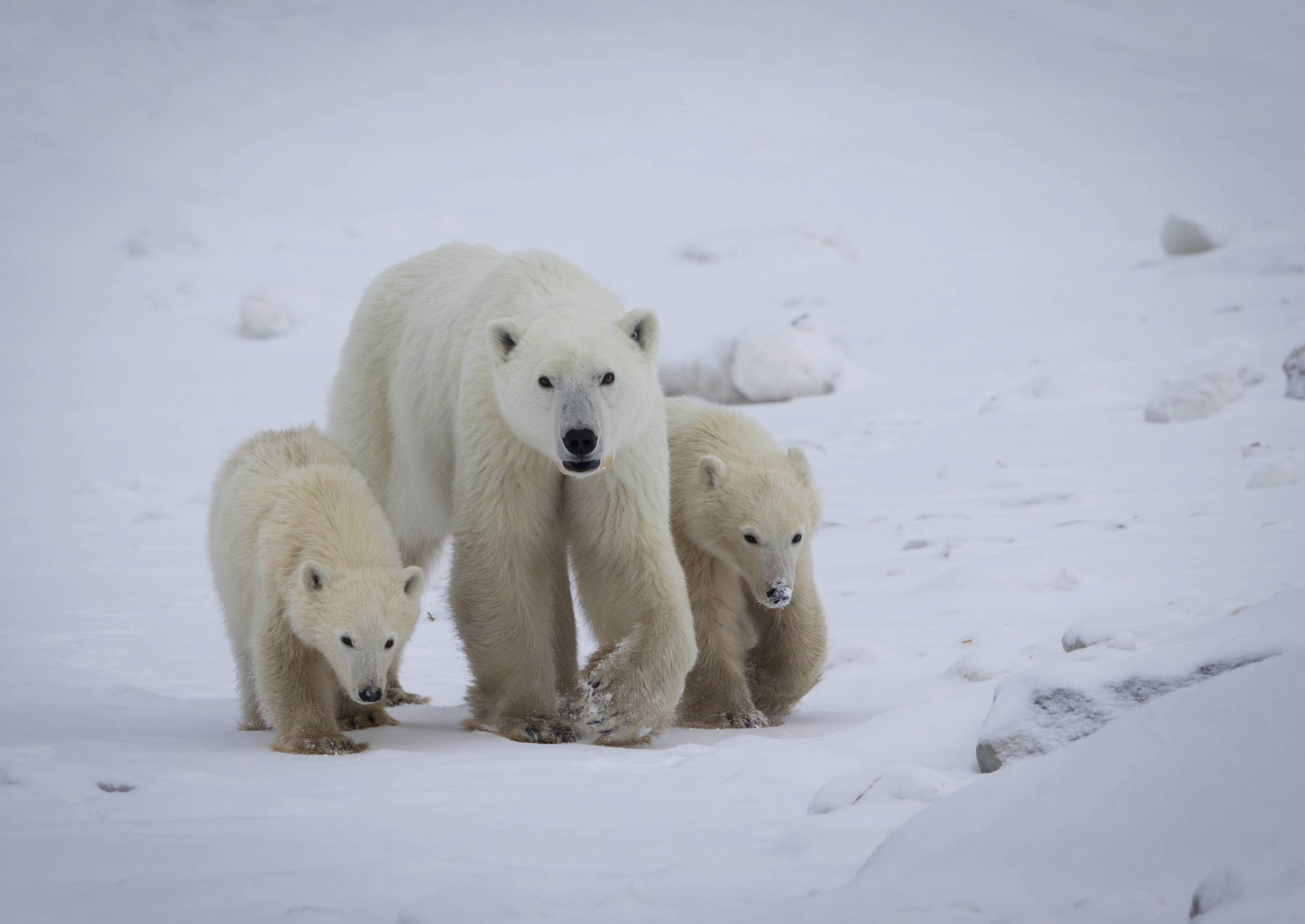
Adoptions like these in a celebration—or group of polar bears—is considered rare. The Western Hudson Bay subpopulation has been studied for over 45 years and has tracked over 4,600 individual bears. This latest incidence is only the 13th known case of polar bear cub adoption.
The team is now analyzing genetic samples taken from the cub to identify the cub’s biological mother. They are looking to see if the mother is in their multi-generational pedigree. In some of the previous adoption cases, the biological mothers were still alive, suggesting that a “switching of litters” is at play rather than the cub being orphaned.

Bear X33991 is wearing a GPS tracking collar as part of a research program by the University of Alberta and Environment and Climate Change Canada, to monitor the bears’ mileston moments, habitat use, denning areas, feeding. The data is being used to better protect this species in the face of climate change.
Scientists expect that bear X33991 and her cubs will stay out on sea ice, where the mother will hunt seals, while teaching the cubs how to be polar bears. You can follow her journey with the polar bear tracker.
