
Sit, stay, roll over, come, fetch, and no. All common commands that responsible dog owners use to train and communicate with their pets. When a dog hears the word “no” there is potentially much more going on inside their minds than just stopping an unwanted (and sometimes dangerous) behavior. When dogs restrain their behavior, their brains show a pattern that looks remarkably like human self-control. These new findings are detailed in a study published in the journal Animal Cognition.
Stopping our actions at a moment’s notice can be the difference between life and death. A rabbit that stops moving when it hears a coyote or other predator in the distance or a human who gives up smoking or drinking alcohol are ways that saying “no” and controlling actions can save lives.
Different biological mechanisms control these behaviors. A rabbit stopping when it hears a predator is automatic and rooted in a deep evolutionary fear of being eaten and comes from a more primal part of the brain, while humans giving up smoking is a conscious effort and takes willpower. Self-control relies on the frontal lobes, which are the youngest part of the brain’s self-control system and only evolved about 310 million years ago in mammals. When scientists measure neural activity in the frontal lobes, increased frontal theta waves are the telltale sign that self-control is happening.
“Dogs live and age faster than humans but move in the same environments and adapt to the same social and physical challenges,” Márta Gácsii, a study co-author and ethologist who specializes in dog cognition at Eötvös Loránd University in Budapest, Hungary, said in a statement. “This means that developmental and age-related factors associated with pathological conditions can be examined more time-efficiently than in human populations.”
To see what is going on when a dog hears “no,” Gácsii and two other researchers measured their activity using non-invasive electroencephalography (EEG) scans. They measured 226 EEG recordings, each about 30 seconds long, from 14 dogs. During the recordings, they were either obeying a command or sitting still. They then analyzed the data to see if the theta waves seen when humans are exhibiting self-control are more pronounced when the animals are obeying a command.
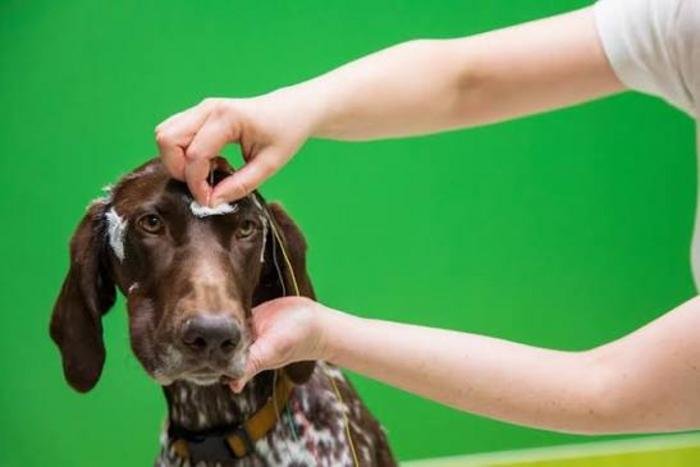
“During self-control situations, we [sic] observed EEG activity that resembles human theta in both frequency and localization,” added study co-author and ethologist Ivaylo Borislavov Iotchev.
According to the team, studying dogs can help us better understand human conditions, including attention-deficit/hyperactivity disorder (ADHD) and obesity.
“In humans, failures in the function of the frontal lobes play a role in both ADHD and abnormal weight gain,” added Hungarian Academy of Sciences ethologist Anna Kis. “The ability to measure the EEG correlates of frontal lobe involvement in dogs will allow us to investigate just how close these conditions in dogs resemble their human counterparts and allow us to extrapolate better predictions for humans, too.”