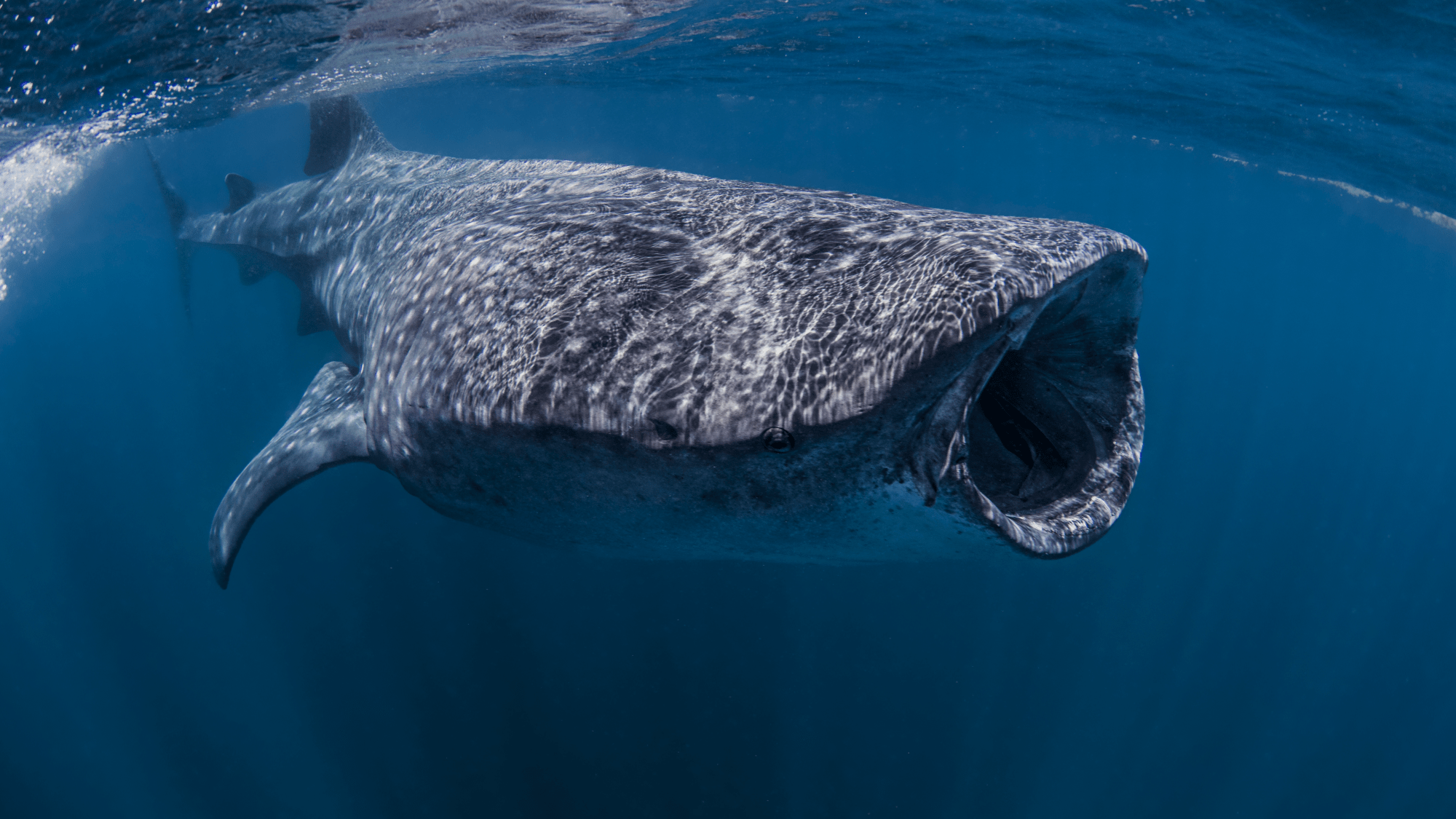
Enormous animals have called the Sunshine State home for centuries. From some giant prehistoric sloths that fell into a sinkhole 500,000 years ago to extinct elephants to today’s massive invasive pythons, Florida has always been a biological playground. Its oceans are even home to the world’s biggest fish—aka the whale shark (Rhincodon typus).
Recently, the Florida Fish and Wildlife Conservation Commission’s Fisheries Independent Monitoring program spotted whale sharks about eight miles west of Loggerhead Key in Dry Tortugas Northern Ecological Reserve. They used the stereo baited remote underwater video survey (S-BRUV) camera, which normally observes the conditions of reef fish in the area.

“Whale sharks can be found year-round within Florida waters and may be more common than we currently understand,” Douglas Adams, a research scientist with the Florida Fish and Wildlife Conservation Commission, tells Popular Science. “They are observed intermittently by recreational or commercial fishers, aerial surveys, fisheries monitoring surveys, and other opportunistic methods.”
The ocean’s biggest fish, whale sharks are found in tropical oceans around the world. They are typically around 18- to 40 feet-long, but can grow up to 60-feet-long. That’s about as long as a bowling lane or fishing boat. They also give live birth (like many large sharks) and even their pups come into the world at about two-feet-long. Come whale sharks can carry over 300 embryos at once.
They are also filter feeders. They eat by swimming forward through concentrated patches of prey with their mouths open wide. The water passes over or through filtering organs that sift out the solid food.
“Whale sharks feed on an array of zooplankton, small fishes, crustaceans, and phytoplankton via a suction filter-feeding behavior with well-developed gill rakers and specialized modifications,” Adams explains. “They help to maintain an effective balance of the plankton and other small marine species they consume, and we have more to learn about their ecological roles.”
There is currently only one known species of whale shark, however there may be a genetic difference between those found in the Atlantic Ocean and those found thousands of miles away in the Indo-Pacific Ocean.
“Although they occur in Florida waters, they can certainly move to adjacent waters of the Atlantic and Gulf of Mexico,” Adams says. “They can occur alone or in large aggregations. These large aggregations, that can be related to feeding, reproduction, or other aspects, can be found off the coast of Mexico, the northern Gulf of Mexico, Western Australia, and other sites.”
These groupings can range from a few individuals to 420 whale sharks.
Despite their large size, they are completely harmless to humans. However, they are listed as Endangered by the International Union for Conservation of Nature (IUCN) Red List of Threatened Species and their global populations are decreasing. Their primary threats are fishing-related, such as getting caught in nets and finning, boat strikes, human encroachment from tourism, and climate change.
Using passive underwater cameras, like S-BRUV, can help scientists observe, record, and quantify whale sharks and pinpoint which habitats they are swimming in. If you are in Florida and see a whale shark, you can also report the sighting to the University of Southern Mississippi to help track them. Having this type of data is crucial in protecting these gentle giants.