
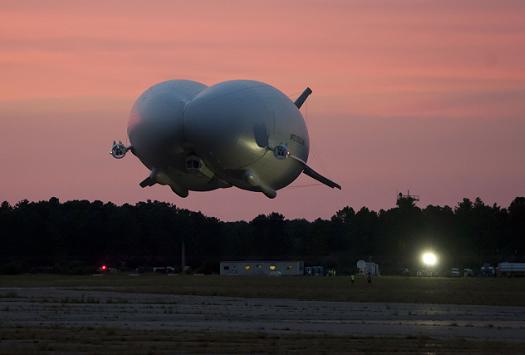
UPDATE, 6:30pm Thursday: The Army confirmed that the LEMV airship project has been canceled. Here's the statement an Army spokesman emailed us:
--Dov Schwartz
Army Public Affairs
InsideDefense is reporting that the Long-Endurance Multi-Intelligence Vehicle (LEMV), the U.S. Army's hybrid airship and a Popular Science Best Of What's New winner in 2012, has been canceled. The U.S. Army did not immediately return a call for confirmation.
Designed to stay aloft for 21 days and provide continuous surveillance, the LEMV was heavier than expected and could only "stay aloft for about five or six days," despite two years of development and $356 million having been spent on it so far, InsideDefense reports.
Problems with development are not the only reasons for cancellation, the news site says. Designed to serve in Afghanistan, a firm 2014 deadline for withdrawing U.S. forces from the country means that the airship was a tool without a mission. Another potential problem that had not yet been overcome in development was bandwidth. As anyone who has ever tried to stream a Netflix film over a weak wireless connection knows, it can be tricky to get video to work over distances. Recording and streaming 21 days straight of video would pose a new level of technical challenges, ones that had not yet been resolved.
The end of the LEMV would mark the third modern airship to be canceled by the military, following the Navy MZ-3A airship, which was mothballed in February of 2012, and the Air Force Blue Devil 2, whose funding disappeared from the Air Force's 2013 budget.
That said, don't rule out the modern airship revival entirely. U.S. Customs and Border Protection, which is already becoming a home for Predator Drones, may appreciate the possibilities afforded by a potential 21-day continuous stare. When talk in Washington turns away from budget cuts, expect the idea of a surveillance airship to be floated again.

Five amazing, clean technologies that will set us free, in this month's energy-focused issue. Also: how to build a better bomb detector, the robotic toys that are raising your children, a human catapult, the world's smallest arcade, and much more.


Online Content Director: Suzanne LaBarre | Email
Senior Editor: Paul Adams | Email
Associate Editor: Dan Nosowitz | Email
Assistant Editor: Colin Lecher | Email
Assistant Editor: Rose Pastore | Email
Contributing Writers:
Rebecca Boyle | Email
Kelsey D. Atherton | Email
Francie Diep | Email
Shaunacy Ferro | Email
Yes the governmental and military cuts are coming.
I am sick to death of the military appropriations process. First, they had a bugnut insane schedule for this thing- 18 months from contract to first flight! Then they were scratching their heads as to why it took 24 months to build due to delays caused by subcontractors and customs. Then they wondered how the ship managed to gain six tons, because the subcontractors messed up the tail fins and gondolas and they were given NO TIME TO FIX IT. Then there was the Blue Devil 2 cancellation before THAT- the airship was built, with millions still left in the program, and a glowing program review from a Naval investigation, but the Air Force cancelled it ANYWAY because they hated the idea of saving billions of dollars by using it instead of expensive, inefficient drones and satellites.
And a minor factual correction, the MZ-3A was cancelled, but it was returned to service again.
My only wish now is that they do not repeat the Air Force's godawful decision to just put the ship in a crate and let those millions to to waste(the cameras and intelligence systems cost more than the aircraft itself!). We already have aerostat balloons watching the southern border, stick it down there so we can at least get some money back from this. And I'm sure many other domestic security agencies would live something like this.
Oh well. Now the hybrid airship torch has been passed down to the private market. I guess it was too much to expect our modern gridlocked hack-n'-slash government to show any competence developing new hybrid airship technology. This leaves us with Lockheed Martin's Skytug, a cargo ship for use in Canada(currently starting the FAA certification process, with first flight in spring), the Canadian's Solar Ship, of which there are now three, Worldwide Aeros Corporation's DARPA-funded Aeroscraft(which is built but also awaiting FAA approval), and the LEMV's designer's AIRLANDER 50, which just yesterday announced a capital-raising project and is about to take orders and set prices.
Lesson learned: never trust the government to do something that the private market SHOULD.
---
Always defer to facts rather than philosophy.
Helium shortage.
Well I wouldn't blame the government as much as James, Northrop Grumman is equally to blame, if from the start they couldn't make the time frame, they could of A) said No to the project and got no money .... or B) said OK to the project knowing they couldn't meet the deadline......which would you choose? Northrop Grumman would of pushed for the project even if it knew it couldn't be done, who'd pass up hundreds of millions of dollars??? There is no downside for Northrop Grumman, its not like they get punished for failing but would of been punished if they had passed up the contract.......
Plus the fabric production and customs issue isn't the government's problem, the company decided to outsource and paid the price for it. Plus being 12,000 lbs overweight sounds like the company majorly screwed up in the beginning when designing it.
So I'd say the military was smart to get out of the project now, many many airships have been attempted and many have failed. A few months ago some California based airship company closed their doors because (they claimed) the helium shortage affecting prices. While I don't doubt prices have gone up, no material we can create can contain helium, it'll always leak out, so you should anticipate this in your business plans. I'm curious how this airship was intending to contain enough helium for 21 days....
And how much money did this cost taxpayers. People don't need surveillance, this could be used for transportation (food&drinks etc)
Actually, brightblade, Northrop Grumman WOULD have been able to make the schedule had they not run into those delays. The problem is that they had zero margin of error. And anyone who has worked on a large project, much less a brand-new aircraft, can tell you that there will ALWAYS be delays and that you should plan for them. The military did not, despite ostensibly being experienced with production delays. I blame them. You'll notice that few of the delays were due to incompetence by Northrop, they were issues like customs withholding parts, subcontractor chicanery, a forced evacuation of the facility because of a hurricane, etc.
"Plus being 12,000 lbs overweight sounds like the company majorly screwed up in the beginning when designing it."
That's actually an interesting story. Many people predicted that the LEMV could never live up to its promised 21 day endurance because of various inherent factors of hybrid airships. They said it could last maybe 5 or 10 days. They ended up being right, but for the wrong reasons. The LEMV's design is fine- but subcontractors hired by the main contractors were very rushed in their production of various hull elements like the gondolas and tail fins in particular. This shoddy fabrication ended up adding 12,000 pounds to the aircraft. Had the subcontractors actually followed the designs correctly, the LEMV could carry 12,000 pounds more fuel and make it to the full 21 days. As of now, though, it can "only" make it 16 days at 16,000 feet. Another factor in the arithmetic is that as a hybrid between an airship and an airplane, the aerodynamic drag, and therefore fuel use, lessens as the fuel is burned off, but structural weight does not.
"So I'd say the military was smart to get out of the project now,"
Not at all. Stopping now doesn't just mean wasting the millions that went into it, it means forfeiting the millions that this thing would save. It's far more cost-effective than a Reaper drone, which is a fraction as costly as manned surveillance, which is orders of magnitudes cheaper than satellite surveillance, etc., etc.
"many many airships have been attempted and many have failed."
Not failed, necessarily, just stillborn. The projects were either cancelled before they could take off or they were never seriously funded in the first place. The times when modern airships actually get USED finds them extremely successful, just going off the record. Blimps were used with incredible success in World War 2, with the best mission readiness of any air unit and only two failures of their over 80,000 escort missions. Aerostats are used today, and they are unbelievably cheap and effective compared to conventional aircraft. The Navy's MZ-3A airship, which was cancelled last year, like the LEMV, was shortly thereafter returned to service where it has proved incredibly cheap and efficient.
"A few months ago some California based airship company closed their doors because (they claimed) the helium shortage affecting prices."
You are referring to Airship Ventures, and that's not actually the reason it went under. They leased their Zeppelin NT at the worst possible time- give years ago, right before the recession hit. They failed to secure a corporate advertising sponsor then, so they had to go hand-to-mouth doing passenger flights, seasonal NASA work and short ad gigs to stay afloat, pardon the pun. The reason they went under is they finally failed to secure the next sponsor. The lower ticket sales and rising Helium costs were just annoyances compared to the revenue loss that having no advertiser entailed. Ergo, they went out of business and shipped the NT back to Germany.
"While I don't doubt prices have gone up,"
True, but bear in mind the Helium shortage is a temporary production infrastructure crisis(read: the plants are old and shutting down). The supply is fine. In fact, the Qataris have pioneered efficient new technologies to extract Helium from a far greater range of sources. The Helium supply has never been more accessible and abundant.
"no material we can create can contain helium, it'll always leak out, so you should anticipate this in your business plans. I'm curious how this airship was intending to contain enough helium for 21 days...."
While this is true, you don't quite grasp the scale of the problem. It's much smaller than you imagine. Helium leaks from the airship's hull, but only at a rate of about 6% AT WORST per annum, usually more like 3%. It's much more advanced materials than mere latex or Mylar balloons. The helium loss after just 21 days is absolutely negligible. It works out to be about $55 dollars per day in helium loss, worst-case. And if you've ever seen the terrifying maintenance bills of a helicopter, you'll understand just how little that is.
---
Always defer to facts rather than philosophy.
Thanks James for the very detailed response, Popsci needed you to co-write this article.
James, you do know your airships.
Maybe some of the programs you've mentioned will get there.
On the other hand, I'm just an old f**t, but I've read about the revival time and time again -- always seems to fall apart.
Here's hoping...
A new paradigm, J James. Lighter than air ships should use an exoskeleton of 12 inch pcv pipes filled with compressed Hydrogen. Each pvc pipe forms an oval. The hydrogen is fuel for Ford V8 and generator. Electric fans provide thrust. Inside of the exoskeleton are large bags of helium which provide the lift. The 6 or 8 fans can be vectored to provide direction control and extra lift.
J.James and BrightBlade81-you seem to have some lessons learned from this program/process, would you be willing to share to avoid this happening again? Email me
artificial Helium shortage.