
Not all computers are made of silicon. By definition, a computer is anything that processes data, performs calculations, or uses so-called logic gates to turn inputs (for example, 1s and 0s in binary code) into outputs. And now, a small international community of scientists is working to expand the realm of computers to include cells, animals, and other living organisms. Some of their experiments are highly theoretical; others represent the first steps toward usable biological computers. All are attempts to make life perform work now done by chips and circuit boards.
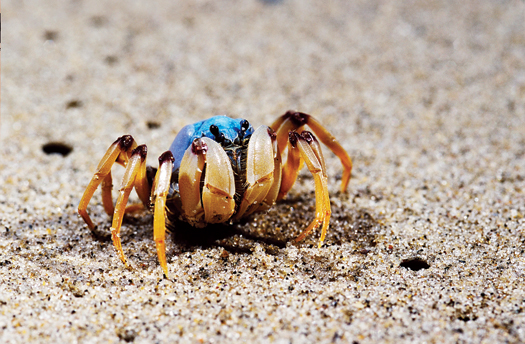
Last year, for example, a computer scientist at the University of the West of England named Andy Adamatzky and a team of Japanese researchers built logic gates that ran on soldier crabs. First they constructed mazes that replicated the shape of the wires in a computer’s logic gates.
Then they chased two swarms of crabs (inputs) from one end of the gate to the other. When the swarms collided, they combined to form a new swarm (output), which often headed in the direction of the sum of their vectors, demonstrating that a living, somewhat random system can produce useful order.
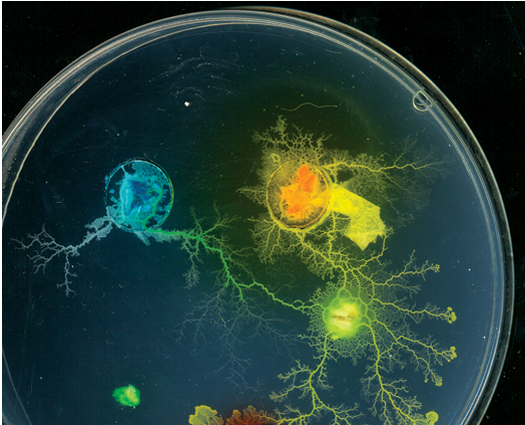
If crabs are good at clustering together, a single-celled organism that resides in rotting trees—Physarum polycephalum, or slime mold—is surprisingly adept at making maps. Adamatzky and Selim Akl, a computer scientist at Queens University in Ontario, have spent the past few years using slime mold to map networks.
Slime mold “will lead the revolution in the bioelectronics and computer industry.”
In one experiment, they took a map of Canada, dropped oat flakes (slime-mold food) on the nation’s major cities, and placed the mold on Toronto. It oozed forth to form the most efficient paths to the cities, creating networks of “roads” that almost perfectly mimicked the actual Canadian highway system.
Last April, biocomputers got even more impressive. Swiss bioengineers announced that they had programmed human cells to do binary addition or subtraction, which is how a computer does arithmetic. They genetically engineered the cells with an elaborate circuit of genes that turn one another on or off. The cells can process two inputs added to their dish (the molecules erythromycin and phloretin) and display an answer by producing red or green fluorescent proteins.
What’s the point of all of this? Adamatzky says that slime mold’s mapping abilities could design roads, wireless networks, and information-processing circuits better than today’s computers. Combining slime mold with electronics could also yield benefits. Adamatzky is already making a computer chip that marries the speed of electrical communication with the learning capabilities of slime mold.
The hybrid technology would process information less like a computer and more like a brain, learning and growing through experiences and trial and error, making it possible to solve problems in both neuroscience and computer science. “We envisage that the Physarum-based computing research will lead to a revolution in the bioelectronics and computer industry,” he says.
His colleague Akl says one advantage of biocomputers may be that they can function in places that conventional electronics can’t. “Think about computing in harsh environments like the bottom of the ocean, the human body, or on another planet where our computers may not survive,” he says. Life forms could thrive in settings where silicon chips might melt, freeze, or disintegrate.
But the biggest benefits could be in medicine, because cells are adept at interacting with other cells. Martin Fussenegger, a bioengineer at ETH Zurich and the lead researcher on the cell-calculator project, says cells could be programmed into “smart cell implants” that sense health problems in the human body and administer tailored therapies.
For example, a patient with a high risk of breast cancer could receive an implant that would recognize cancer-indicating molecules and produce proteins to kill the cells making them. “A diseased cell is a program with a bug,” Akl says. “Computer scientists are good at finding bugs and fixing them. I leave the rest to your imagination.”
