
Though NASA holds the keys to some of the most sophisticated technologies ever to make it into low Earth orbit, the spacesuits that astronauts wear up there are still in many ways similar to those worn during the Apollo missions of the 1960s and 1970s. Fortunately for future astronauts, they may get a next-gen visual upgrade via a piece of technology that is coming down from the mountaintop at this year’s Desert Research and Technology Studies (RATS).
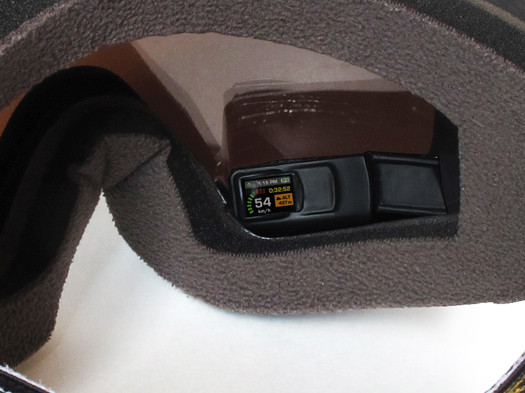
Vancouver-based Recon Instruments, maker of GPS-enabled ski goggles with in-goggle displays tucked in the peripheral, is sending its technology to NASA for potential inclusion in the next generation of spacesuit helmets in which mission critical information and checklists could appear right before astronauts eyes. NASA’s spacesuit designers have been toying with the idea of an in-helmet displays for a while now, and considering that spacewalking astronauts currently rely on paper checklists taped to their arms, such a display represents a pretty big technological leap forward.
Recon has some experience packing display tech into small, lightweight packages. Its current technology tucks a tiny LCD screen right into the frame of a ski google and lets downhill daredevils access information like GPS location, temperature, altitude, and maps right on the edge of their fields of view. For astronauts, the idea would be quite similar, though given the increased real estate inside a spacesuit visor the possibilities for the display are even more ranging.Say an astronaut is performing repairs on the outside of the international space station or on an orbiting satellite. The astronaut could call up his mission checklists when needed (voice commands? Yeah, let’s see if we can integrate some voice commands in there) and put them out of sight when they aren’t necessary. But crew inside the ship/station could also beam him or her diagrams, schematics, and detailed instructions on how to perform repairs on the fly, making missions more nimble.
It’s conceivable that a full heads-up display and even augmented reality might at some point be integrated into the helmet, making it easier for astronauts to identify mission targets and components and quickly find things they are looking for. Engineers could even upload a demo to an astronauts HUD talking him or her through an unexpected repair that wasn’t covered in training.
But one step at a time. Desert RATS takes place every year in Arizona and gives NASA engineers the opportunity to work alongside researchers and scientists from around the country on technology development and to field test technologies that NASA might potentially want to tap. If Recon’s HUD technology makes the cut, those paper checklists might soon (finally) get a space-age upgrade.
Five amazing, clean technologies that will set us free, in this month's energy-focused issue. Also: how to build a better bomb detector, the robotic toys that are raising your children, a human catapult, the world's smallest arcade, and much more.


Online Content Director: Suzanne LaBarre | Email
Senior Editor: Paul Adams | Email
Associate Editor: Dan Nosowitz | Email
Assistant Editor: Colin Lecher | Email
Assistant Editor: Rose Pastore | Email
Contributing Writers:
Rebecca Boyle | Email
Kelsey D. Atherton | Email
Francie Diep | Email
Shaunacy Ferro | Email
How do we not have this already?
I think we DO already have this, just not in space helmets.
now all we need is advanced language parsing, and the ability for a central computer somewhere to gather any data the astronauts could possibly request. oh, and let's not forget that they'd have to address it as "computer" before each request. ^_^
this technology is so old. why hasn't nasa already used it? i hope the new design for the spacesuits is more protective and cooler looking.
What about a Space suit that works like a cell membrane. So a bubble, say an energy shield or something physical, that could eat things for the wearer to interact with. Then it could have it could stick to a wall and open up on it, like a suction cup, in order to do those repairs that require one to open a panel or something. This Concept of mine reminds me of the grabbing ball filled with coffee beans.
Of course, with the demise of our space program the only chance NASA will have of using the new headsup space helmet is at Halloween.
the space program is not ending, SHUTTLES are ending, because NASA is upgrading to something else.
Sorry, with the demise of our SHUTTLE program they can at least use these riding simulators at theme parks.
"with the demise of our space program the only chance NASA will have of using the new headsup space helmet is at Halloween"
I dont get how science fans and geeks can get away saying and thinking things like this. People need to understand one thing: NON-manned missions have expanded our scientific understanding and exploration of the universe about 100000 times more than manned missions. Manned missed cover VERY little. A large part of putting men into space is just that. to put a man into space or on the moon, etc. Yes there are some things we can only learn by using a human, and some experiments are impossible without a human running them. but take a simple satellite like Hubble. Hubble has added a zillion terabytes of data to our understanding of the uni. That is 1 of 1000 experiments out there right now floating in space. They are launching a new telescope that will make hubble look like your iphone camera. And they already have the successor to THAT telescope planned.
Manned missions are looking grim at the moment, and yes that is a super bummer. But SCIENCE, NASA, SPACE EXPLORATION, and SCIENTIFIC LEARNING are at its PEAK right now. do a little more reading we are in the golden age of non manned missions in orbit around the earth and to other planets, commits, the sun, etc etc etc. What about the new mars rover. It could eat Spirit and Opportunity and crap them out and then use that crap for more fuel. its that BAD ###! not to mention a new manned capsule is almost complete that will be used to take man to the moon and mars. the shuttle was a death trap. and its a shame they waited so long to make a replacement... but they are making it! oh yeah. what about the new ground based telescope they will build soon with a combined surface area of 1 square km!!!!! only a few hundred times bigger than the VLA and 1000 times bigger than the LA.