
Feature
When radioactive tomatoes were the crop of the future

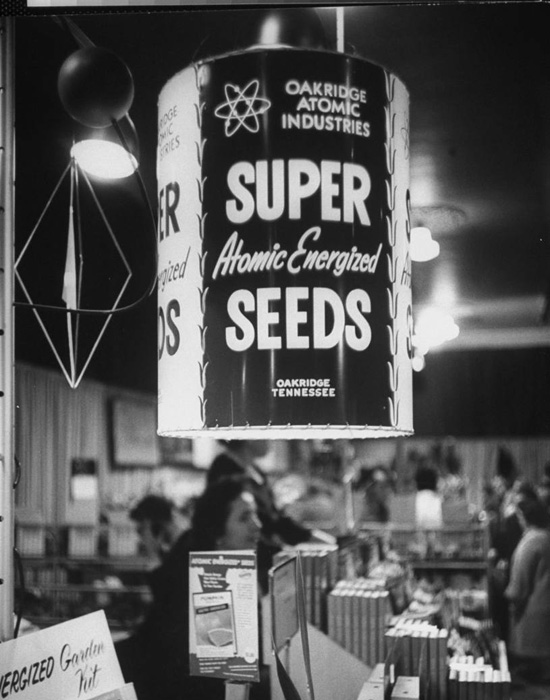
Atomic Seeds Life Magazine via Pruned

One look at the wedge-shaped rows of plants and anyone could tell the circular garden was not grown under normal conditions. Plants sown in concentric circles displayed wildly different vitality and viability.

The innermost circle of plants, gathered around a central pole, were dead; slightly farther away, the plants were stunted and tumor-ridden; and past that, the plants may have looked right, but possessed strange new mutations.

It was the latter part of the archetypal “gamma garden” that most interested plant researchers in the 1950s and 1960s. The central pole contained a radioactive source, commonly cobalt-60, so that scientists could see how the gamma rays affected plants.

Before scientists learned how to modify genes, they induced mutations with radiation. It was a sincere effort to feed the world, and amaze home gardeners, by modifying plants to have desirable traits.

Nanotechnologist Paige Johnson shares the history of atomic gardening on her blog, Garden History Girl. Writer Alexander Trevi interviewed Johnson for his own blog, Pruned.

“If we think of modern GM as taking a scalpel to the genome, mutation breeding by irradiation was a hammer,” she says. The full interview is well worth a read; click through to it here.

It’s an interesting tale in light of radiation and food safety concerns after the Japanese nuclear disaster. But there are also some interesting parallels between atomic gardening and 21st-century biotechnology, which also promises to feed the world by modifying plants to have new traits. The promises, and the controversies, feel very familiar.

Back in the 1960s, scientists bombarded plants with gamma radiation hoping to see beneficial changes in the plants’ structure and yield. Advocates included entrepreneur C.J. Speas and Englishwoman Muriel Howorth, who started the Atomic Gardening Society to promote mutated varieties. Johnson describes a dinner party in which Howorth served “NC 4x,” North Carolina 4th generation X-rayed peanuts that were produced from seeds exposed to 18,500 roentgen units of X-rays. After the party, Howorth planted the irradiated seeds and they grew like magic beanstalks.

Journalists and sightseers came to visit the mutant plant; garden writer Beverley Nichols called the peanut the “most sensational plant in Britain.”

“To me it had all the romance of something from outer space. It is the first ‘atomic’ peanut. It is a lush, green plant and gives you a strange, almost alarming sense of thrusting power and lusty health. It holds a glittering promise in its green leaves, the promise of victory over famine,” she wrote, as recounted on Johnson’s blog.

As with modern biotechnology, industry was the main driver behind the new plant modifications. Two modern cultivars are the result of atomic gardening, Johnson says — most of the world's mint oil, used in toothpaste, chewing gum and more, comes from the “Todd's Mitcham” peppermint cultivar, which is resistant to a fungus. It was produced in radiation gardens at Brookhaven National Laboratory. And the “Rio Star” grapefruit varietal, which Johnson says accounts for three-fourths of grapefruit production in Texas, is another atomic mutant bred for its dark red flesh and juice.

Gamma garden research was conducted in the U.S., Sweden, India and other countries in the 1960s, leading to untold numbers of new plant varieties. But s far as Johnson can tell, the entrepreneur Speas was the only source for home gardeners to buy irradiated seeds. Seed packets depicted robust flowers and vegetables, calling them “atomic-energized” and offering an interesting definition of what radiation does — “gamma rays tend to shake up the normal balanced system of the embryo inside the plant.”

Atomic Energized Poppy: The seed packet advises gardeners that it may take more than a year for mutations to manifest themselves, and therefore not to destroy stunted plants: “The stunted plants may contain desirable changes when they again regain their hereditary balance in subsequent generations.”  Paige Johnson via Pruned

Eventually, as scientists and the public grew to understand the dangers posed by radiation exposure, gamma gardens fell out of favor. The notion of irradiated plants feeding a hungry world soon wilted, too.

Decades later, scientists would figure out how to make much more precise mutations, inserting new genes and switching them on to make plants do things they couldn’t do before. But this method has its own detractors, some of whom would argue genetic modification is just as bad for health and the environment as radioactivity research.

We know much more about biology today than we did in the 1960s. But will future generations look back on genetic modification like we reflect on atomic gardens, with an amused sense of nostalgia illuminated by hindsight?

4 Comments

I like this idea. In modern gm crops you have to have some idea of what genes to implant and make sure its patentable. I would have instead irradated the seeds, then stopped irradating at planting. Might end up with some very useful mutations, cull out the damaged stuff keep the best. Might be worth trying again, now just need some cobalt-60.

@Mycellium,

Or a field trip to Fukushima/Chernobyl :D

You are a bit late. Plant breeders have been using radiation and mutagenic chemicals for about eighty years to generate new strains of crops plants, a procedure called "mutagenic breeding". The configuration you describe is not the common one: mostly, seeds are irradiated with gamma rays from cobalt-60 or treated with chemical mutagens until many, perhaps most, are rendered sterile. But from the survivors, interesting and valuable mutants can sometimes be recovered. It is estimated that about 70% of our current crop plants (including those used for so-called "organic" agriculture) carry such an event in their breeding histories. Moreover, the International Atomic Energy Agency wants to do more of it. Note that such breeds do not have to be tested for safety as regards human health nor for possible 'environmental" effects. Until recently little or no analyses has been undertaken to find out what had happened to the genomes but it is now becoming clear that there are often extensive and uncharacterised alterations. By comparison, GM is directed, not random, and price – and the products are tested before being approved. So just what are you on about?

@Valentine Dyall,

The most obvious difference between GMO and "atomic" plants are that if you irradiate seeds you can patent the "process" you use to do it, but you cannot patent the plants themselves.

If you mutate some seeds with radiation, and then you SELL me those seeds, I "own" them.

I can plant them, I can harvest the future generations and replant them, I can mutate and modify the future generations however I want, etc.

"GMO" plants are different from an Intellectual Property (IP) standpoint. Monstanto doesn't "sell" seeds to farmers, it LICENSES the genes inside.

That means if the farmer breaks the license agreement (by saving the seeds and replanting them next year instead of renewing the license agreement) then they have committed a crime--they have infringed upon the IP of Monsanto and can be sued.

Furthermore, if I sprinkle some of Monsanto's patented genes/seeds onto your lawn... YOU are liable for any license fees associated with having Monsanto's IP in your control.

Even if the wind blows the pollen from my licensed Monsanto plants onto your yard and cross-pollinates your non-Monsanto plants... if the patented gene is transferred, YOU are once again liable for license fees for the IP you now control.

Maybe from an "environmental/safety/health" perspective "atomic" plants from 50 years ago were no better than the GMO plants of today...

But from an IP perspective, the GMO plants and patent laws are MUCH more conducive to giving a single entity (such as Monsanto) the ability to control the food supply (and charge whatever it wants for your ability to produce food).

I try my best to avoid GMO foods not because I'm worried they are bad for my health, but because I don't want to live in a world where most veggies are tainted with a patented gene and the ONLY way to produce food "legally" is to pay license fees to Monsanto.


June 2013: American Energy Independence

Five amazing, clean technologies that will set us free, in this month's energy-focused issue. Also: how to build a better bomb detector, the robotic toys that are raising your children, a human catapult, the world's smallest arcade, and much more.


Online Content Director: Suzanne LaBarre | Email
Senior Editor: Paul Adams | Email
Associate Editor: Dan Nosowitz | Email
Assistant Editor: Colin Lecher | Email
Assistant Editor: Rose Pastore | Email

Contributing Writers:

Kelsey D. Atherton | Email
Francie Diep | Email
Shaunacy Ferro | Email

circ-top-header.gif
circ-cover.gif
bmxmag-ps