Ed Note: In 2005 Dan Koeppel traveled to Central America to begin his research on the banana—a fruit whose ubiquity, he discovered, may very well prove to be its downfall. His book, ‘Banana: The Fate of the Fruit That Changed the World,’ was recently published to much acclaim. Here’s the feature that started it all.
A banana is not just a banana
“A Banana,” says Juan Fernando Aguilar, “is not just a banana.” The bearded botanist and I are traipsing through one of the world’s most unusual banana plantations, moving down row after row of towering plants and ducking into the shade of broad leaves in an attempt to avoid the Central American midday heat. In an area about the size of a U.S. shopping mall, Aguilar, 46, is growing more than 300 banana varieties. Most commercial growing facilities handle just a single banana type-the one we Americans slice into our morning cereal.
The diversity of fruit in Aguilar’s field is astonishing. Some of the bananas are thick and over a foot long; others are slender and pinky-size. Some are meant to be eaten raw and sweet and some function more like potatoes, meant for boiling and baking or frying into snack chips. But Aguilar’s admonition is aimed squarely at our northern lunch boxes and breakfast tables.
For nearly everyone in the U.S., Canada and Europe, a banana is a banana: yellow and sweet, uniformly sized, firmly textured, always seedless. Our banana, called the Cavendish, is one variety Aguilar doesn’t grow here. “And for you,” says the chief banana breeder for the Honduran Foundation for Agricultural Investigation (FHIA), “the Cavendish is the banana.”
The Cavendish-as the slogan of Chiquita, the globe’s largest banana producer, declares-is “quite possibly the world’s perfect food.” Bananas are nutritious and convenient; they’re cheap and consistently available. Americans eat more bananas than any other kind of fresh fruit, averaging about 26.2 pounds of them per year, per person (apples are a distant second, at 16.7 pounds). It also turns out that the 100 billion Cavendish bananas consumed annually worldwide are perfect from a genetic standpoint, every single one a duplicate of every other. It doesn’t matter if it comes from Honduras or Thailand, Jamaica or the Canary Islands-each Cavendish is an identical twin to one first found in Southeast Asia, brought to a Caribbean botanic garden in the early part of the 20th century, and put into commercial production about 50 years ago.
That sameness is the banana’s paradox. After 15,000 years of human cultivation, the banana is too perfect, lacking the genetic diversity that is key to species health. What can ail one banana can ail all. A fungus or bacterial disease that infects one plantation could march around the globe and destroy millions of bunches, leaving supermarket shelves empty.
A wild scenario? Not when you consider that there’s already been one banana apocalypse. Until the early 1960s, American cereal bowls and ice cream dishes were filled with the Gros Michel, a banana that was larger and, by all accounts, tastier than the fruit we now eat. Like the Cavendish, the Gros Michel, or “Big Mike,” accounted for nearly all the sales of sweet bananas in the Americas and Europe. But starting in the early part of the last century, a fungus called Panama disease began infecting the Big Mike harvest. The malady, which attacks the leaves, is in the same category as Dutch Elm disease. It appeared first in Suriname, then plowed through the Car- ibbean, finally reaching Honduras in the 1920s. (The country was then the world’s largest banana producer; today it ranks third, behind Ecuador and Costa Rica.)
Growers adopted a frenzied strategy of shifting crops to unused land, maintaining the supply of bananas to the public but at great financial and environmental expense-the tactic destroyed millions of acres of rainforest. By 1960, the major importers were nearly bankrupt, and the future of the fruit was in jeopardy. (Some of the shortages during that time entered the fabric of popular culture; the 1923 musical hit “Yes! We Have No Bananas” is said to have been written after songwriters Frank Silver and Irving Cohn were denied in an attempt to purchase their favorite fruit by a syntactically colorful, out-of-stock neighborhood grocer.) U.S. banana executives were hesitant to recognize the crisis facing the Gros Michel, according to John Soluri, a history professor at Carnegie Mellon University and author of Banana Cultures, an upcoming book on the fruit. “Many of them waited until the last minute.”
Once a little-known species, the Cavendish was eventually accepted as Big Mike’s replacement after billions of dollars in infrastructure changes were made to accommodate different growing and ripening needs. Its advantage was its resistance to Panama disease. But in 1992, a new strain of the fungus-one that can affect the Cavendish-was discovered in Asia. Since then, Panama disease Race 4 has wiped out plantations in Indonesia, Malaysia, Australia and Taiwan, and it is now spreading through much of Southeast Asia. It has yet to hit Africa or Latin America, but most experts agree that it is coming. “Given today’s modes of travel, there’s almost no doubt that it will hit the major Cavendish crops,” says Randy Ploetz, the University of Florida plant pathologist who identified the first Sumatran samples of the fungus.
A global effort is now under way to save the fruit-an effort defined by two opposing visions of how best to address the looming crisis. On one side are traditional banana growers, like Aguilar, who raise experimental breeds in the fields, trying to create a replacement plant that looks and tastes so similar to the Cavendish that consumers won’t notice the difference. On the other side are bioengineers like Rony Swennen, who, armed with a largely decoded banana genome, are manipulating the plant’s chromosomes, sometimes crossing them with DNA from other species, with the goal of inventing a tougher Cavendish that will resist Panama disease and other ailments.
Banana experts disagree on when the Latin American and African crops will be hit by the Panama fungus. Ploetz won’t venture a guess, but he notes that the Malaysian plantations went from full-scale commercial operations to “total wipeout” in less than five years. Currently, there is no way to effectively combat Panama disease and no Cavendish replacement in sight. And so traditional scientists and geneticists are in a race-against one another, for certain, but mostly against time.
Honduras: Epicenter of the American supermarket banana
Honduras is in many ways the epicenter of the American super- market banana. More than a century ago, a pair of U.S. companies-United Fruit and Standard Fruit, now known, respectively, as Chiquita and Dole-built some of the world’s first commercial banana plantations in the Central American nation. Technological infrastructure was the first task: The banana producers began as railroad companies, with friendly local governments granting thousands of acres of surrounding rainforest for each mile of track laid. Although bananas had been sporadically available in the U.S. since colonial days, the post”Civil War advent of motorized transit by rail and steamship made the importation of tropical fruit practical. (An 1896 article in this magazine entitled “Where Bananas Grow” observed that the U.S. market for bananas had increased more than 40-fold in the previous quarter century, owing mostly to improved “facilities for transporting and preserving them.”)
By the early 1900s, bananas surpassed apples as the nation’s favorite fruit, becoming so popular that in the days before municipal trash collection, the slapstick slip on a discarded peel was a genuine hazard. (Luckily, Boy Scouts were on the case: “A good turn may consist in removing a piece of banana peel from the pavement,” their 1914 handbook advised.) The problem of banana litter helped lead to the development of the earliest urban refuse-removal networks, according to Virginia Scott Jenkins, author of Bananas: An American History.
Bananas have always been a technology incubator. Because they’re a time-sensitive product-they need to be harvested green, then delivered to market just at ripening time-systems had to be developed to bring precision to the picking and shipping processes. Leonel Castillo, a banana-production consultant who grew up in Chiquita’s corporate compound near the city of San Pedro Sula, on Honduras’s northern coast, explains that the old way was “to wait until you could see the ship coming over the horizon toward port.” Then banana workers would engage in frantic nonstop harvesting and rush the crop to the boats. Chiquita engineers developed the first radio networks in the tropics as a way to bypass this antiquated system. The fruit’s popularity also led to the development of ripening rooms whose controlled environment can slow or speed the way picked fruit ages; refrigerated steamships; and early precursors to bar-coding that allowed each bunch to be tracked by field, plantation, originating country and shipping container.
But the main thrust of banana tech has always been the search for new varieties. FHIA now occupies the buildings at Chiquita’s old Honduran headquarters that since the 1920s have been the global hub for traditional banana breeding (the buildings also hint at the lifestyle once provided for executives at tropical outposts, spreading across a campus-like compound that once housed a swimming pool and horse-racing track).
Chiquita abandoned most tropical research in the 1970s; FHIA opened in 1986 as part of an initiative to promote local economic development. One of the first new breeds to come out of the effort, which is funded by a combination of government and private grants, was the “Goldfinger” banana, also known as FHIA-01. The Goldfinger was developed by painstakingly cross-breeding samples from the more than 350 banana types originally collected by United Fruit scientists. It is a highly versatile fruit, suitable for cooking and eating; it has a slightly tart, apple-like flavor and is one of the few bred bananas to gain significant consumer acceptance.
The Goldfinger was created by Philip Rowe, a legendary advocate for traditional methods of banana breeding; Rowe died in 2002, and the program was taken over by Aguilar. Like Rowe, Aguilar believes that conventional hybridization-not genetic engineering-is the best way to devise a Cavendish replacement. The Goldfinger was evidence of that belief: It transported well and caught on in certain markets, notably Australia. But it didn’t taste like the sweeter Caven- dish and never took hold in the Americas.
The race to save the banana
Aguilar moves quickly through the fields surrounding the old Chiquita headquarters, chain-smoking Marlboros between taking bites of sample fruit. He understands that to actually find the needle he’s looking for in his vast yellow haystack, he’s got to maintain a fast pace. But he also knows that agricultural husbandry is a slow process. It requires patience. To balance both, he says, it is necessary to see the job as something more than just ordinary science. The race to save the banana is personal. “The bananas,” he says, “are my children.”
Each of Aguilar’s experimental varieties are tagged and set off in rows. To put the new bananas to the test, no fungicides are used here, so it isn’t difficult to see the difference between healthy, resistant plants and afflicted ones. The strong plants have expansive green leaves. Both Panama disease and another malady, Black Sigatoka (which unlike Panama disease is present in Central America), cause leaves to wilt and crumble, leaving the fruit unprotected from the sun and reducing photosynthesis-the dying plant can’t make sugar, and fruit yield is severely diminished. Sigatoka is a major problem, but, unlike Panama disease, it is controllable with chemical sprayings.
Bananas grow from an underground root structure; what juts out of the ground is more like a stem than a trunk. A long spike, covered in tiny flowers, emerges from the stem. The female flowers grow into fruit at the base of the flower-bearing stalk, while the male flower-bulbous and red-grows at the very tip of the stalk, weighing it down, curving toward the ground. The fruits grow in spiraling groups called “hands” (they’re the bundles you buy in the store; an individual banana is called a “finger”). A banana plant can have up to a dozen attached hands; together, a plant’s entire output is called a “bunch.”
Bananas are different from most other cultivated plants in that almost all the varieties-including the Cavendish-lack seeds (that round, dark center in a banana slice is the vestige of what was once the fruit’s reproductive core). Cultivated bananas never reproduce sexually on their own. Rather, new stems grow from the existing root, sometimes for many years. Forcing the pollen from one male flower to make its way to the female of another plant, however, is how traditional banana breeders like Aguilar’s team develop new varieties. Most mornings, usually just as dawn is breaking, a team of hand pollinators pedal through FHIA’s dirt-tracked fields on battered three-speed bicycles. They move from plant to plant, gathering the powdery pollen from the males and transferring it to receptive female flowers, keeping meticulous records of their activities (Aguilar calls the field “a giant spreadsheet”). The goal of all this is to get seeds, and to use them to grow Aguilar’s experimental varieties, one of which, he hopes, will ultimately yield a tasty, market-friendly Cavendish replacement. What are the odds of an individual seed ultimately yielding a thriving hybrid? “About 1 in 10,000,” Aguilar says.
It takes about four months for a pollinated plant to bear fruit, which is harvested and brought to a processing shed for seed extraction. Workers press thousands of bananas through mesh strainers. About one seed is found for every 300 bananas. The seeds are then brought indoors, to what Aguilar calls the “embryo rescue unit.” Of the tiny number of seeds, only a third of them actually germinate. As the plants grow, they move from test tubes through a series of protected greenhouses and finally back to the fields. The first fruits are harvested two years after the initial pollination. “That’s when we begin to get a sense of what we got,” Aguilar says.The difference between a near-natural banana and an FHIA hybrid can be significant. Aguilar shows me a series of photos dating back to 1959. The fruit yielded by Phil Rowe’s earliest experiments in cross-breeding are very small. The descendants of those initial plants-the most recent is called FHIA-26-are massive and hardy.
Looking good is important for a consumer-friendly banana (Chiquita used to publish color charts that were hung in supermarkets, all designed to guide shoppers to the most yellow bananas). But taste is equally critical. As Aguilar leads me through the fields, we pass row after well-delineated row of exotic bananas. He stops at a group of plants marked “Umpiko,” pulls a fruit off the stem, and peels it, taking a quick taste before handing a chunk to me. It’s quite good-maybe milder-tasting than typical bananas-but the big problem with the Umpiko is that it ripens too fast. It would never make it to U.S. stores in time.
A few rows down, we duck into the shade of a low-slung plant. Height, too, is key; the Gros Michel was so tall that it was susceptible to wind blow-down. The Cavendish is considerably lower and, therefore, hardier in bad weather, although in 1998 nearly the entire Honduran banana crop was still wiped out by Hurricane Mitch. Aguilar picks and tastes another banana.
None of our snacks are Cavendish, or descended from Cavendish-and none taste much like the banana I’m used to. Just as importers were afraid that consumers would reject today’s most popular banana when it replaced the Big Mike, they worry that a fruit that isn’t creamy and sweet, like the Cavendish, will destroy markets. “We can make bananas that could be equal,” Aguilar says, “but not the same.”
The banana scientist
Far from the steamy bananalands of the Caribbean, an entirely different effort to create the banana of the future nearly fills a basketball-court-size greenhouse 20 minutes east of Brussels, Belgium. Rony Swennen is director of the Laboratory of Tropical Crop Improvement at the Catholic University of Leuven. He oversees the world’s largest collection of bananas and plantains. More than 1,200 varieties are kept in rows of test tubes, tiny plantlets encased in glass-each a potential donor of genetic material to be used in engineering new banana varieties. For the past decade, Swennen and his colleagues have been decoding and manipulating banana genes in the hopes of building resistance to the main afflictions that strike the fruit’s commercial varieties: Black Sigatoka; nematodes, a kind of minuscule worm; and the various strains of Panama disease.
Banana-bereft suburban breakfast tables notwithstanding, Swennen says that the real danger the spread of these path- ogens poses is in the developing world, especially East Africa. In the densely populated countries around Lake Victoria-Uganda, Kenya, Tanzania, Burundi and Rwanda-bananas are primary nutrition, accounting for near-total carbohydrate consumption in some diets (in Uganda, the word for food, “matooke,” translates from Swahili as “banana”). The bananas eaten in East Africa are not the dessert-style fruit consumed in the West; they are far more versatile (there’s even a beer brewed from bananas sold in Kampala). But like the Cavendish, African bananas are threatened. The Ugandan National Banana Research Program says that plants that once yielded fruit over a 50-year life span are now so much less resistant to disease that they become unproductive and require replacement after as few as five years. Bananas are also essential to the region’s other crops: They provide cover for tropical forests, allowing staples such as beans and sweet potatoes to grow in their shade. Without bananas, Swennen says, 20 million people would face “massive destabilization.”
The reason bananas are so susceptible to disease has to do with their ancient origins. Almost no plant has been cultivated longer by humans. The earliest banana production began in Southeast Asia, but of the hundreds of varieties found in that region, only about 10 or 15, according to Swennen, were brought to Africa. (Bananas are a perfect crop for subsistence farming, since once a family has a healthy plant, no more seeds need to be planted-or bought; instead farmers simply replant shoots, called “suckers,” from existing trees.) Bananas mutate easily, and of the few Asian banana varieties that originally made it to Africa, more than 200 new varieties have emerged. But these varieties remain genetically similar, so they’re prone to parallel afflictions. The situation in Latin America is even worse. “Only a few moved from Africa to there,” Swennen says, “so you’ve got even lower variability.”
The geneticist has already created one sweet banana that, using genetic material from radishes, has built-in resistance to Black Sigatoka. The lab is also developing high-yield plantains for Africa and a banana manipulated to be high in beta-carotene. Swennen emphasizes that biotech is literally the only way to save the Cavendish, which, because it is 100 percent seedless, can’t be improved on by traditional hybridization methods. And FHIA’s approach of growing a new variety from scratch, he argues, is too slow.
Traditional banana scientists, like the ones in Honduras, know that the methods they use are slower by decades than the lab-induced DNA manipulation that Swennen and his fellow researchers are working on. But they also know that resistance to genetically engineered foods runs deep among the world’s consuming public. A recent survey by Fyffes (the banana importer that is to Britain what Chiquita is to the U.S.) found that 82 percent of U.K. shoppers said they would never buy a genetically altered banana, even if proven to be safe, even if doing so allowed the elimination of pesticides and other potentially harmful agricultural chemicals-a major advantage, supporters say, of biotech crops. Public aversion to DNA-altered foods exists throughout Europe, where most such fruits and vegetables are banned. Although Chiquita wouldn’t comment for this story, company executives have repeatedly rejected biotech techniques for use in consumer products.
“I can’t understand this romantic idea that nature is perfect, and that what we do is create Frankensteins,” Swennen says. People “are frightened-and they’re wrong.” He believes that the threats bananas face mean that they are likely to be the bioengineered food that finally forces global shoppers to consider-and accept-science’s inevitable intervention in the agricultural process. “There’s almost no choice,” he says. “We need resistant bananas.”
Is time running out?
The sprawling old compound in Honduras still houses a small set of Chiquita offices, but the company’s presence in the region is better symbolized by the oversize, fading logo-a blown-up version of the sticker you find on your grocery-store fruit-painted on the side of the com-pany’s now run-down country club.
Chiquita and Dole still farm thousands of acres here, but they’re more absentee landlords than the all-powerful entities they once were. When I had dinner at the club, Leonel Castillo told me that the dining room we were sitting in was “the place where governments were once made-and broken.” That controversial legacy, which led to the coining of the term “banana republic,” is one of the reasons the major banana companies are generally unforthcoming with the media. Chiquita does nod to the old days on its Web site, where a chronology page called “Our Complex History” acknowledges, alongside more positive achievements, dubious acts: the company’s participation in the 1954 overthrow of Guate- malan president Jacobo Arbenz Guzmn; the 1961 use of its corporate steamship fleet to support the failed Cuban Bay of Pigs invasion; antitrust lawsuits; the suicide of United Fruit chairman Eli Black (he jumped from the 42nd story of New York’s Pan Am building) after a 1975 bribery scandal. Banana companies remain the focus of environmental and labor activism, although both Chiquita and Dole have worked in recent years to have their operations certified by groups such as the Rainforest Alliance.
There’s no doubt that workers at banana plantations are better treated than they were in the 1950s, when Honduran author Ramn Amaya Amador published an allegorical novel called Green Prison, but some critics say the industry has a long way to go. The biggest problem, says Alistair Smith, coordinator of BananaLink, a British activist organization, is the continued use of pesticides, which have huge “negative human and environmental impact.” His group cites instance after instance of long-term ill health effects in workers.
The pesticide issue is a big one for banana researchers as well. It isn’t so much for banana consumers, at least directly, since most of the substances used on the plants don’t make it into the flesh of the thick-skinned fruit. But the human and monetary cost of spraying grows higher as more chemicals are needed to battle increasingly virulent diseases. “In the 1970s we controlled Black Sigatoka by spraying 10 to 12 times a year,” says FHIA director Adolfo Martnez, an agricultural economist. That frequency has jumped to almost weekly, at a cost of up to $1,000 per acre for every spraying. “There will come a point at which that is neither environmentally nor economically sustainable,” Martnez says. Despite concerns over pesticides, the position of the fruit companies has been to combat disease with chemicals. David McLaughlin, Chiquita’s senior director for environmental affairs, told the Boston Globe in 2003 that programs like FHIA’s “cost us a lot of money for very little result. We concentrate on research into fungicides now.”
The increasing possibility of problems with the Cavendish has led to a change in that position. During a 2004 conference call with shareholders, Chiquita president Fernando Aguirre said that FHIA would be “providing Chiquita with an R&D department that is working on several varieties of bananas with different sizes and tastes. They are also working on better resistance to plant diseases.”
How much time is left for the Cavendish? Some scientists say five years; some say 10. Others hold out hope that it will be much longer. Aguilar has his own particular worst-case scenario, his own nightmare. “What happens,” he says, with a very intent look, “is that Pan-ama disease comes before we have a good replacement. What happens then,” he says, nearly shuddering in the shade of a towering banana plant, “is that people change. To apples.”
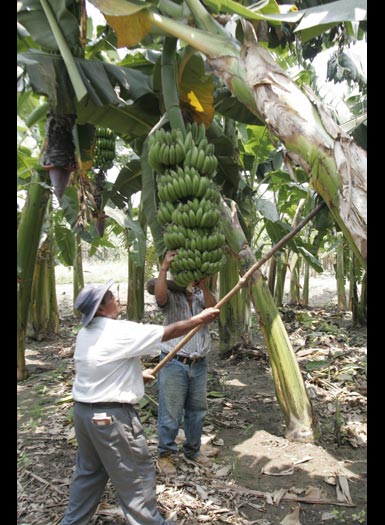
Each plant produces what banana growers call a single “bunch” [shown here]. The attached half-dozen bananas we buy in a supermarket is known to banana growers as a “hand.” A single banana is referred to as a “finger.”
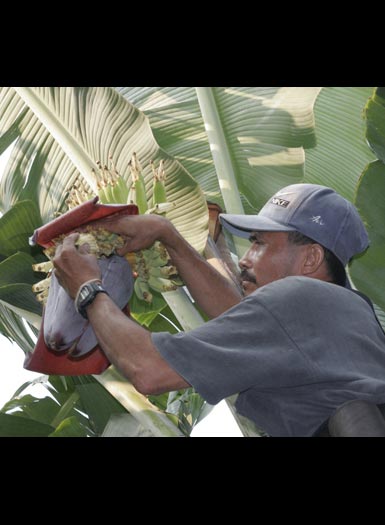
The average American eats 150 bananas a year—which is why a new fungus that threatens our supermarket banana (the variety is called the Cavendish) is alarming experts and prompting initiatives to develop new strains of banana that will resist the blight. The Honduran Foundation for Agricultural Investigation (FHIA) is a leader in the effort to create a Cavendish replacement through hybridization. Here, a FHIA worker stands on a ladder to fertilize one banana plant with the pollen of another plant. Today´s cultivated bananas do not reproduce without human intervention. New plants are grown from shoots of existing plants.
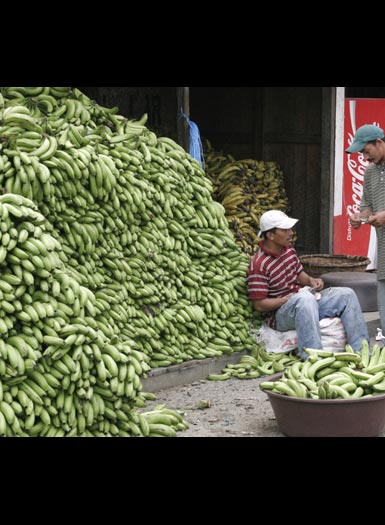
One of the many street vendors selling bananas in San Pedro Sula; the city is Honduras´s second largest, with a population of half a million people.
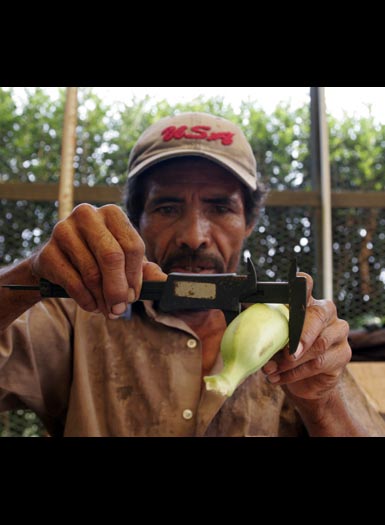
Taking measure of a fruit.
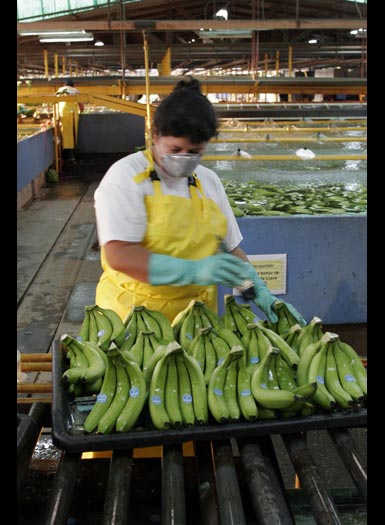
The final touch is the Chiquita seal.
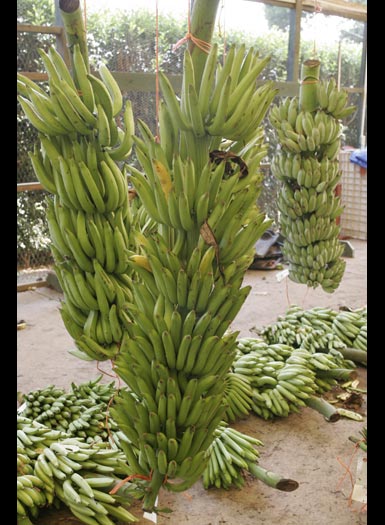
Because it is almost impossible to predict how new hybrids will look and taste, FHIA growers focus on volume, creating hundreds of new varieties.
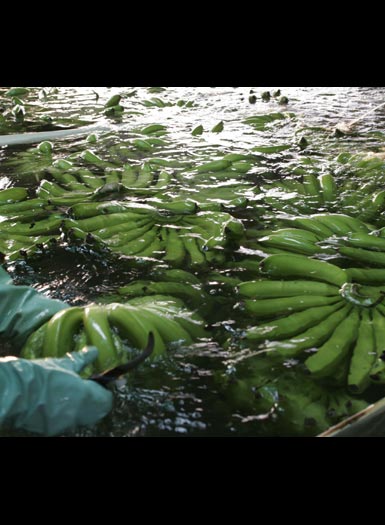
Before being packaged for shipping, supermarket-bound bananas are cut into smaller bunches and washed to remove dirt and pesticides.

Plantains [the larger fruit] and bananas [the smaller fruit on the far right] hang in the FHIA facility, where workers study would-be successors to the Cavendish.
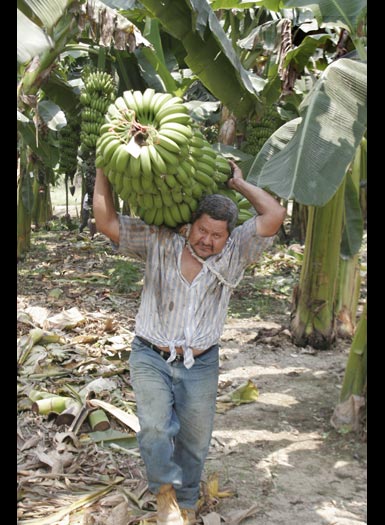
To transport the heavy load, the worker wears a pad on his shoulder.
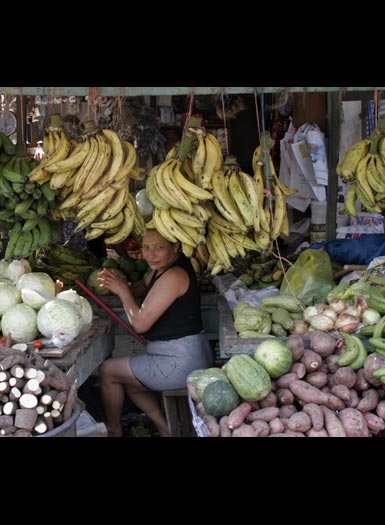
Local Honduran businesses sell far more plantains than bananas. The great majority of Cavendish bananas grown in Honduras are bound for export; the country is the world´s third largest banana producer.
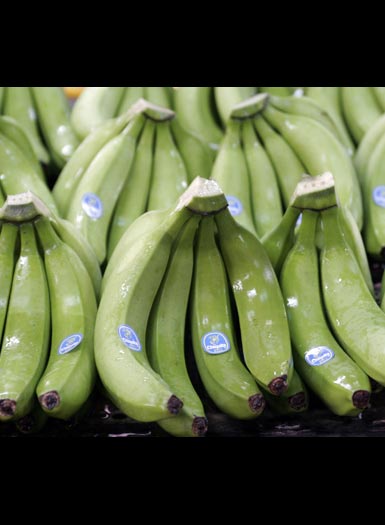
“Quite Possibly the World´s Perfect Food?” At least for now.