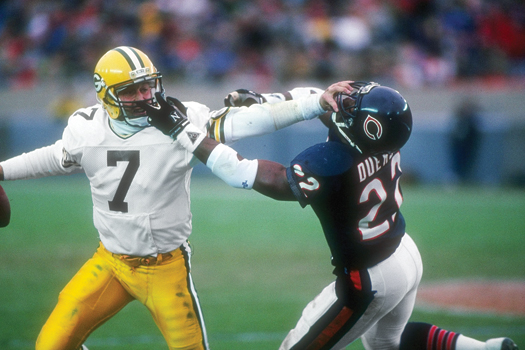
On August 19, 2012, in week two of the NFL preseason, Indianapolis Colts wide receiver Austin Collie ran 17 yards out from the line of scrimmage, cut right toward the center of the field, caught a pass, and was immediately tackled by Pittsburgh Steelers cornerback Ike Taylor. As Taylor came in for the hit, his football helmet appeared to glance off the left side of Collie’s helmet. Then the cornerback wrapped his arm around Collie’s neck and jerked the receiver’s head to the right. An instant later, Steelers linebacker Larry Foote came barreling in from the opposite side and slammed his elbow into the right side of Collie’s helmet. As the receiver fell to the ground, his helmet first hit Foote’s knee and then struck the ground face-first.
Collie sat up, dazed, and had to be helped off the field a minute later. He didn’t return to play for three weeks. The diagnosis: concussion. It wasn’t the first time Collie had suffered what’s clinically called a traumatic brain injury. On November 7, 2010, he spent nearly 10 minutes lying motionless on the 34-yard line after being hit in the head almost simultaneously by two Philadelphia Eagles players. Medics carried him off the field on a stretcher. In his first game back, two weeks later, he left in the first quarter with another concussion. He missed three more games, only to suffer yet another concussion on December 19, which ended his season.
Professional football players receive as many as 1,500 hits to the head in a single season, depending on their position. That’s 15,000 in a 10-year playing career, not to mention any blows they received in college, high school, and peewee football. And those hits have consequences: concussions and, according to recent research, permanent brain damage. It’s not just football, either. Hockey, lacrosse, and even sports like cycling and snowboarding are contributing to a growing epidemic of traumatic brain injuries. The CDC estimates that as many as 3.8 million sports-related concussions occur in the U.S. each year. That number includes not only professionals but amateurs of all levels, including children. Perhaps most troubling, the number isn’t going down.
In the past two years, the outrage surrounding sports-related concussions has mounted. In January 2011, Senator Tom Udall (D-NM) called for a Federal Trade Commission investigation of the football helmet industry for “misleading safety claims and deceptive practices,” which the agency is currently pursuing. In June 2012, more than 2,000 former NFL players filed a class-action suit against the league as well as Riddell, the largest football-helmet manufacturer and an official NFL partner, accusing them of obfuscating the science of brain trauma. The litigation could drag on for years and cost billions of dollars.
The real issue is that lives are at stake. In 2006, this fact became tragically clear when former Philadelphia Eagles star Andre Waters committed suicide by shooting himself. Subsequent studies of his brain indicated that he suffered from chronic traumatic encephalopathy (CTE), a form of brain damage that results in dementia and is caused by repeated blows to the head. A sickening drumbeat of NFL suicides has followed, including former stars Dave Duerson, Ray Easterling, and Junior Seau, who by one estimate suffered as many as 1,500 concussions in his career.
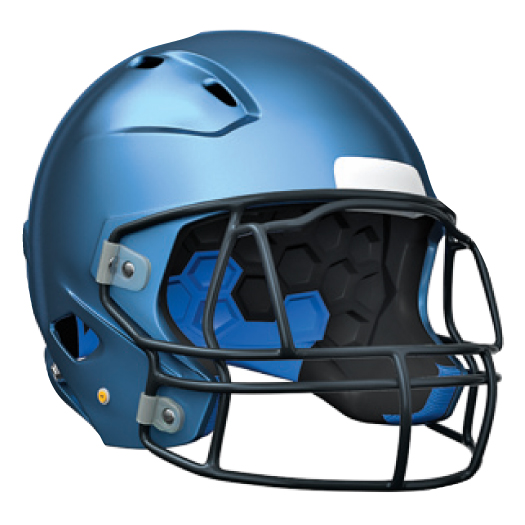
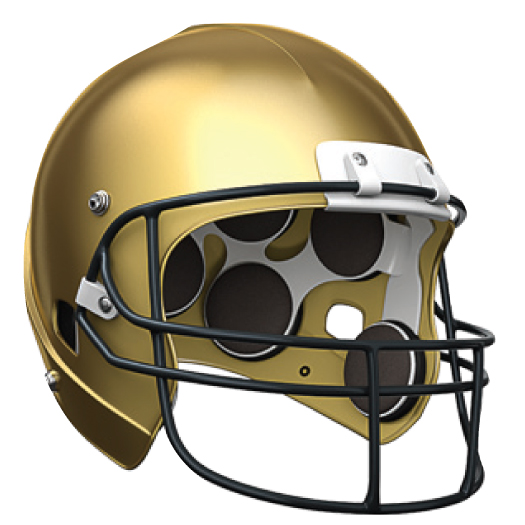
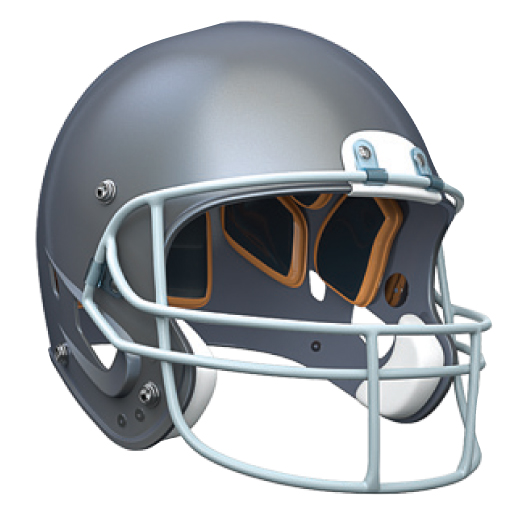
For equipment manufacturers, the demand for protective headgear has never been greater. Leading companies, as well as an army of upstarts, have responded by developing a number of new helmet designs, each claiming to offer unprecedented safety. The trouble is that behind them all lie reams of conflicting research, much of it paid for, either directly or indirectly, by the helmet manufacturers or the league.
For players or coaches or the concerned parents of young athletes, it’s hard to know whom to believe. And despite all the research and development, and the public outcry, the injuries just keep coming. What makes the situation even more tragic is that a helmet technology already exists that could turn the concussion epidemic around.
THE TROUBLE WITH CONCUSSIONS
To understand why current helmets aren’t better at reducing concussions, consider the nature of the injury. A concussion is essentially invisible. Even the most advanced medical-imaging technology isn’t sensitive enough to show the physical manifestations, the damaged brain tissue. Diagnosis, then, is based entirely on symptoms and circumstances. Is the patient dizzy or confused, or was he briefly unconscious? Does he have a headache or nausea? Does he remember what happened, and did it look like he got hit in the head really hard?
Even if doctors could reliably diagnose concussions, identifying the injury does little to protect against it; for that, scientists need an accurate picture of what’s happening inside the head. For generations, doctors believed that concussions were a sort of bruising of the brain’s gray matter at the site of impact and on the opposite side, where the brain presumably bounced off the skull. The reality is not nearly that simple: Concussions happen deep in the brain’s white matter when forces transmitted from a big blow strain nerve cells and their connections, the axons.
To understand how that happens, it’s important to recognize that different types of forces—linear and rotational acceleration—act on the brain in any physical trauma. Linear acceleration is exactly what it sounds like, a straight-line force that begins at the point of impact. It causes skull fracture, which makes perfect sense: You hit the bone hard enough, it breaks.
Rotational acceleration is less intuitive. It occurs most acutely during angular impacts, or those in which force is not directed at the brain’s center of gravity. You don’t have to know much about football or hockey to realize that rotation is a factor in a whole lot of hits. “Think about it,” says Robert Cantu, a neurosurgeon at Boston University School of Medicine and the author of 29 books on neurology and sports medicine. “Because most hits are off-center and because our heads are not square, most of the accelerations in the head are going to be rotational.”
Further complicating matters, the human brain is basically an irregularly shaped blob of Jell-O sitting inside a hard shell lined with ridges and cliffs. After a football tackle or a hockey check, that blob moves, and does so in irregular ways. “Rotational forces strain nerve cells and axons more than linear forces do,” Cantu says. “They’re not only stretching, but they’re twisting at the same time. So they have a potential for causing greater nerve injury.”

So what’s the problem? If scientists know that a concussion is nerve strain caused largely by rotation of the brain, why can’t they figure out a way to stop the rotation?
Just as the actual injury isn’t visible to medical imaging technology, the rotation that causes the injury isn’t measurable in impact conditions; scientists cannot be inside an athlete’s brain measuring its movement. But in a grisly 2007 study, researchers at Wayne State University in Detroit used a high-speed x-ray to observe the brains of human cadaver heads fitted with football helmets and struck from various angles. The research, corroborated by computer models, showed that the brains moved very little—just millimeters. Yet those small movements are enough to cause nerve strain and affect neurological function.
Making things even more difficult is that every brain is different. Young brains respond differently than older brains, female brains differently than male. Researchers have also found that weaker, subconcussive hits can have a cumulative effect over time and lead to CTE, which is likely the cause of many former-player suicides. But how many hits it takes, and what kind, is unclear—and the condition can’t be diagnosed while the player is alive. Only when his brain is cut open can researchers spot the dead zones in the tissue.
The scientific ambiguity surrounding concussions clearly impedes the development of better helmets. But there’s another reason helmet technology hasn’t improved, one more troubling than gaps in our knowledge: a self-regulated industry governed by badly outdated safety standards.
40-YEAR-OLD STANDARDS
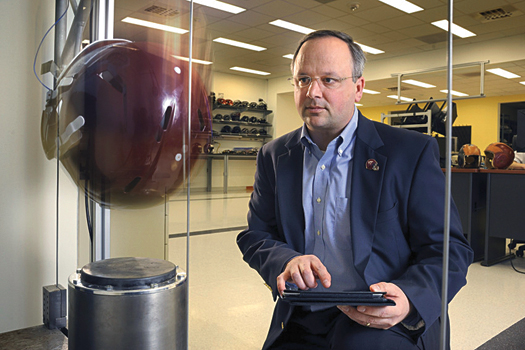
Picture the head of a typical crash-test dummy, the kind you see in car commercials. It’s attached to a rigid metal arm that hangs above a cylindrical anvil topped with a hard plastic disc. A lab technician straps a football helmet to the headform, cranks the arm up to precisely five feet above the anvil, and lets it drop—crack. Inside the dummy head, an accelerometer positioned at the center of gravity records the linear acceleration transmitted during impact. This brutish trial is called a vertical drop test, and it’s the basis for how all football helmets are certified safe by the National Operating Committee on Standards for Athletic Equipment (NOCSAE), an association funded by equipment manufacturers, which in turn funds much of the research on sports-related head trauma. The standard has remained largely unchanged since its creation in 1973.
Now think back to Austin Collie’s concussion in August 2012—the jerking of the head after the initial hit, the collisions with Larry Foote’s elbow and the ground. Those impacts don’t look much like the straight-line force of the NOCSAE drop test. And that brings up a very important question, perhaps the central question scientists and helmet makers are trying to solve today: Is the linear acceleration measured by a drop test correlated to rotational acceleration, and if so, by how much?

Untold lives and billions of dollars in sales, medical fees, and litigation costs could depend on a clear answer. If the relationship between the forces is strong, the key to reducing rotational acceleration is the same as reducing linear acceleration: Add more padding. Clearly helmet manufactures would prefer such a simple solution. If the connection is weak, however—or at least weak in the most dangerous hits—more padding will do little to reduce concussions, and companies will need to rethink current designs entirely, a very costly endeavor.
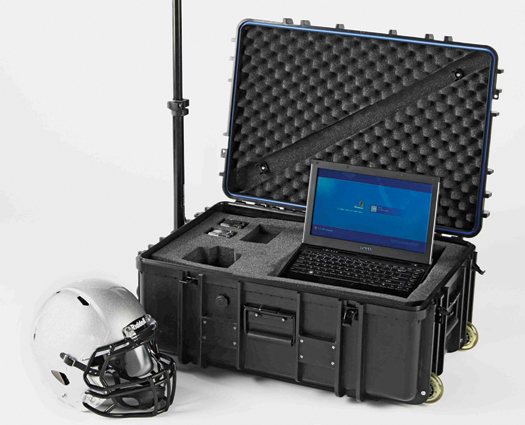
In 2003, a New Hampshire–based company named Simbex introduced a research tool called the Head Impact Telemetry System (HITS). Among other things, it seemed to have the potential to answer the question of correlation. HITS is an array of six spring-loaded accelerometers positioned inside a helmet to record the location and severity of significant impacts. After any hit over a certain threshold, the system beams the data to a companion device on the sidelines. Coaches can monitor players in real time, and researchers get reams of real-world data to dig through. Stefan Duma, the founding director of Virginia Tech’s Center for Injury Biomechanics, is among those working with HITS data; at his urging, every player on the university’s football team wears a HITS-equipped helmet. After analyzing data from two million impacts, Duma says there is a clear and strong connection between linear and rotational forces.
Unfortunately, other researchers say it’s not that simple. The correlation is high if you look at all hits, they say, but it falls apart when you look at highly angular ones—the hits that carry a greater risk of concussion. “Take an extreme example,” says Boston University’s Cantu. “If you impact the tip of the face mask, if you have another player coming at it sideways, you’re going to spin the head on the neck and have very low linear acceleration and very high rotational acceleration.”
Indeed, for every advocate of the HITS data, there exists an equally vocal critic. They say that helmets deform under the force of a 250-pound linebacker, skewing data. They say the HITS algorithm that calculates rotation is flawed. They point out that the founder of HITS is a co-author on all the published studies that validate the system. Blaine Hoshizaki, a biomechanics professor at the University of Ottawa whose research focuses on angular hits, sounds exasperated when I ask him about Duma’s findings. “You’ve got to look at the events that are really contributing to concussion,” he says. “It may be that in 1,000 hits, only 50 are highly non-centric, but maybe those 50 are the most dangerous—and that’s what our data shows.”
In essence, the system created to answer questions about concussions has raised a lot more questions. The resulting confusion sets off a cascade of effects. Unclear science makes for unclear standards, and unclear standards leave a lot of room for interpretation. The impact on the helmet industry is conspicuous: It’s become a free-for-all.
THE HELMET ARMS RACE
In December 2010, a longtime auto-racing safety equipment maker named Bill Simpson happened to attend one of the Colts games in which medics helped Austin Collie off the field after a concussion. Following the incident, Simpson asked the Colts’ offensive coordinator, a friend, what had happened to his receiver.
“Oh, that’s just part of the game,” the coach said.
Simpson saw an opportunity. In auto racing, he’s known as the Godfather of Safety, and once set himself on fire to demonstrate the efficacy of one of his racing suits. He figured he could make a better football helmet, so he got to work in his Indianapolis warehouse. By 2011, several pros, including Collie, were wearing early experimental versions of Simpson’s helmet.
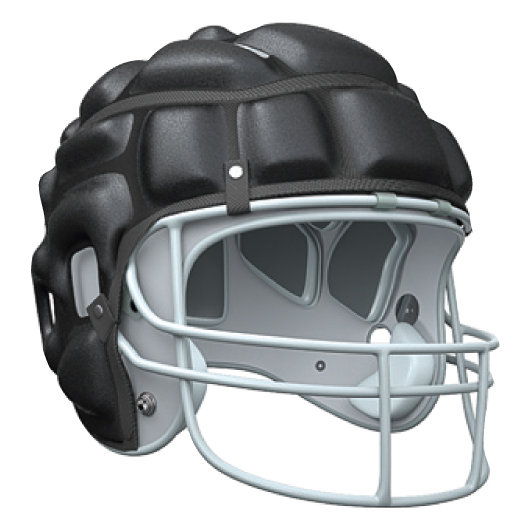
That an individual inventor could develop, produce, and deliver a product into the hands of professional athletes speaks to the upheaval in the world of helmet manufacturing. What was once a rather staid industry dominated by a few large companies has now grown to include an increasing number of upstart firms, serial entrepreneurs, and individual inventors. The result has been a proliferation of new designs. Mainstream helmet makers have stuck with variations on previous models: polycarbonate shells filled with various densities and thicknesses of padding. Newcomers have developed more creative, albeit less rigorously tested, approaches. Perhaps the best-known is the bizarre-looking Guardian Cap, a padded sock that slips over a typical helmet. Another approach that received a lot of attention in 2011, the Bulwark, came from the workbench of an aerospace engineer and self-professed “helmet geek” in North Carolina; it had a modular shell that could be configured to match the demands of different players. It never made it out of prototype stage.
For his part, Simpson officially launched his SGH helmet in October 2012 to immediate fanfare. Sports Illustrated “injury expert” columnist Will Carroll tugged one on and had someone whack him over the crown of the head—a strong, almost purely linear force. He reported not feeling much at all. His conclusion: This helmet must work.
When I called Simpson to discuss the helmet and ask how it reduces the forces responsible for concussion, he mentioned that none of the neuroscientists he’s spoken with have been able to tell him what forces actually cause a concussion. “How do you know you’re stopping the right forces, then?” I asked him. “If you don’t know what’s causing a concussion, how can you prevent it?”
“You’re asking me a lot of questions that are pretty off the wall, my friend,” he said. “A lot of questions I can’t answer.” He explained that his helmet uses a composite shell made of carbon fiber and Kevlar, plus an inner layer of adaptive foam made of Styrofoam-like beads. It performs better in a NOCSAE-style drop test than anything else on the market, he said.
“Does it specifically address rotational acceleration?” I asked.
He laughed. “No helmet does that.”
I tried a more direct approach: “Can you make claims about concussion reduction with your helmet?”
“Oh, hell no,” he said, “I would never make a claim about that.”
The NFL, at least since Congress took an interest, has gotten serious about sorting out who is claiming what—or not. “There is not a week that passes that I don’t see a new device,” says Kevin Guskiewicz, a University of North Carolina sports medicine researcher and MacArthur Genius Grant recipient who also chairs the NFL’s Subcommittee on Safety Equipment and Playing Rules. “There’s a binder weighing down the corner of my desk. I don’t think you’re going to see the NFL flat-out endorsing a product, but they certainly feel that they’re responsible for trying to help prevent these injuries. So we’re going to be reviewing these technologies in order to say, here are three or four that need to be studied further.”
The boldest claim from mainstream helmet makers comes, perhaps not surprisingly, from Riddell. The company’s newest helmet, the 360, builds on a system called Concussion Reducing Technology (CRT), which it first launched in 2002. According to a highly adrenalized promotional video, which has since been removed from the Riddell website, engineers designed CRT in response to an NFL-funded study by a Canadian research lab called Biokinetics. Researchers looked at film from actual NFL hits that resulted in concussions and attempted to map their location, distance, and speed. The two main findings: that rotational acceleration is a major factor in concussions, and that players get hit a lot on the side of the head.
In response to the study, the designers developing CRT added energy-attenuating material (extra padding) to side- and front-impact areas. They also increased the overall dimensions of CRT-equipped helmets by a few millimeters to allow for still more padding. The designers of the 360 built on the CRT but went a step further, adding an even greater amount of padding to the impact areas. It wasn’t clear to me how those changes addressed rotation—the single greatest factor in the concussions that CRT and the 360 helmet meant to reduce. So I asked Riddell’s head of research and development, Thad Ide. “Well, in many cases the linear acceleration and the rotation that linear imparts go hand in hand,” he said, echoing Duma’s HITS findings at Virginia Tech. “Reducing linear forces will reduce the rotational forces.”
So the question remains: If addressing linear force is the key, and better padding is the way to do that, then why hasn’t the number of concussions decreased? “You haven’t seen it change because [the helmet makers] haven’t addressed it,” says the University of Ottawa’s Hoshizaki.
A NEW HOPE
In a small room off the basement garage of a building on the outskirts of Stockholm, an entirely different kind of helmet test is taking place. Peter Halldin, a biomechanical engineer at the Royal Institute of Technology, is strapping a helmet onto a dummy head affixed to a custom drop-test rig. Rather than slamming a helmet into a stationary anvil, as in the NOCSAE test, Halldin’s rig drops it onto a pneumatic sled that moves horizontally. By calibrating the angle of the helmet, the height of the drop, and the speed of the sled, Halldin says he can more accurately re-create the angular forces that result in rotational acceleration than other labs can. Within the dummy head, nine accelerometers measure the linear force transmitted during impact; a computer nearby calculates rotational acceleration from that data.
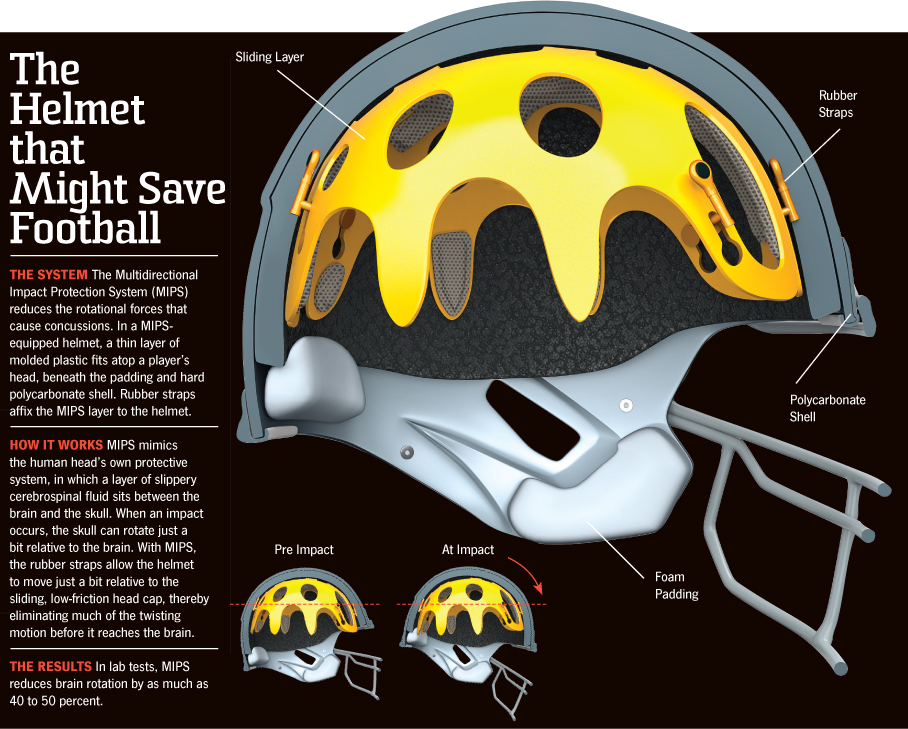
Today Halldin is testing two ski helmets that are identical except for one thing: Inside one, a bright yellow layer of molded plastic attached with small rubber straps sits between the padding and the head. This is the Multidirectional Impact Protection System (MIPS), which is also the name of a company he co-founded. Halldin spends about half of his time as CTO of MIPS and the other as a faculty member of the Royal Institute.
The idea behind MIPS is simple: The plastic layer sits snugly on a player’s head beneath the padding. By allowing the head to float during an impact, MIPS can eliminate some of the rotational force before it makes its way to the brain.
First up in Halldin’s test is the non-MIPS helmet. Halldin flips on a high-speed camera and steps back from the impactor, ready to catch the helmet on its rebound. “Five, four, three, two, one…” There’s a loud clattering as the sled shoots forward at 22 feet per second and the helmet drops to meet it at 12 feet per second—crack.
I can see on the computer that the head sustained about 170 Gs of linear force, and it rotated 14,100 radians per second squared (the standard scientific metric for rotation). It’s a big hit, one that would probably result in a concussion or worse.
Now comes the second helmet. Every variable is the same as in the first test except for the addition of the low-friction MIPS layer. “Five, four, three, two, one…”—crack. This time the computer shows rotation of 6,400 radians per second squared, a 55 percent reduction.
Halldin starts in on a detailed explanation of the effects of multiple impact tests on the performance of a helmet over time, but I interrupt: “How would you characterize that test result?”
He looks at the colorful graphs on the computer screen again. If the test dummy were a football player, he would have just walked away from a game-ending impact without a concussion. Halldin smiles just a bit, and permits himself a very un-Swedish boast. “I would say that’s f––king amazing.”
Halldin is careful not to claim the MIPS system can create those kinds of results in all impacts in all helmets. But, he says, “we can reduce rotation in all directions, and it’s significant in most directions. We might get 35 percent in one direction, 25 percent in another direction, and 15 percent in another. And hopefully the 15 percent is not in the most common impact direction for that sport.”
MIPS is not new: The company’s roots go back to 1997, when Hans von Holst, a neurosurgeon at Stockholm’s Karolinska Hospital (the same hospital that adjudicates the Nobel Prize for medicine), got tired of seeing patients come in with brain injuries from hockey and other sports, and decided to do something about it. He joined up with Halldin at the Royal Institute, and together they spent the next 10 years studying traumatic brain injuries.
Rotational forces quickly became their focus, and eventually they came up with the idea for MIPS. The first product was a complete helmet, designed for the equestrian market. Although the helmet was well received, the team quickly learned that a smart concept in the lab doesn’t easily translate into a successful product launch. Production problems and quality-control issues led the team to rethink their strategy and hire a new CEO, an experienced Swedish executive named Niklas Steenberg. Steenberg took a look at the situation and decided that, like airbags in cars or Intel chips in laptops, MIPS was not an end-market product. Instead they would focus on licensing it to existing helmet companies so those manufacturers could improve their own products.
Since then, MIPS has licensed its sliding low-friction layer to about 20 helmet manufacturers, for sports from snowboarding and skiing to cycling and motocross. Recently, Steenberg decided, the company was ready to start hunting the big game—first American hockey and then the biggest of all, football.
FOLLOW THE MONEY
One would think the Riddells of the world would fall all over themselves to license or create something like MIPS, a simple product that directly addresses a critical factor in concussions and incorporates easily into existing helmet designs.

“I thought we’d have people hugging us, saying, ‘Thank you!’ ” says Ken Yaffe, a former NHL executive who left the league in March 2012, after 19 years, and signed on with MIPS to help them get an audience with U.S. manufacturers. But after nearly a year of squiring Steenberg and Halldin around to different companies, he says, “we’ve been met with skepticism.”
One of the reasons, Yaffe suspects, is that current safety standards don’t require the companies to do anything more than what they’re already doing. It’s a criticism privately echoed by most helmet researchers: Simplistic certification standards provide convenient legal cover for the manufacturers. If NOCSAE certifies a company’s helmets as safe, then the company has less risk of being held responsible for injuries. On the other hand, if that same company goes above and beyond the standards, it could put itself at risk of getting sued: Suddenly all of its existing helmets would appear to be inadequate, and worse, the company might have to admit knowing that they fell short.
Duma, of Virginia Tech, points to NOCSAE’s industry funding to explain how such a situation has persisted in football. “Follow the money,” he says. “Imagine if Ford were the only organization testing its cars, and it was saying that every one got the top rating. It’s a very unusual arrangement.”
To Steenberg, the MIPS CEO, the situation is both harmful and backward. “If something is available that makes your helmet more safe, you should be held liable for not using it,” he says. It’s not the first time a new safety technology has faced such a paradox. All too often implementation hangs on the grim calculus of whether the cost to industry of adopting a safety measure is more or less than the cost to the public of going without it. When liability enters the equation, lawyers and judges and lawmakers get involved, and even the most urgent matters can end up mired in argument. For example, it took more than a decade to legislate seat belts as standard equipment in automobiles. It’s worth noting that the two companies that first popularized and implemented seat-belt standards were Saab and Volvo, both Swedish.
Change is on the horizon, though. The University of Ottawa’s Hoshizaki has a grant from NOCSAE to develop a new standard that incorporates rotation. “I want to be fair to the manufacturers,” he says. “If they could make a safer helmet, they would. I don’t think they are against it; they’re just making sure they don’t cross that line and say, ‘Yeah, we should be managing rotation,’ because that would bring up liability issues.” With a new standard, that roadblock could vanish.
One enterprising company has already launched a product to directly address rotational acceleration in another contact sport. In the summer of 2012, Bauer, the number-one helmet maker in ice hockey, released the Re-akt. Inside the helmet, a thin, bright-yellow layer of material sits loosely between the head and the padding, allowing the head to move a little bit in any direction during an impact.
Called Suspend-Tech, the layer appears, to the color, suspiciously similar to MIPS. In fact, during the development of the Re-akt, MIPS co-founder Halldin tested an early version on his impact rig at the Royal Institute. The stories diverge as to how that collaboration came about, and how Bauer came up with the idea for a sliding layer, but any questions that arise about intellectual property may not matter. Bauer’s Suspend-Tech is a significant debut: It is the first attempt by a mainstream company to include a rotational layer in contact-sports helmets. MIPS is betting that since one hockey manufacturer has embraced the idea, the rest of the field will start shopping for their own version. And that, in turn, could create enough momentum for MIPS to break into the football market.
In perhaps the most hopeful sign of all, the NFL acknowledges that MIPS-like products have the organization’s attention. Kevin Guskiewicz of the NFL’s safety equipment subcommittee says the league is already evaluating the concept. “We’re looking at it very seriously,” he says.
Meanwhile, as scientists do more tests and manufacturers bicker, 4.2 million people will suit up and play football this year, most of them children with still-developing brains. Every one of them needs a good helmet.
Tom Foster is based in Brooklyn, New York. This is his first story for Popular Science. It originally appeared in the magazine’s January 2013 issue.