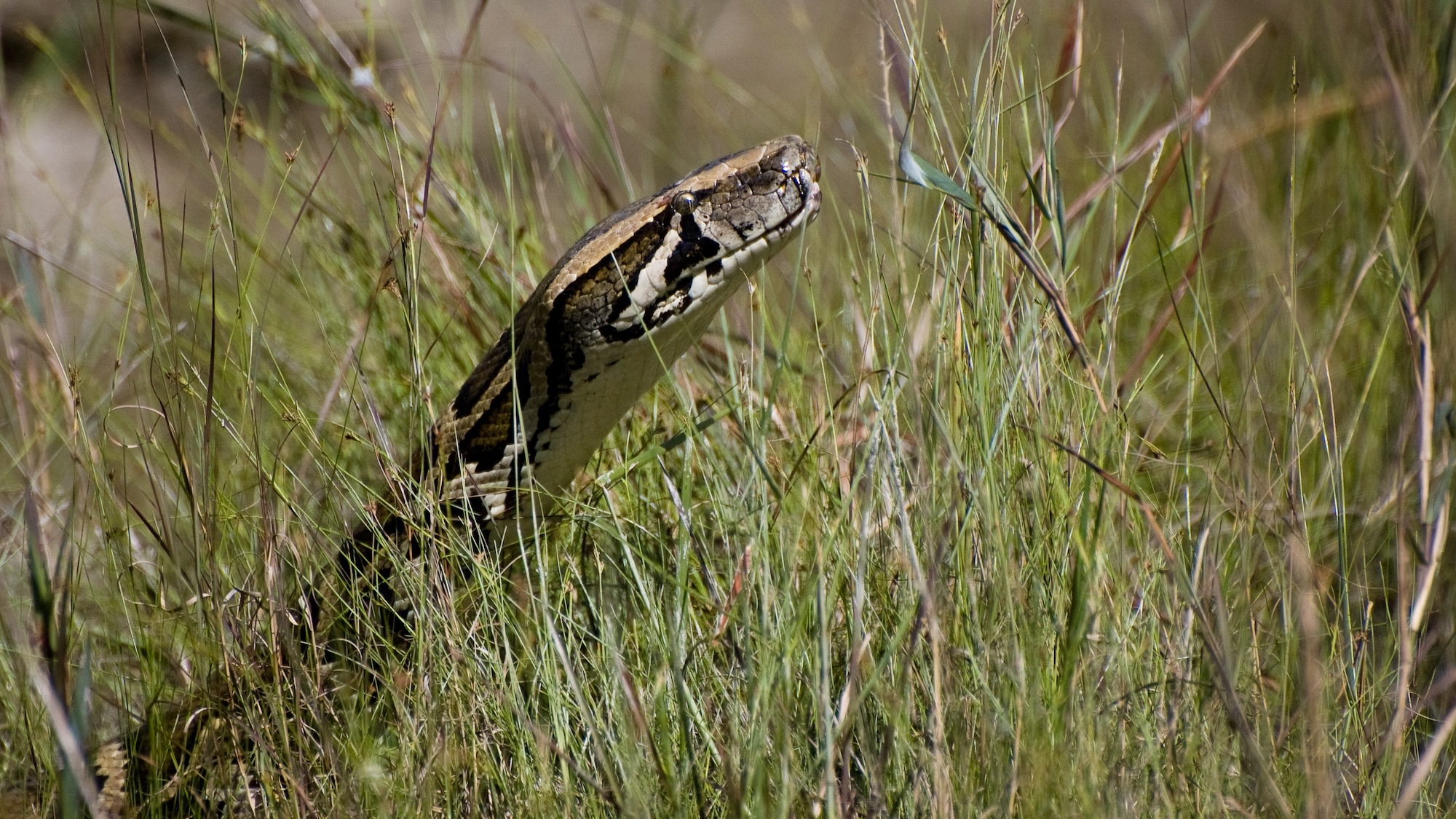
Florida’s war against the Burmese python (Python bivittatus) is still going strong, but you can do your part to battle one of the state’s most destructive invasive species. Earlier this week, Everglades National Park announced it is once again teaming up with local organizations for this year’s Florida Python Challenge.
The task is straightforward enough: From July 10–19, participants are encouraged to trap and humanely dispatch as many snakes as possible. The pythons must then be deposited at one of the competition’s designated check stations within 24 hours, at which point they’re measured and added to the hunter’s overall tally. At the end of the 10 days, prizes are awarded to the participants who caught the most snakes and whoever bagged the longest serpents.
“Protecting Everglades National Park, one of the world’s most globally significant ecosystems, requires ongoing partnerships and community stewardship,” Everglades National Park superintendent Pedro Ramos said in a statement. “By engaging the public in science-based invasive species management, we are able to raise awareness and strengthen support for conservation across South Florida.”
Burmese pythons are native to southeast Asia, but arrived in the United States during the 1970s via the pet trade. After realizing the average adult python easily reaches 13-feet long, many unprepared owners in Florida eventually released their sizable mistakes into the wild. These first generations of snakes weren’t only perfectly suited for the state’s subtropical conditions—they faced zero competition from native predators and quickly rose to the top of the food chain.
Florida’s Burmese python population has skyrocketed since then, in the process decimating local wildlife and ecosystems. It’s difficult to put an exact number on them, but researchers previously estimated anywhere between 100,000 and 300,000 snakes slithering through the Everglades and surrounding regions.
Plenty of ongoing projects and experimental solutions are in the works, but one of the easiest ways to cull pythons remains simply going out and nabbing them. The first Florida Python Challenge took place in 2013 and again in 2016 before becoming an annual competition in 2020. Last year, 934 participants from across the U.S. and Canada participated in the challenge, netting a record 294 pythons in south Florida. A $10,000 first-place prize for the most pythons collected went to a competitor who slew 60 snakes in 10 days. The longest snake recorded was eliminated by someone in the “Novice” category. Although, whoever takes down a 15-foot-11-inch python probably wouldn’t count as an amateur to most people.
The Florida Python Challenge isn’t a free-for-all. The event implements strict rules, and any aspiring snake sleuths must pass an online safety course before heading out to predesignated hunting grounds. No firearms or trained hunting animals, either. Instead, challenge organizers recommend either air guns or pithing techniques, such as quickly impaling the snakes through the head.
For those of you who think you have what it takes to help curb a serious problem in an essential ecosystem—you’ve got at least a few weeks to start honing your skills.