
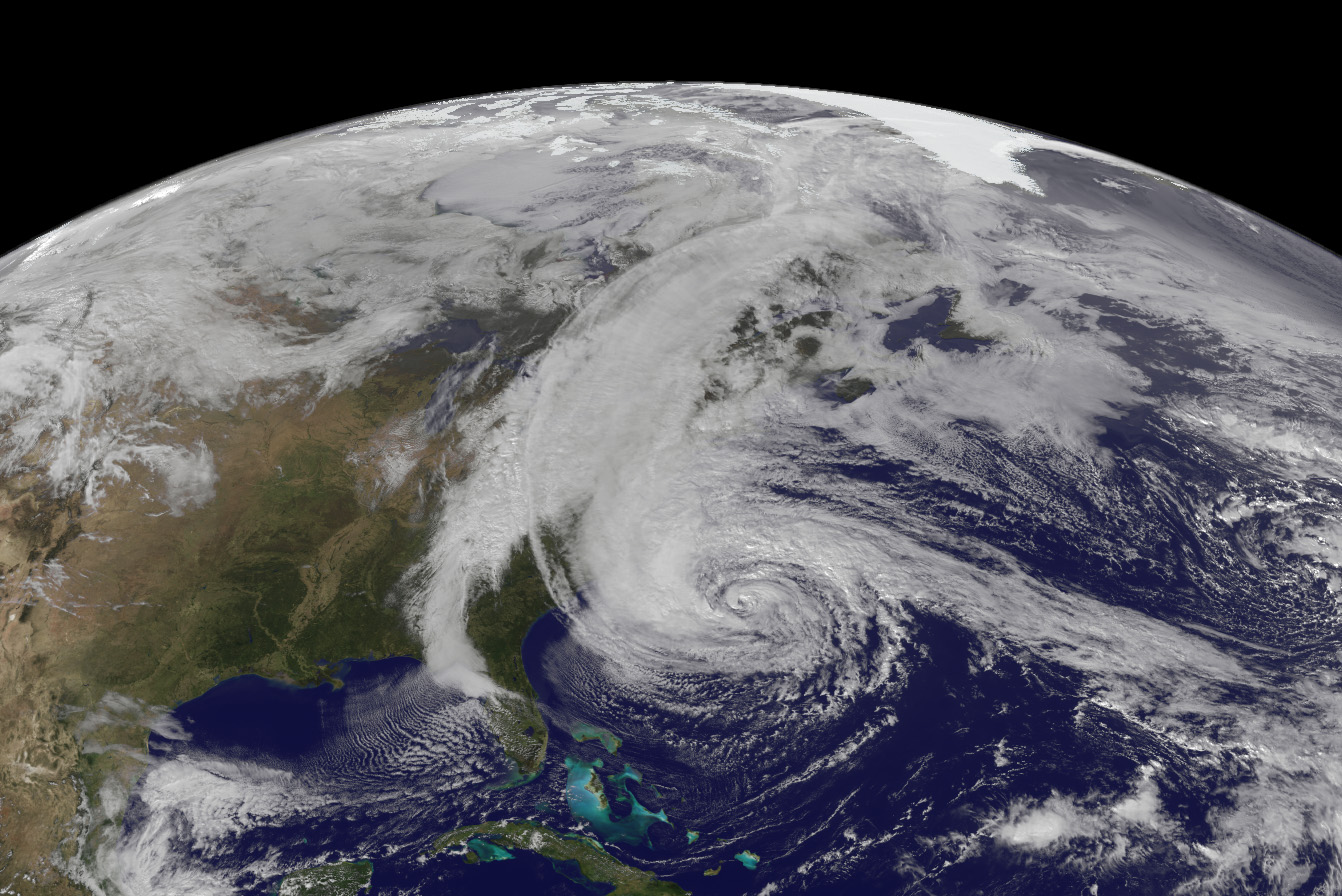
Superstorm [suːpər ˈstɔrm]
Here is a short list of major news organizations referring to Sandy as a "superstorm": The L.A. Times, CBS News, Time, The Guardian, Business Insider, the Toronto Star, and the Wall Street Journal.
Here's what Professor Alan Blumberg, professor of ocean engineering at the Stevens Institute of Technology and director of its Center for Maritime Systems, says a "superstorm" is: "It's a media invention. There's no real meteorological term called 'superstorm.'"
The storm we know as Sandy has gone by several different classifications. Storm classifications are fluid, just as the storms are: what is a Category 3 hurricane in one part of the world might be nothing but a cyclone by the time it reaches another part. "You typically talk about a storm's category depending on where you are," says Blumberg. Sandy was, according to the Saffir-Simpson Category Scale (that's the scale that decides what category a hurricane is, based mostly on wind speed), a Category 2 hurricane when it made landfall in Cuba, early on the morning of October 25th. But when it made landfall near Atlantic City, on the evening of the 29th, it was a tropical cyclone, due to its reduced strength from its trip up the coast. (Well, technically, it was a "post-tropical cyclone," as it had ventured out of the tropics but retained the wind speeds of a tropical cyclone.) A hurricane is a specific type of tropical cyclone, with sustained winds of at least 74 mph. The Sandy that reached New Jersey was not moving fast enough to retain its hurricane status, so it was a mere tropical cyclone.
It gets even more complicated when we talk about the storm that hit northern Appalachia in West Virginia, western Virginia, and central Pennsylvania. Sandy took an abrupt turn west and south after it made landfall in New Jersey, which means for those areas, Sandy was actually classified as a nor'easter (it was coming from the north and east, you see). So Sandy had lots of names. But none of them was "superstorm."
On October 29th, Fox News ran a story called "Hurricane Sandy: Five Reasons It's A Superstorm." The reasons are indeed valid reasons why Sandy is a very big and scary storm--the awful timing of high tide, arctic air coming down from Canada, that kind of thing. Mostly, the reason it feels okay to give Sandy this scary new name of "superstorm" is that Sandy merged with an unusually cold storm to its west which had been hurling early snows down on West Virginia, forming one giant storm that gave Sandy more power and also pushed it west--very unusual for a tropical cyclone, says Blumberg. So, two storms in one = superstorm, right? Well, no. A super storm, perhaps, as in a "very large or powerful" storm, but not a superstorm. There's no such thing as a superstorm.
But the phrase "superstorm" took off, perhaps because "post-tropical cyclone" sounds not as scary. And, in the defense of those repeatedly insisting on the superiority of this storm, it was a very awful and destructive weather system! You could make a reasonable argument that the term is descriptive or evocative rather than scientific, and you could make an argument that playing up the super-ness of the storm served the function of scaring people into protecting themselves. But it's important not to pretend scary-sounding words--or even silly words, like "Frankenstorm"--are scientific classifications. Sandy wasn't "downgraded from a hurricane to a superstorm." Sandy was never a superstorm. There are no superstorms.
Read more entries from the Dictionary of Hurricane Sandy here.

Five amazing, clean technologies that will set us free, in this month's energy-focused issue. Also: how to build a better bomb detector, the robotic toys that are raising your children, a human catapult, the world's smallest arcade, and much more.


Online Content Director: Suzanne LaBarre | Email
Senior Editor: Paul Adams | Email
Associate Editor: Dan Nosowitz | Email
Assistant Editor: Colin Lecher | Email
Assistant Editor: Rose Pastore | Email
Contributing Writers:
Kelsey D. Atherton | Email
Francie Diep | Email
Shaunacy Ferro | Email
@Dan Nosowitz:
Please have a conversation with your co-worker Dave Mosher, who wrote this drivel:
"Hurricane Sandy pummeled the eastern United States with unprecedented storm surges, rainfall, and howling winds Monday. Making matters worse: A cold front strengthed the cyclone into a snowy "Frankenstorm," ...." Etc. Etc.
http://www.popsci.com/environment/article/2012-10/5-climate-change-truths-about-hurricane-sandy#comment-148649
(Both articles are in the same edition of Popular "Science".)
Climate scientists may want weather annoucers to use an acurate term like "post-tropical cyclone", but these same annoucers also have to answer to their programming directors (who in turn have to answer to network excecutives and boards of directors ) for why their network show isn't pulling in the same ratings as their competitors, so a little hypebole is understandable, if not completely justifiable, in these situtations.
Not much of a source to cite for anything other than dingy design.
google it and you'll see how 'credible' it is
It looks like Stevens 'expertise' is in designing small boats
and engaging in questionable self dealings.
per wiki
In 2009, after a two-year investigation by the New Jersey Attorney General, Stevens and the attorney general filed competing lawsuits against one another.[68] The attorney general suit against Stevens, its then-president and chairman of the board of trustees alleged numerous claims involving breach of fiduciary duty and other causes of action primarily relating to financial practices and the financial management of the institute and the compensation and certain loan transactions involving the then-president.[69] The Stevens suit against the attorney general contended that she had overstepped her legal authority over a private institution, and sought that any case be pursued by confidential arbitration.[68] per wiki
Since I started with my online business I earn $62 every 15 minutes. It sounds unbelievable but you wont forgive yourself if you don't check it out. Buck6dotcom
The media and the public will continue to use terms like superstorm, frankenstorm or perfect storm to convey urgent meaning whenever the relevant scientific community is unwilling or unable. Calling that storm a post-tropical cyclone is worse than useless.
I do appreciate the effort to adress journalistic integrity. However... what person was actually fooled to believe "superstorm" is a scientific term? And how is "supersorm" remotely scary? To any reasonable person, a "superstorm" is cutesy word for a storm that is bigger or more powerful than the average storm. The only person that is going to be shocked or scared by "superstorm" is an astraphob, who is better off not reading any weather related news period.
Bottom line is that Fox News is not trying to pass "superstorm" off as a scientific term, and they are not misusing an actual scientific term. I think the Dan is getting riled up over his own misinterpretation of a no-so-clever embellishment.
If you are looking for an article that truly sacrifices journalistic integrity for shock value, you need to look no further than one of your fellow Pop Sci contributors:
http://www.popsci.com/technology/article/2012-07/working-assault-rifle-made-3-d-printer
What things are called matters. And all things being equal I'd prefer things were referred to by their correct names by as many people as possible. It helps provide consistency of communication and meaningfulness over time. And I also agree that "superstorm" should be kept in quotes to help remind people that it's not a meaningful term.
However, I'm pretty sure that the media whirlwind about the "superstorm" (not the "great big storm" or the "post-tropical cyclone") helped to get people to take the phenomenon seriously and hunker down. In fact, it probably saved lives. So...I'll cut them a little slack this time around.
> Not because it wasn't a "super" "storm," but because
> "superstorm" is an imaginary
Google shows 31 *MILLION* different webpages that say "superstorm" as one word, not two.
So PS doesn't care about the storm, people, death, injury or massive damage.... just so long as it's spelled as 2 words, not 1 word.
Sheezessss. That's what's important here????
It seems to me that with the current death toll, which is still climbing, the news media should be justified in using whatever scare tactics it can think of to convey the danger that people will face in an event like this.
I have a plan... catagorizing storms is for us right? Not the wind gods to skeep score right? Its to give us an idea of how much damage or how dangerous the storm could potentially be. So... here's a thought.... what if instead of just saying its a catagory 2 cuz of windspeed.... we do like the NFL and we give it an overall "quarterback rating" type thing.... example: if a storm has 90mph windspeed, storm surge is in the 15 foot range, and is moving into a heavily populated area that is not ready or is not built to withstand such a storm ... we say its a cat2/pfd6... as in "catagory" 2 and "potential for disater" 6.... The same storm making landfall in Miami may be a cat2/pfd2 lets say. Sandy, who combined with other factors making it a "superstorm" could have been a cat1/pfd7! Katrina cat2/pfd9! And a cat 5 storm out in the middle of the ocean that isnt going to make any landfall at all could be a cat5/pfd1.... so we can take into account not only windspeed, but many other factors into determining what warning should be given to a populace. I dont know about you but if there was a post-tropical cyclone with a pfd10 headed my way, I'd be outta there!!! Then again, if there was a cat2/pdf1 coming... i may not be in such a rush to leave. Meaning, even though its a more windy storm lol... the storm surge wont be so bad... and the city is built to withstand it... etc, etc... hence the low pfd. I dunno.... to me it makes more sense to rate the destructive potential. Useful information makes more sense to me.
Today's magic is tomorrow's technology.
While I totally agree that the media shouldn't be making up meteorological terms, Sandy was not a typical hurricane, and we need some kind of vocabulary to talk about that. To be fair, I have heard actual meteorologists saying that Sandy was 'well deserving of the super-storm classification.' (paraphrasing from an interview on DemocracyNow!)
The Saffir-Simpson hurricane scale categorizes hurricanes based solely on wind speeds, and does not take into account the scale of the storm, nor any other factors. Not only was Sandy an unseasonably late hurricane, reaching landfall at an uncommonly high latitude - it was, in fact, the largest hurricane in recorded history, by diameter. The other four largest hurricanes by diameter have all occurred within the last 16 years.
TL;DR: Sandy was the most a-typical hurricane in a group of a-typical hurricanes that did not exist before the 1990's. We really should create some vocabulary to talk about it, but that job should probably be left to actual scientists.