Star formation is now 30 times lower than at its peak 11 billion years ago.

Globular Cluster M10 NASA/ESA/Hubble Space Telescope

In its youth, the universe was a roiling soup of star ingredients, with new stars forming rapidly. But now it’s much quieter, and things are not expected to get more exciting anytime soon, astronomers say. For the first time, astronomers have figured out the universe's star-birth rate, and found that today, it's 30 times lower than its likely peak some 11 billion years ago. As a result, all of the future stars may be no more than a 5 percent increase above what we’ve got now.

Astronomers figured this out by taking snapshots of the universe at 2, 4, 6 and 9 billion years of age. (It’s 13.7 billion years old now.) The results show a clear decline in star-forming activity. A team led by David Sobral at Leiden Observatory studied the universe’s hydrogen-alpha emission line, which is a reliable indicator of star formation. They used Japan's Subaru Telescope and the United Kingdom Infrared Telescope (UKIRT) on Mauna Kea in Hawaii, and the Very Large Telescope in Chile, covering a huge portion of the sky.

The team’s observing area encompassed the largest sky samples ever, more than 10 times larger than any previous samples. Observing the cosmos at different ages--so at different distances--with the same observational technique provides an apples-to-apples comparison.

It turns out that half the stars in existence now formed more than 9 billion years ago, and it took just 2 billion years to form all of them. The other half took almost five times as long to produce. If this trend continues, the universe will only get 5 percent more stars, even if we wait forever, the scientists say.

“We are clearly living in a universe dominated by old stars. All of the action in the universe occurred billions of years ago,” Sobral said in a statement.

Better go enjoy them while we still can.
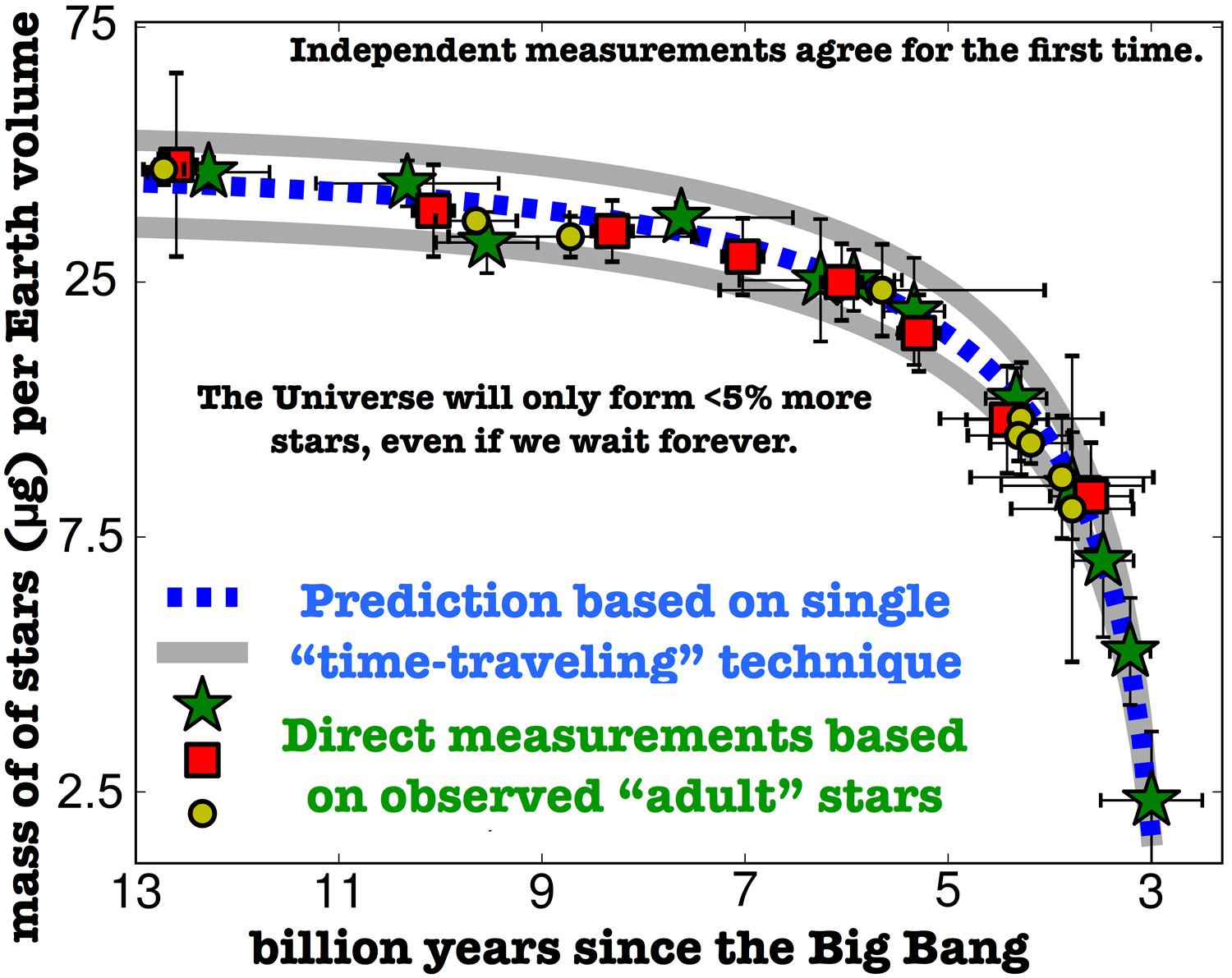
Star Formation Slowing Down: The single method used for tracking and studying galaxies revealed a continuous decline of star formation in the last 11 billion years. By using this method and the derived star formation history of the universe, it is possible to predict the total mass in stars and its distribution in the universe. The prediction fully agrees with independent measurements.  David Sobral/HiZELS

[NAOJ]

97 Comments

I'm aware that we've seen star deaths. But has there been a recorded observation of a star birth?

Further how is it that we've been able to maintain records from observations made 13.7 Billion years ago?

Finally what is the purpose of "just so" stories that are not falsifiable or repeatable?

Bagpipes is right! I ain't never seen a star bein' born so that means it must not ever happen! All the stars we see today were created by the Hand of God all at the same time and they will last forever! And man sprouted fully formed from the head of Zeus with a Bible in one hand and a spatchula in the other, with innate knowledge of language and farming and cooking on a gas grill.

@HBillyRufus

Mockery aside. Do you have a response?

While playground mockery does seem to be the only tool available to naturalists as scientific reasoning isn't their forte, I would like to know if there are any tests proposed by naturalists to show that stars can naturally form.

So far all I can see is that they have seen that there are stars, don't want to believe in a creator, so they make up a "just so" story to explain the stars, and insist that their circular reasoning of pointing back to their original observation (which their model was made to fit) some how proves their case.

having never seen a single star form how do you distinguish between an "adult" star and an "young" star? Are you sure it is a "young" star or just a different type of celestial body?

>Bagpipes100

There are (or rather were) several star forming regions in the cosmos, most of them are far away and hence in the past.

We can see the stars forming 13.7 billion years in the past by looking further away, actually about 13.7 billion light years away.

No idea what a "just so" story is.

Look up "pillars of creation" there are shots showing where stars are created. Also check out "protoplanetary disk" to see early formations of planets around young stars.

@Bagpipes

Actually we witness star births all the time, hundreds, maybe thousands, per year, and we only look at a very small section of the sky. So... yeah.....

Bagpipes100

The short answer to all of your questions: Astronomy.

The slightly longer version.

When you look at a galaxy billions of light years away, you are seeing it as it existed then, not as it exists now.

The light from a star tells you how far away it is, how hot it is, how big it is, what it is composed of, and how much fuel it has left. Astronomers have observed millions of stars in various stages of their evolution. With all that data, it's not hard to connect the dots.

http://news.yale.edu/2010/06/17/astronomers-witness-star-being-born

But, really, the universe we see wouldn't make much sense without new star formation.

http://www.ngawhetu.com/Resources/StellarEvolution/index01.html

But really, these are astronomy 101 questions you are asking. If you really want to know more about astronomy, take a class online or at your local community college.

Well about 13 billion years ago the creator introduced UNIVERSAL STARCARE and the numbers of new born stars increased dramatically. About 11 billion years ago the star counter in chief annoyed by the celestial proliferation forced universal insurers to provide free star birth control and the rest is history. Soon there will be plenty of space and no stars to enjoy it.

Ok, so I've been a lab assistant for an astronomy 101 class and I understand what all of you said.

But none of you answered what i was asking.

Has a star ever been observed to have formed?

You point a telescope at one point in space and note no star there. Later you observe the same point and there is a star there. Has this type of thing ever been observed?

Eternal return theory around and around we go where the universe stops no one knows. Everything is a cycle,if the stars end at once in the rip. God has the blueprints.

There is so much we don't know that I don't understand how we even dare to guess about what is out there, fourteen billion light years away. For all we know, right now ten billion light years away there is not another big bang happening. And we wouldn't know about it for another ten billion years. If a big bang happened once, it could happen again, and could have happen twenty billion years ago.

Bagpipes100: Who let you be a lab assistant in astronomy?
The short answer to you question is YES.
But stars are not being created in an instant. There is no way a person could look at at an empty piece of cosmos and BAM! a star forms.
Big gas cloud -> denser gas cloud -> hot dense gas cloud -> something we call a star. This takes a lot of time.

How is it possible to be a lab assistant in astronomy and not believe in star formation?! Is this how it is living in the US?

Sorry for my lacking English skills.

@Regen

Really? If they have observed what I asked, then please give me a citation.

Otherwise admit that it was not observed, but only inferred from a scientific model.

Bagpipes100:
Just check the wikipedia page or whatever, there are references to 34 other pages there you can read as well.

What kind of proof do you want? A time lapse movie of it? It cant be done since it takes so long time.

Have you ever seen an oak grow from seed to tall tree? But you still believe it does right? Since you have seen both seeds, tiny oaks, small oaks, medium oaks, big oaks and huge oaks. It's not hard to see?
Same with stars, it's not hard to find pictures of all the steps it takes for stars to form either.

EVERYTHING that takes longer then a lifetime to observe is inferred from a scientific model. Whats important is that we believe in the most probable one.

@ Bagpipes100

Here are five references and two Youtube vidoes about star formation. The process of star formation occurs on a time scale that is relatively very long compared to that of a human life.

The process has been observed at different stages and from this a model of how it happens was built. Given all the research that has been done in this area, I think the standing model of star formation is a creditable one.

“The Orion molecular cloud and star-forming region”
//adsabs.harvard.edu/full/1989ARA%26A..27...41G

“The Initial Mass Function in the Taurus Star-forming Region”
//iopscience.iop.org/0004-637X/580/1/317

“Star Formation in Galaxies Along the Hubble Sequence”
//arxiv.org/abs/astro-ph/9807187

“Chemical evolution of star-forming regions”
//www.annualreviews.org/doi/pdf/10.1146/annurev.astro.36.1.317

“Star forming regions”
http://adsabs.harvard.edu/abs/1988VA.....31..199K

“Stephan Hawking- the Birth of Stars”
//www.youtube.com/watch?v=9EnBBIx6XkM&feature=related

“Life Cycle Of A Star Video”
//www.youtube.com/watch?v=mzE7VZMT1z8

@Regen & matsci1

Do either of you understand the difference between "observation" and "inference"?

@Regen & matsci1

I asked if star formation was "observed" not if it had been "inferred". (simple "yes/no" type of question, with a if "yes" then give proof).

But now that you have stated that the objects we call "young stars" are just inferred to be so, and no new star has ever been observed to have formed, how is it not just circular reasoning?

You had an observation of a celestial body, you came up with a "just so" story about what it was and how it got there to fit some predetermined outcome. Now every time you observe something similar you scream "proof!"??

@Regen

BTW your analogy fails. I've planted seeds. I've watched single seeds go through those stages. That's repeatable, many people have done it.

Stars? Nobody has watched a single star go through all those stages as you so hesitantly (but finally) admitted.

You're comparing apples and oranges.

@Bagpipes100

I infer that you live in a small and boring world.

Do you honestly try to tell me you only believe in what you see? Doesn't get more egocentric than that?

@Bagpipes100
Oaks takes a long time, I doubt you have seen the whole cycle from seed to death.

Let me be the fist to actually say "Bagpipes youre a dumbass." Like a child that says "..but why? but why? but why?".

I can point to a number of things youve never seen happen and yet you still believe they do, as another poster suggested. In fact, we have seen the displacement of stellar gas from a forming star. The actual event was too cloudy to see directly but we have enough evidence. Youre a tool. Usually people who toss their resume out when questioned are lying anyways. I dont think anyone who works in Astronomy would ask such a stupid question. If you really do then youre obviously eccentric and annoy the crap out of others too. Either way, stop wasting our time.

Ive seen the video, others have seen it, I still have no reason to help you see it. I guess I have one more beautiful experience in my life that you dont? Sweet.

Enjoy the rest of your day. Hopefully it doesnt involve us proving to you that stars have a moment of creation. Your question is similar to : "Does a tree make a sound in the woods if no one is observing it?". Yes, it does. Standard physics don't stop working because no one is watching them work. Save your time and money for some science classes.

"Do not try and bend the spoon. That's impossible. Instead... only try to realize the truth. There is no spoon."

When you infer something you are drawing a conclusion from premises. In the field of science these premises are based on two foundations… theoretical or experimental. For the experimental premises, observations are made of the topic in question and are compiled into what is call “Empirical Data”…data derived through experiment.

When a sufficient amount of this data has been collected an inference is made about the behavior, origin, content…etc of the subject in question.

Observation and Inference are part of a process that has been come to be called the “Scientific Method”

How did I do Bagpipes100?

@D13
Thank you, I needed a closure.

Why do you people entertain this idiot? They are obviously exostential and the answer to this question will then lead to some sort of creationist proof of existence, beginning of the universe question, or that we are all some sort of hologram of non-reality. I already find them boring and their arrogance leads to suspicion that are not looking for answers, only looking to impart their view of reality. Waste of time.

"Do not try and bend the spoon. That's impossible. Instead... only try to realize the truth. There is no spoon."

Np, Regen. Call it early and save valuable seconds, minutes and hours of our precious lives. We look forward to real questions in the future Bagpipes.

"Do not try and bend the spoon. That's impossible. Instead... only try to realize the truth. There is no spoon."

@Bagpipes100
Have you ever seen the hour hand on a clock move?
Well you cant if you sit across the room and stare at it. All you know is it was here, and now its there.
It simply happens too slowly to be directly observed.
If you alter the time in which it happens by speeding up the clock, or change the space my moving closer to the hand, then it will be easy to see it move.
So even if you are immortal, unless you have a time machine it is pointless to watch a star birth from beginning to end.

Einstein was certain that one thing was infinite.
Nobody has ever been inclined to argue.

On a real note... the average life of "average" size stars in only about 11 billion years. THis would put a serious dimming to happen in the univers in about 2 -5 billion years. Little depressing.

"Do not try and bend the spoon. That's impossible. Instead... only try to realize the truth. There is no spoon."

@ D13

“Why do you people entertain this idiot?”

Bagpipes is relatively not sooooo bad…well..er…I make this inference form the observation of his comments on this post. There have been others that post on Popsci that you really need to read to believe.

However something that interests/amazes me is how far people can go in ignoring evidence/data that is in conflict with what they are putting forward as reality. People do it for different reasons. Politicians and sociologists are also included in this group.

Bagpipes100

I see. You think your questions are clever. You think you have unraveled the foundations of science. You have not. Your questions are akin to, "If the world is round, why don't we fall off?" or, "If we evolved from monkeys, why are their still monkeys?"

Your questions may endear you to your like minded bible school brethren, but in a science classroom, you are seen for what you are; a modern day flat-worlder.

@matsci1

Thanks for this reasonable response.
"When you infer something you are drawing a conclusion from premises. In the field of science these premises are based on two foundations… theoretical or experimental. For the experimental premises, observations are made of the topic in question and are compiled into what is call “Empirical Data”…data derived through experiment.
When a sufficient amount of this data has been collected an inference is made about the behavior, origin, content…etc of the subject in question.
Observation and Inference are part of a process that has been come to be called the “Scientific Method”
How did I do Bagpipes100?"

But it would lead me to ask this.

What experiments have been done in re-creating stars? (computer models don't count as they can only operate on the model they are based on and so may not reflect reality).

@D13

Could I suggest a quote to you?

"Do not try and bend the spoon. That's impossible. Instead... only try to realize the truth. There is no spoon."

That is to say, you might benefit from a little inquiry into "established" scientific models. After all Copernicus was right to question the models of his day.

@democedes

I'm sorry, did you have something to add to the conversation? Or are you just interested in name calling?

The experimentalists and the theoreticians work hand in hand. Maxwells equations (Derived by James Maxwell the Scottish mathematician) describing electrical and magnetic fields were based on the observations made by Michael Faraday. Science is always improving itself by refining its theories as more observations are made. If the theory does not fit the observation, it must be modified to do so…that is doing good science. On the other hand, when observations are changed, ignored or suppressed to fit a theory, then a swindle is afoot.

There have been experiments done to recreate the processes that drive the stars. This is the field of the plasma physicists and their goal of trying to harness fusion as an energy source on earth.

The ITER project is an example of this

www.iter.org/

www.youtube.com/watch?v=U67u5NLxMSY

Yawn.

"Do not try and bend the spoon. That's impossible. Instead... only try to realize the truth. There is no spoon."

@matsci1

I understand the scientific method. That's not the issue. The question is "Is the scientific method being followed?"

Observation/Formulate a question:

Yes. We see stars, it does lead to asking how do they form.

Hypothesis:

Yes. There are who knows how many hypotheses as to how this happens. (these are the models we use and we use hypothesis to make inferences about observations).

Prediction:

Yes. These get made.

Test:

Here's the break down. Who made a star in a jar?

@matsci1

Thanks for the link and comment. "There have been experiments done to recreate the processes that drive the stars. This is the field of the plasma physicists and their goal of trying to harness fusion as an energy source on earth."

But even if we wrapped our minds around the fusion process going on in stars, that wouldn't necessarily tell us how they formed. Nor confirm that our models for star formation are correct. What goes on in a star and how the star formed are different questions. It may be useful in refining the hypotheses about star formation, but star formation is one step back.

“Behind every man now alive stand thirty ghosts, for that is the ratio by which the dead outnumber the living. Since the dawn of time, roughly a hundred billion human beings have walked the planet Earth.

Now this is an interesting number, for by a curious coincidence there are approximately a hundred billion stars in our local universe, the Milky Way. So for every man who has ever lived, in this Universe there shines a star.

But every one of those stars is a sun, often far more brilliant and glorious than the small, nearby star we call the Sun. And many--perhaps most--of those alien suns have planets circling them. So almost certainly there is enough land in the sky to give every member of the human species, back to the first ape-man, his own private, world-sized heaven--or hell.

How many of those potential heavens and hells are now inhabited, and by what manner of creatures, we have no way of guessing; the very nearest is a million times farther away than Mars or Venus, those still remote goals of the next generation. But the barriers of distance are crumbling; one day we shall meet our equals, or our masters, among the stars.

Men have been slow to face this prospect; some still hope that it may never become reality. Increasing numbers, however are asking; 'Why have such meetings not occurred already, since we ourselves are about to venture into space?'

Why not, indeed? Here is one possible answer to that very reasonable question. But please remember: this is only a work of fiction.

The truth, as always, will be far stranger.”
― Arthur C. Clarke, 2001: A Space Odyssey

@ Bagpipes

"But even if we wrapped our minds around the fusion process going on in stars, that wouldn't necessarily tell us how they formed. Nor confirm that our models for star formation are correct. What goes on in a star and how the star formed are different questions. It may be useful in refining the hypotheses about star formation, but star formation is one step back."

That is where the inference from observation of many stars in their different stages of life comes in. I have nothing against the standing theory of stellar evolution.

Let me ask you this... how do you think that the stars formed?

Bagpipes100

"Who made a star in a jar?"

Is it required that every experiment be made by human hands?

Newton (arguibly one of the most influential scientists of all time) proved universal gravitation with mathmatics and obervational data of Haley's comet. This was 230 years before mankind ventured into space. Are you saying that Newton was not doing Science? Are you doubting gravity?

Surely in all this time in your Astronomy 101 lab you have heard the name Isaac Newton?

@democedes

"Is it required that every experiment be made by human hands?"

It depends. Is science based on the scientific method, or is science based on convenient "just so" stories?

And was I asking about or doubting gravity? I'm not sure how it's relevant to the discussion.

'course I heard of the discoverer of calculus. Who studies mathematics and doesn't hear about Newton? (Ok, so Fermat may have discovered calculus first...or that's how that debate goes).

@matsci1

"That is where the inference from observation of many stars in their different stages of life comes in. I have nothing against the standing theory of stellar evolution."

If that's what you choose to put your faith in, and you're honestly admitting it. Good for you.

"Let me ask you this... how do you think that the stars formed?"

To be honest I'm not settled on this. But given the practical limitations, I'm not sure it is even in the scope of what science can speak to at this time.

From this conversation here it would appear you might be the only person in this conversation who doesn't just blindly put their faith in a model for star formations just because some men in white coats say it is so.

I know of the debate about the discovery of calculus between Leibntz and Newton. Who is Fermat?

Bagpipes100

So universal gravitation is a "just so" story? Newton didn't make Halley's comet, moon, planets or the Sun. He didn't experiment with them. He used oberservations of those celestial bodies to confirm his hypothesis.

If you beleive astronmers need to make a star in a jar to prove stellar evolution, why isn't Newton heald to the same standard with universal gravitation?

@bagpipes100, what are you doing?

@bagpipes100, STAHP!

@matsci1

Ouch! you're right. Talk about brain farts. Thanks for the correction. I'll hold my head in shame now. :(

@democedes,

Are you putting words in my mouth? When did I doubt gravity?

It seems to me that experiments in gravitation are fairly repeatable, even to people w/o many resources. I fail to see how you are making this connection between the two subjects. Not that I'm interested in talking about gravity at this time.

@Army Juggernaut,

I'm asking questions. I'm sorry if that's not allowed in a scientific conversation. I figured it was.

Bagpipes how do you think the stars formed?

@matsci1

I already answered that.

"To be honest I'm not settled on this. But given the practical limitations, I'm not sure it is even in the scope of what science can speak to at this time."

@Bagpipes100

Have you ever heard of Occam's razor?
Maybe you should look into it, before you so hypocritically accuse others of so called "circular thinking."
Why are you so quick to pass judgement before you critically judge yourself?

You say you are not settled on it. That is not a problem in itself. What possible ways do you see that they can be formed?

Wow, lots of energy given to the eccentric. Bagpipes dont you hvae something better to do? Like maybe use a magnifying glass to look at pixels up close on your monitor or something? You will question everything, as I stated orginally. No one will prove you right or wrong without giving you a documentary of a star being born so... guess we all fall short of your exacting standards for proof. We all question, we all pull things apart and not take them at simple face value but this star birth isnt really a question in science. We know how they form, we have the math to show it and have models that grow stars in a similar fashion. Thats proof enough for most of us. Since your in the field of Astronomy I would think you have direct access to much better sources of information than popsci. So, why are you still here? Your witty question of "everything" are getting us know where. You have succeeded in wasting the time of many now. I'm sure a star was born while your lengthy disdain for rules and authority has been rambling on. One may dereive a great many questions from this article, like :

-How long before we see a steady decline in the brightness of our universe?

-How long before the cummulative resonant field of said stars fades?

-What part does that star energy play in the Higgs Scalar field that vibrates our tiny strings giveing things mass?

...but no, not your question. Yours goes to denying the existing deifnition of star formation. Pretty stupid. I don't care how much detail you put into the scientific questioning or methodology of scientific proof. WASTE OF TIME. Surely you have someone that you can impress that is near you? No?

"Do not try and bend the spoon. That's impossible. Instead... only try to realize the truth. There is no spoon."

This basically means humans are one of the youngest species in the universe!! We are learning how to crawl. One day we will fly.

@RonPielep

Did I present an alternative at this point in the conversation? If not, then prehaps the application of Occam's razor is not appropriate.

Have I used circular thinking? If not, then why have you accused me of being hypocritical?

Bagpipes100

I'm trying to show you that there are concepts at the foundation of science that were proven without direct experimentation. Newton's universal gravitation is a great example.

By Newton's time Galileo had already described gravity as it applied to objects here on Earth. Newtons law of universal gravitation was all about the movement of planets and comets. Newton didn't use data from experimentation. He used data from observations only.

Why doesn't universal gravitation qualify as "just so" non-science if there was no experimentation involved?

@D13

"Bagpipes dont you hvae something better to do?"

Does it matter? But it seams you don't have anything better to do.

" We know how they form, we have the math to show it and have models that grow stars in a similar fashion. Thats proof enough for most of us."

If you understood math better you wouldn't call it proof enough. Further, models are based on assumptions. They will always show what you program them to (whether or not it matches with reality). That's the nature of a mathematical model, which is why I wouldn't count a mathematical model as any kind of proof, but merely a way to generate new questions.

" Since your in the field of Astronomy I would think you have direct access to much better sources of information than popsci. So, why are you still here? "

How did you ever come to this conclusion? I said I was a lab assistant for an astronomy class while I was in undergrad. I never said I was in the field of astronomy. My degrees are in pure mathematics, one of the reasons I find your "proof" by mathematical model hilarious.

"You have succeeded in wasting the time of many now."

Again, if you're time is being wasted why respond? I can't force you to respond, even if I try to direct your responses to be part of a reasonable conversation.

If you feel that threatened by a math guy's questioning of the rational behind your beliefs, maybe you should work them out a bit more before just demanding silence?

@matsci1

Many I would assume would be the possibilities. But the question still remains how any of them fit the scope of what science can currently answer?

@democedes

"He used data from observations only."

Exactly. And we can still observe the effect of gravity on different objects.

But our observations are still things that aren't stars, and things that are, and we haven't observed a switch from a non star to a star yet. Infered? Yes. Observed? No.

Again I ask, how does gravity compare to star formation?

To further get rid of your example. We have since (even if Newton hadn't) done experiments to help confirm gravitation and they are possible to do today. They are in the scope of what is possible for science to speak on right now.

Bagpipes your name is quite fitting. Youre full of air.

"Do not try and bend the spoon. That's impossible. Instead... only try to realize the truth. There is no spoon."

@D13

"Youre full of air."

Says the guy who argues with the guy he keeps accusing of wasting everyone s time. If you feel your time is wasted, then save your breath.

@ Bagpipes

"Many I would assume would be the possibilities. But the question still remains how any of them fit the scope of what science can currently answer?"

"If you understood math better you wouldn't call it proof enough. Further, models are based on assumptions. They will always show what you program them to (whether or not it matches with reality). That's the nature of a mathematical model, which is why I wouldn't count a mathematical model as any kind of proof, but merely a way to generate new questions"

"My degrees are in pure mathematics, one of the reasons I find your "proof" by mathematical model hilarious."

I am starting to see a more philosophical thread in your statements. What is truth and how can we know it? Plato ( I think it was Plato) was asking the same and said that the closest thing to the truth is the "Forms" which are mathematicaly describable but they are not the total truth.

Is this what you are getting at Bagpipes?

@matsci1

"I am starting to see a more philosophical thread in your statements. What is truth and how can we know it? Plato ( I think it was Plato) was asking the same and said that the closest thing to the truth is the "Forms" which are mathematicaly describable but they are not the total truth.
Is this what you are getting at Bagpipes?"

More or less. I get annoyed by the lack of understanding about what the power of the science actually is. Too much gets passed off as science that doesn't fit the scientific method. And if you're going to open it up to things that don't follow the scientific method, then the scope ought to be widened to include more than just naturalism (which of course is taken dogmatically to be the truth around this site...which honestly maybe I do have a little fun trolling here because of that. People who blindly accept things are fun to mess with.)

Astronomers witness a star being born

www.sciencedaily.com/releases/2010/06/100617132226.htm

@ Bagpipes

"I get annoyed by the lack of understanding about what the power of the science actually is. Too much gets passed off as science that doesn't fit the scientific method. And if you're going to open it up to things that don't follow the scientific method, then the scope ought to be widened to include more than just naturalism"

What is your understanding about what the power of scinece is?

I will agree with you that there is stuff that is "junk science" out there. However it is attempted to keep it to a minium. That is why there are "Peer Review" Journals that are suppose to be trustworthy because of the review process that the article goes through before it is published.

However, all things should be read with a critical eye because that is the job of the scientists to "Extend the Concepts"...and sometimes these concepts get extended to far or in the wrong direction.

But, what about the example I gave earlier of the observations of Faraday being explained mathematically by Maxwell and, lets go one step further, applied by Nikola Tesla. I would say that that is an example of how experimentalist, mathematician and engineer can work together to describe a couple of the realities in the universe with enough accuracy to change the world. Without their work, we would not be communicating with each other now

The stars never formed. Some idiot is putting a lot of holes in the dark space!

@BWilson80

Good find. And when they look at that region of space again and see a star, you will have served many of the people in this discussion well.

@matsci1

BTW, I have enjoyed this conversation.

I'm not sure I would agree that "Peer Review" is that reliable. There's a lot of power to be abused in who says what ideas get published. Many models can fit the current observations, but the grant money can't go to all of them.

But to answer your questions. I think science is limited to what experimentation can be done w/ good controls. It can never prove anything in the positive, but if experimentation leads to observations which contradict predictions made by a hypothesis then science is good at pointing out that that hypothesis needs refinement if not abandonment. I do not think that science can be used to say much with any certainty about events before we have any written records. As by that point it is inference made from a hypothesis built on more inferences made from hypothesis (and the chain continues) all interpreting the same observations that other hypothesis are using but telling a different story about.

If we are interested in truth, then yes extending scientific notions beyond the scope of the scientific method is helpful. But by that point we are in the realm of philosophy, and in order to have an intellectually honest discussion we ought to come to the table saying "X, Y, Z are my assumptions that I am starting with and I am accepting them as such and I am not going to attempt to prove them further."

@Robot

Welcome. You always have something interesting to say.

@matsci1

Those three men did a lot of good research. But they did experimentation, used controls, etc to do their work. They weren't leaving it at the hypothesis stage of the scientific method.

So...you want to see the exact instant a star is born? Why??

We know the process that makes stars works. When a ball of gas becomes massive enough nuclear fusion occurs. That's when it's a star. No matter what anyone says, you will never change your mind. You are not interested in science, you are interested in Jesus.

You are an idiot.

@Jackson0458

Really? If you are interested in science, why then do you blindly follow hypothesis with no experimental verification?

If science can go beyond the scope of the scientific method then on what basis can you discredit any other hypothesis which goes beyond the scope of the scientific method even if it be theistic in nature?

And watch the name calling, 1. it doesn't help your case. 2. you don't do it very well.

"Those three men did a lot of good research. But they did experimentation, used controls, etc to do their work. They weren't leaving it at the hypothesis stage of the scientific method."

I am of the opinion that observation (With telescopes that cover a quite a goodly portion of the electromagnetic spectrum) and comparison with the experimentaly derived "Laws" of science are also being used in this case . From these the hypothesis are being formed.

when you say in regards to your ideas of star formation
"Many I would assume would be the possibilities. But the question still remains how any of them fit the scope of what science can currently answer?"

That is one of the challanges of science... how to determine if the hypothesis is correct.

@matsci1

"That is one of the challanges of science... how to determine if the hypothesis is correct."

I would disagree. I would say "The challenge of science is to determine which hypotheses are incorrect."

Even in mathematics, which precedes science in our ability to understand the world around us, we must make assumptions(axioms) in order to build up theorems. But all those theorems stand and fall with the assumptions you make. When you take them to be true to begin with the only way to see if any of them are false is to find a contradiction.

For example in the Reimaan hypothesis all non-trivial root's of the zeta function are hypothesized to exist on a line with real part 1/2. You can observe as many roots on this line as you like, but you will never observe enough to say that you have proved the Reimaan hypothesis. But a single (non-trivial) root found else where would disprove the hypothesis. (not a completely good analogy, but hopefully the point I'm attempting to make will get across).

Sorry bagpipes. I just get tired of your comments in every interesting thread. I just want to read this without having some moron constantly arguing against science in the comments.

Would you argue so much in person? I don't think you would. You don't even say your name. My name's Jackson Roe. What's yours?

@ Bagpipes

I bring the case of Maxwell up again. He applied mathematics to explain the observations of Faraday. Vector caclulus was more or less invented to explain the observations made in electricity and magnitism.
For instance why electromagnetic waves can propagate through space. ..the curl of a magnetic field is an electric field and the curl of an electric field is a magnetic field. Why something is heated in a miocrowave oven is caused by the "Displacement current"...an extention of Ampers law...all explained well by mathematics.
I know that you are dealing with the "pure" mathematics and the application of it usually does not interest pure mathematicians. I used to irritate my third semester calculus teacher by asking the question "Can you give us an application for this?"

There are some number of stars created outside of stellar nebulae though, correct? Like when multiple galaxies collide?

May I ask a question related to the science behind how we can look into the past at the center of the universe which is apparently 13.7 approximate light years away?

In order to "look back" and see the center of the universe as it was some 13.7 billion years ago, our telescopes must capture light that was emitted 13.7 billion years ago. This perplexes me in that light was emitted from the very same region and pretty much the same time which we (or rather the matter that makes us) started from. Therefore it seems we would have had to travel faster than the speed of light to get out in front of it, then slow down to below the speed of light, in order to allow that 13.7 billion year old light to catch up to us and enter the telescopes that we now use to observe it.

How can this happen in a universe where nothing travels faster than the speed of light?

To take it a step further, the above assumes we are looking back at a stationary center of the universe. I realize we may be looking at the other side of the big bang, at galaxies traveling away from us. And that together, the combined velocities of our galaxy and the observed galaxy could have, in the past exceeded the speed of light. But eventually that combined velocity would still have to slow down to below the speed of light in order to be captured by us. This would work except everything I hear is that the bang is accelerating.

I also note that any matter that continues (or begins) to travel away from us at a combined speed above the speed of light would certainly appear dark to us wouldn't it? But that is another query for another day.

Thanks

I think if the human race is still around in a billion years or two and has managed sustained progress with few calamities, it will have technology that can reverse anything affecting the universe. Perhaps other beings already have such power and may have already altered their immediate space … we just won’t see it for a very long time if ever.

@rleissner
Keep in mind that before there were stars and galaxies, the Universe which was just quark-gluon plasma and then eventually cooling hydrogen gas, expanded at an enormous rate. By the time there were galaxies, the Universe was already quite large (and still expanding) and the light from those galaxies has been traveling to our location ever since, overcoming the distance and the continuing expansion. Those most distant objects are not traveling faster than light. Rather the space between us is expanding faster than light. As the expansion accelerates, closer and closer galaxies will go dark and eventually the rest of the Universe will disappear. Only our local cluster will remain visible as clusters are not affected by the expansion of space.

@Quasi44
I think new stars would still be “born” in these stellar nebulae which form when galaxies collide … that is the normal process. Eventually all galaxies within clusters will merge but the clusters themselves will get further apart from each other, so there will be no more galactic collisions.

@Bagpipes100
You brought up Fermat so consider his famous Last Theorem. For hundreds of years there was no proof to be found. Yet it was obvious that the theorem was almost certainly correct. Of course anyone could have stood up and proclaimed “it’s not true … where’s the proof” but they would have looked rather foolish. All “evidence” suggested it was true and no data indicated it was false.

Similarly there is substantial evidence which has been collected and supports the current theory of star formation. Certainly that is not proof but there is also little or no data that disproves the theory. For astronomers star formation probably is as close to the Last Theorem as the natural world can get. (if you have a link for alternate theories of star existence, please produce it for us to examine)

By the way, gravity has not been proven either. Only when the relevant particle and/or field is discovered and all other influences are eliminated can that claim be made. At the moment, we only have evidence of an effect and we don’t even know if it is the same throughout the Universe. However, the evidence we have is considerable. For most of us, that is enough to believe in it.

Props to fellow intelligent life forms who steered this forum back to what the article is about: astronomy.

If you were confused by the retards who littered the space with astroturf, blame the Obama administration, which is trying its damndest to drag American discourse into the sewer along with it. Ditto its sycophants at propaganda outlets.

As an empiricist, I'd like to see them shot and dissected by scientists who can tell us what they are -- because they seem like a lower species to me.

And as a God-fearing Christian, I'd like to remind people that many scientists are Christians and it's rude to attack another human being's religion.

humanbeing,
"...And as a God-fearing Christian, I'd like to remind people that many scientists are Christians and it's rude to attack another human being's religion..."

I appreciate this comment you said so much!!! 7 billion people in the world and God made them with love, purpose and speaks to all their hearts. All of us are born in a unique part of the world, unique enviroment. Yes we need to be more respectful. Take care. ;)

With our limited perception of time and dark matter; would it be worthwhile to question that since the universe is exponentially expanding would it not have an effect on the way we measure mass, gravity, light, radiation and other factors with the stars at such a great distance?
How can we be 100% sure that data points from the past universe can be static to our current knowledge and substantiate our claims?

@Heap
Astronomers can examine galaxies from the past (far away) and compare certain features with our own (composition, structure, luminosity, spectra and other characteristics) and see that they are very similar. It would be difficult to explain unless the physics is unchanged. That's the empirical side of things but also I believe that the other fields (e.g partial and energy physics, mathematics) add to the understanding. These other fields challenge astronomers to observe aspects of the Universe that match those findings and they have done so repeatedly (e.g. black holes, Einstein rings).

We as casual readers have no comprehension on how much data is available to support cosmological theories. I think it is considerable but there's really no way to present it all to us in a meaningful way. The Big Bang theory could be "wrong", but with so much data, the truth can't be that far off.

I mostly agree however there are data points that are being used as concrete evidence when the definition of those data points have only been "reckoned" as concrete. I think you might agree that some jumping to conclusions have been made and when those premature calculations and/or "fudging" of the numbers exist we can never be completely sure...correct?

I'm sure there are many parts of cosmological theory that are hazy and many that are quite solid ... like star formation! I don't think scientists jump to conclusions too easily. They are generally very careful interpreting data.

However, when we as laypersons, read textbooks or encyclopedias, the theory needs to be presented in a way that makes sense and unfortunately scientists come off as arrogant and all-knowing. Presented any other way, it would all be gibberish to any of us not willing to spend months if not years studying the subject. You'd end up more confused than when you started.

I suppose that in some of the hazier parts, it is much like a criminal trial with lots of strong circumstantial evidence. The conclusions can be reasonably obvious despite not having "concrete evidence". Just like the trial though, occasionally those conclusions are wrong.

I understand what bagpipes is saying. I also understand what the rest are saying. Objectively, I'll have to side with bagpipes on this. Since star formation is impossible to observe, it is then only inferred - theories. Scientific but still theory.

Eons ago, most inferred that the world was flat. Even scientists. Eons later technology advanced and we finally knew otherwise.

Have an open mind. Being fanatical about theories (no matter how popular they are) as though they are irrefutable truth kills the promise of Science.

@chrisbasilio
having an open mind does not mean that you believe in anything and everything, ignoring tremendous amounts of data.

Why bring up the flat Earth believers? What testing did they do? How much data did they have? There was nothing scientific in that belief.

Don't confuse that with hard science like star formation where perhaps many thousands of dedicated investigators have spent many decades accumulating endless amounts of data and many more have spent their lives interpreting that data in a meaningful way. Don't compare modern scientists to quasi scientists of the "dark ages".

Furthermore, this article was about star formation specifically. Please let us know of any other theories that exist ... so that we may keep an open mind!

The flat earth believers went with something observable. They could see it was flat. Therefore it was fact. People had to think out of the box for them to have an idea that the world is not flat.

I don't know man. The science I know respects other ideas especially if it is only contrary to theory. To be fanatically rude I feel only turns us into the religious fanatics we've come to hate in the Dark ages.

What if eons from now, someone builds a ship (inspired by the ship that first circled the world) that can go out of the universe and see it from afar? Will they see an expanding universe like an exploding firework in slow motion? Or will they see a universe moving in one direction like a comet with us in the decellerating tail end about to be left off hence what we think to be fewer and fewer new stars is actually just the comet's head getting further and further away form us hence our telescopes see fewer and fewer new stars?

No one really knows for sure. Hence theory.

chrisbasilio,
The Sumerians put the sun in the center of the solar system and correctly identified the planets and their placements. They knew about Pluto, Uranus and Neptune. They knew Uranus and Neptune’s colors. They correctly describe how our solar system was in the beginning and in its youth, a young rogue planet came into our solar system, hit the Earth and made the moon and asteroid belt. Then with this change, the orbits of solar system changed slightly, to what it is now. All their knowledge and history was written down by the Sumerians, who the sky visitors who created humans and taught them.

Then came later the religions and somewhere in the process the Earth became flat.

It took Galileo to begin the change and he almost killed for thinking different.

We can only look backward into the universe and not forward.It makes sense that as the universe expanded the rate of star growth would slow (at least what we can see) but we have no way of knowing how far the universe might expand. For all we know more stars could be born simply by the exponential growth but at a much slower rate given the greater size of the universe. It is great that people speculate on this but articles should be a bit more honest and say "this is our best guess because no one really knows". We still have no clue as to how many stars and galaxies there really are!!

Sure, there are many things we don't know and certainly at the very boundary of the Universe, there are a lot more unknowns. However, many laypeople seem to have trouble understanding that there are countless details about our Universe that are known. Every new fact or data point that is discovers constrains any theory of the Universe ever more. Any alternate theory that a layperson can come up with can easily be disproven.

Crisbasilio's attempt at an alternate solution is of course silly and easily refuted even by a non-scientist! It does not match even the simplest of data points available. We can't be in a Universe-sized comet tail. Every single galaxy outside of our local group appears to be accelerating away from us in EVERY direction.

When you have large amounts of data, any theory proposed is tightly constrained by that data. If it doesn't fit the data, it is most likely wrong and many theories go by the wayside and only a few or one remain.

@Bagpipes100

"why then do you blindly follow hypothesis with no experimental verification?"

I know this a week old post, but..

Using this same logic, how could one possibly say that God exists, since the only evidence of there being a god is an old book? But you still believe in God don't you, even though there's no evidence? Same should apply to this star debate...

@Far Out Man

"Crisbasilio's attempt at an alternate solution is of course silly"

You're missing the point. Its not the alternate solutions. Its keeping an open mind when scientists define something as only just theory. To not do so is unscientific.

"When you have large amounts of data, any theory proposed is tightly constrained by that data."

I believe what seems to be large amounts of data for Man is really just a drop in the bucket. We don't even know for sure how big the Universe is. For all we know, all that we have seen so far with our telescopes is just a pin-prick of light in the vastness of the Universe. To constrain all other ideas at this stage of discovery is hubris.

@Robot

The Sumerian angle is really interesting. This idea led me to that TV series about Ancient Astronauts. I see the same thing. They get some unexplainable but unpopular points across. I'm glad these things get the light of day nowadays. A few generations ago, these ideas would have been laughed off and hushed.

@chrisbasilio
if I made it sound as if you were silly, I apologize. What I mean is that any theory you or I or any other layperson comes up with will be silly because anyone can immediately find the holes in it.

No scientists claim to know what is at the boundary of our known Universe or beyond. Absolutely everyone has an open mind so you are not being fair there. Some scientists like the idea of multiple Universes ("bubbles" touching each other). Others like the idea of a "multiverse" where every quantum mechanical local "choice" creates a new Universe and there may be infinite versions of you. Then you have the "superstringers" with structures and fields hidden in other dimensions. The Big Bang could easily have occurred within an already existing super Universe ... there could be galaxies or other structures beyond our Universe that are trillions of years old. We all have an open mind about such things because there is no reliable data.

However, in our "known" Universe, countless observations have been made, checked and re-checked and then confirmed by other disciplines. I don't know much about it but I'm pretty sure that when you combine all that data, it eliminates almost every theory that credible scientists have put forward, leaving only a few or even only one as I said before. Those theories still in contention will be tweaked as better data is obtained but they won't change that much unless a surprising discovery causes a paradigm shift in our concept of physics. That is perhaps as likely as finding out Santa Claus is real.

I don't think Bagpipes100 is allowed to type anymore.

And now for (showing my age) the $64 question (showing my ignorance):

Given the size of the universe and its density; is its gravitational effect enough to create an event horizon? Is it a black Hole?

From what I understand, a black hole develops when the density of matter increases beyond a given point within a given space (Schwarzschild radius). A whole lot of matter has to be packed into a small enough space to trigger the final collapse into a singularity (a infinitely small point).

What we call the "size" of the black hole is just how close anything could get to it before escape would become impossible. The idea of the singularity is only arrived at mathematically as we can't actually take a look inside one! Bagpipe100 will say "There's no proof!". How could there be? ... but there is plenty of experimentation (at the LHC for example) that agrees with the math.

I won't do the calculation to see what the Schwarzschild radius would be for the Universe. Suffice it to say that it is much smaller than the radius of the known Universe and the Universe appears to continue to expand. Lucky for us, as otherwise the entire Universe would have been squeezed into a singularity. Can you have a black hole in a black hole?

That said, anyone can speculate as they wish on what is beyond our known Universe. Perhaps the physics in that place if it exists, is different from our own and our Universe appears as a black hole in that space. It will probably be thousands of years before we can get enough accurate data to come up with serious theories about what lies beyond. I can't see anything useful coming out in our lifetimes.


140 years of Popular Science at your fingertips.


Popular Science+ For iPad

Each issue has been completely reimagined for your iPad. See our amazing new vision for magazines that goes far beyond the printed page


Download Our App

Stay up to date on the latest news of the future of science and technology from your iPhone or Android phone with full articles, images and offline viewing


Follow Us On Twitter

Featuring every article from the magazine and website, plus links from around the Web. Also see our PopSci DIY feed


April 2013: How It Works

For our annual How It Works issue, we break down everything from the massive Falcon Heavy rocket to a tiny DNA sequencer that connects to a USB port. We also take a look at an ambitious plan for faster-than-light travel and dive into the billion-dollar science of dog food.

Plus the latest Legos, Cadillac's plug-in hybrid, a tractor built for the apocalypse, and more.


Online Content Director: Suzanne LaBarre | Email
Senior Editor: Paul Adams | Email
Associate Editor: Dan Nosowitz | Email
Assistant Editor: Colin Lecher | Email
Assistant Editor:Rose Pastore | Email

Contributing Writers:
Rebecca Boyle | Email
Kelsey D. Atherton | Email
Francie Diep | Email
Shaunacy Ferro | Email

circ-top-header.gif
circ-cover.gif
bmxmag-ps