
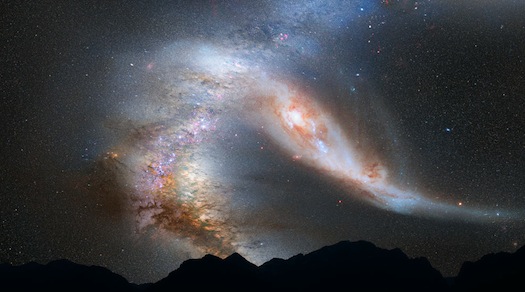
First, the bad news: In four billion years it's going to get a lot more crowded around here. The Milky Way and Andromeda galaxies are on a collision course. The good news is that a new video from NASA shows how it'll go down.
It's been suggested for some time that the two galaxies might have it in for each other, but today NASA says they can "predict with certainty" that Andromeda, which is still 2.5 million light years away but heading toward us at 250,000 miles per hour, will collide with the Milky Way because of the mutual pull of their gravity.
The two galaxies have enough space between them that any direct collision of heavenly bodies is unlikely. But the Sun won't be getting off so easy; it'll probably be flung into another part of the galaxy.

The incredible innovations, like drone swarms and perpetual flight, bringing aviation into the world of tomorrow. Plus: today's greatest sci-fi writers predict the future, the science behind the summer's biggest blockbusters, a Doctor Who-themed DIY 'bot, the organs you can do without, and much more.


Online Content Director: Suzanne LaBarre | Email
Senior Editor: Paul Adams | Email
Associate Editor: Dan Nosowitz | Email
Assistant Editor: Colin Lecher | Email
Assistant Editor: Rose Pastore | Email
Contributing Writers:
Kelsey D. Atherton | Email
Francie Diep | Email
Shaunacy Ferro | Email
As cool as the video is there is no way it could do justice to the real thing. I would love a way to travel time just to see various celestial events like the collision of galaxies. I would like to see a few planetary events as well. It would be fascinating to watch a caldera go off or to see Auroras in different stages in the Earths evolution.
Imagine if all life on planet Earth develop naturally, without the ability to see the moon and the stars.
As I walk about during the day, I see blue sky as the sun light reflects about on the atmosphere and moisture in the air. But if our Earth for "any reason" had a little more density to it and we could not see the moon and the stars, the question is, "How would this affect our thinking, in religion, culture, science, religion and our perspective of the cosmos"?
I think we are very lucky humans to naturally gaze up the heavens and be blessed with the inspiration. To see the cosmos, enhances our being!! Gee Wizz and WoWzers!
Wowzer Robot. What a thought experiment you pose. I love it! At first glance I'd say that theres no reason to believe that your "unenlightened" people wouldnt eventually develope radio anyway. So then they'd begin to hear the multitude of radio signals coming from outer space. Eventually they could put together a virtual "image" of the heavens beyond their eyesight. But their developement, early on, in many aspects of life would be stunted for sure IMO. Perhaps though, they would be more enlightened than us in other ways... spiritually and introspectfully?... (i dont know if thats a word but you get my meaning... i hope). Maybe they would be better at living together and gettin along. Why do i think that? i dunno... maybe because they cant look "out" ... so instead they look "in" more profoundly. Maybe they know their oceans better than we do too. In nature, infants are sheltered from the real world until they can more fully understand it. Using that premise.... perhaps, your hypothetical civilization's extended "nurturing time" would perhaps have them better prepared than we were, to discover the dangers of advanced knowledge. Kinda like star trek's prime directive. Man, my mind is all over the place on this one... good job robot!! Way more interesting than the actual article... which is pretty cool too btw.
Today's magic is tomorrow's technology.
Not to mention the fact that due to lack of stars, many voyageurs of the past would have had little knowledge in regards to seafaring and such.
Eh... Looked better on my Universe sandbox. But I guess it's more accurate.
--------------------------------------------
I like nonsense, it wakes up the brain cells.
Great - We'll be part of the Andromeda Galaxy - I'm already bored with the one we're in now! How will the Milky Way do without us?!?
2 galaxies colliding would be like two flocks of birds flying through each other than coalescing. The merger will cause new stars to form among other things, but it's unlikely in the extreme that any particular star system will have any adverse affects, given the space separating them individually. We'll be LONGGGG gone though.
Or maybe we'll have evolved into pure energy beings, and we'll all get to see it front and center.
Time will tell.
@Robot
Krikkit wars
30bcf4e2
So, How big can a black hole get before it collapses on it self.
I mean if Andromeda has a Super Massive black hole at its center and possibly smaller black hole through out, and the Milky way have a Super Massive black hole at it's center and other black holes through out, if the gravity of the two Super Massive black holes attract each other and collide whats going to happen? Will it be visible like the bigger just eats the other and we watch as matter get pulled out of one into the other? Do they collide and we see nothing they just become one Super Duper Massive black hole? And obviously they will get bigger before colliding as they eat their way through the celestial bodies that are colliding from the two galaxy's smashing into each other and possibly gobbling up smaller black holes on their way. Does the black hole just collapse because it would be to massive so it just disperses or possibly causes a big bang from just to much weight or to much gravity rather?