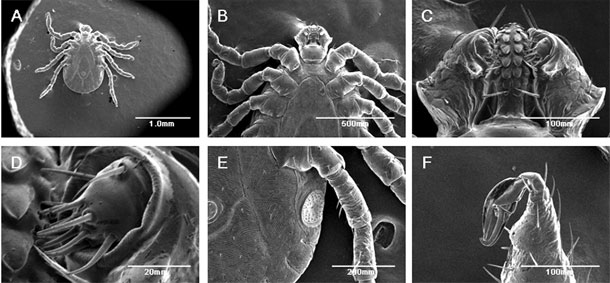
Bombarded with electrons and sealed in a vacuum, the noble tick survived the ordeal

Up Close With the First Living Animal Captured via Scanning Electron Microscopy via Not Exactly Rocket Science

You didn’t wake up this morning thinking that a tick under a scanning electron microscope was going to be the coolest thing you saw all day, and yet here you are. After discovering some ticks alive inside a vacuum drying chamber, Yasuhito Ishigaki of Kanazawa Medical University decided to see if the hardy little bloodsuckers could stand up to the electron bombardment and vacuum conditions inside a scanning electron microscope (SEM). They could, and he’s got the video to prove it.

SEM rigs are great for capturing very fine detail of very small things, but they aren’t easy on their subjects. They work by bombarding a sample with electrons and recording how they scatter to create an image. Air interferes with this electron beam, so all this takes place inside a vacuum. And samples are often stained or even coated with metal beforehand to enhance the resolution of the microscopy.

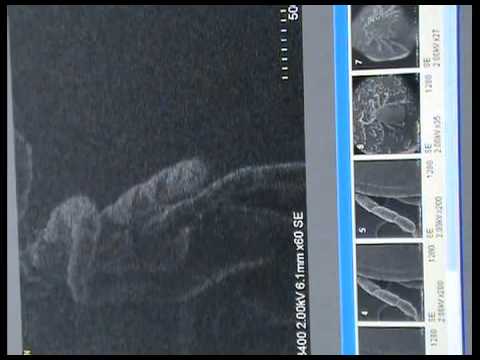
All said, life is not good for a SEM sample. In fact, putting anything living into an SEM sample chamber pretty much ensures that it won’t be living when you take it out. But this clearly isn’t true for ticks. In the video below, you can clearly see the tick moving its legs. Ishigaki did this with 20 different ticks, and all of them survived, making them the first animals to ever be scanned with SEM.
[Not Exactly Rocket Science]

8 Comments

Good trick, I had an invasion of small ants in my house and several were on the bottom of my plate when I put it in the microwave oven, several minutes later I opened the door and much to my surprise they were still walking around. I nuked them again for 5 minutes and watched them as they were still walking around in the microwave. If the ants got close to the food inside the oven they would be roasted but they stayed away from that heat source, these ants must be from Mars, I thought.

They should try this on my small ants or tardigrade's which also can take more punishment but while observation the tardigrade can be frozen to near absolute zero and survive −273 °C, −459 °F, temperatures as high as 151 °C, 304 °F, 1,000 times more radiation than other animals, almost a decade without water and a vacuum of space which is more of a true vacuum, a lab vacuum isn't even close to a vacuum of space just above earth atmosphere.

Ron Bennett

First time? Maybe for that particular tick. I did this with deer ticks (Ixodes dammini) in the early 1990s, soon after these machines became available. The ticks survived a little while, and one even righted itself and started to walk around in the chamber, much to the horror of the machine owner/operator. We also were able to assess the voltage necessary to kill and burn holes in the ticks (quite by accident).

The first time that I know of was in 1972 at DuPont, with one of the original Stereoscan SEMs. Some colleagues put a german cockroach in the chamber, held down with epoxy. It survived almost an hour of imaging, and even managed to scuttle away after it was taken out (and freed with solvents). Lousy fact-checking here.

aliusdragonfly, that is why we have you.

There's always time to do it better NOW.

Um the Water Bear anyone? You can scan them with an electron microscope and they will still go on to live forever.

Maybe they should try this on a lawyer (j/k)

well if we cant fight the insects with high energy, how are we going to fight them when the cockroaches survive nuclear blasts?

I can not watch the video and I have such a desire to squish my monitor! ICK TICKS!

.............................
Science sees no further than what it can sense, i.e. facts.
Religion sees beyond the senses, i.e. faith.


June 2013: American Energy Independence

Five amazing, clean technologies that will set us free, in this month's energy-focused issue. Also: how to build a better bomb detector, the robotic toys that are raising your children, a human catapult, the world's smallest arcade, and much more.


Online Content Director: Suzanne LaBarre | Email
Senior Editor: Paul Adams | Email
Associate Editor: Dan Nosowitz | Email
Assistant Editor: Colin Lecher | Email
Assistant Editor: Rose Pastore | Email

Contributing Writers:

Kelsey D. Atherton | Email
Francie Diep | Email
Shaunacy Ferro | Email

circ-top-header.gif
circ-cover.gif