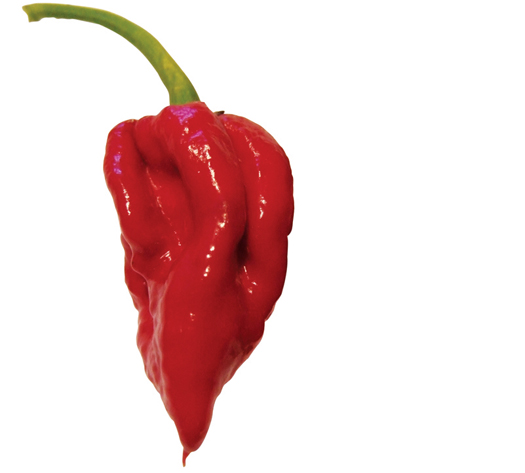
It is very hard to say. In February, the editors of The Guinness Book of World Records announced that the Infinity chili, grown by Nick Woods, the proprietor of a hot-sauce company in Lincolnshire, England, was the hottest pepper ever—more than 250 times as hot as Tabasco sauce. Just two weeks later, Guinness declared that the Infinity had been unseated by another British-grown hybrid, the Naga Viper.
Then things got complicated. The Naga Viper’s creator, Gerald Fowler, who runs the Chilli Pepper Company in Cumbria, England, says he simply cross-pollinated his pepper from three existing varieties: the Naga Morich, the Trinidad Scorpion and the Bhut Jolokia (also known as the ghost pepper, it has been studied extensively by the Indian Defence Research and Development Organisation, and took the Guinness title in 2006). Both Woods and Fowler had sent their peppers to be tested for spiciness at the horticultural research center at the University of Warwick, and the results were submitted to Guinness.
You might wonder if any of these pepper fiends has died. Not yet.When Warwick’s labs rated Fowler’s Naga Viper equivalent to the combined strength of some 250 jalapeños, pepper experts balked. Jim Duffy, a chili grower in San Diego, criticizes Guinness for bestowing the title on insufficiently authenticated fruits. Dave DeWitt, the founder of Chile Pepper magazine, author of 35 books about chilies and an adjunct professor at New Mexico State University, flatly dismisses the Guinness record as well. “This is science, and they are a beer company,” he says, adding that test results should be corroborated by at least two labs. “With one test, the most you can show is that a single pepper–or a part of a single pepper–had that heat rating. To establish that a variety of pepper is consistently the world’s hottest, you need more than that.” Even Andrew Jukes, who conducted the pepper tests at Warwick on which Guinness based the Naga Viper and Infinity records, concurs: “I am surprised that all record values are not verified on additional samples in other labs. I’ve suggested to customers in the past that this would be required, but it seems that it is not.”
Duffy also says that there is no way Fowler could have created his record pepper in such a short time. “It’s a fairy tale,” he says. “It’s scientifically impossible. If you were going to try to create a new variety by cross-pollinating two varieties, it would take you five years. And the Naga Viper, which is a three-way hybrid? That would take you 10 to 12 years.” DeWitt would like to see an independent certifying authority that takes the place of Guinness and requires at least two separate tests for each submission, maintaining a “totally scientific” list of the world’s hottest peppers. Yet no matter how scientific that list might be, “heat” is quite difficult to measure.
In 1912, chemist Wilbur Scoville determined that no chemical test for spiciness could be as accurate as the human tongue, and so he devised a subjective scale, the Scoville Organoleptic test. An alcohol-based pepper extract is progressively diluted in sugar water and tasted until its spiciness can no longer be discerned. The amount of water required dictates the rating; a jalapeño takes about 5,000 parts water to one part pepper to neutralize the heat, so it is rated at 5,000 Scoville heat units (SHUs). The Bhut Jolokia registered 1,001,304 SHUs when it took the record, breaking the million-Scoville barrier for the first time.

www.chilefoundry.co.uk Darth Naga Vs The Naga Viper
Today a pepper’s heat is measured in a lab, using high-performance liquid chromatography to precisely gauge the concentration of pungent compounds within peppers called capsaicinoids. Capsaicinoids make peppers hot; the relative proportion of various capsaicinoids (such as dihydrocapsaicin and nordihydrocapsaicin) is the reason some peppers’ burn lingers in the mouth while others are potent but fleeting. (For more info on how capsaicinoids affect the mouth, check out our video explainer.) Lab tests that measure the concentrations of capsaicinoids first issue the results in American Spice Trade Association pungency units. One ASTA pungency unit is equivalent to about 15 SHUs. Out of tradition, the Scoville scale remains, so ASTA pungency units are multiplied by 15 and the results are given in SHUs. Yet even with precise tools, determining which strain of pepper is consistently the hottest is tricky. “The pungency in chili peppers is 50 percent genetic and 50 percent environmental,” DeWitt says. “Pods that grow lower down on the plant are hotter. Stress on the plants, if water is withheld perhaps, makes them hotter.”
In March, one month after the Guinness announcement, the controversy deepened. A group of Australians announced that they had grown a pepper that rated 1,463,700 SHUs, far hotter than the Infinity and the Naga Viper. The Australians’ pepper was cultivated from a strain of the Trinidad Scorpion that the developers called the Butch T. They are now marketing a sauce called Scorpion Strike with the tagline “Stupidly Hot BBQ Sauce.”
The Trinidad Scorpion, which has a pod that comes to a point like a stinger, was tested last year by Marlin Bensinger, a chemical engineer who has worked with peppers extensively for more than 40 years. He rated it 1.2 million SHUs and calls it “the hottest pepper we have seen with the most consistent analytical performance.” The SHU rating was corroborated by Analytical Food Laboratories in Dallas.
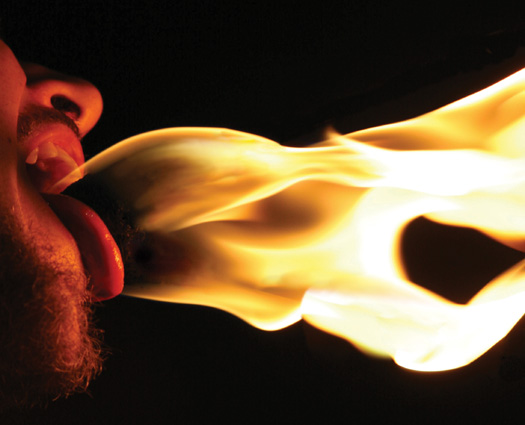
A pepper so hot has market potential beyond barbecue sauce and designer salsa. “There are economic perks that come with laying claim to having, developing, or engineering the hottest pepper in the world,” Bensinger says. “Unlike the Guinness records for eating the most hot dogs or packing the most people in a VW Beetle, this type of record could change the microeconomics of small geographic areas of the world.” For example, Blair’s Reserve 16 Million Crystals hot sauce claims an SHU of 16 million and retails for $595 a bottle. Some people love to eat the hottest of all peppers raw, or take their hot sauce by the spoonful. Watch videos of such fire-eaters (British men mostly, and alarmingly pale) on YouTube, where they stare into the camera sweating and hiccuping while describing the exact nature of their excruciation. You might wonder if any of these pepper fiends has died in the process. The answer is no, at least not yet.
In a 1980 study called “Acute Toxicity of Capsaicin in Several Animal Species,” researchers administered pure crystalline capsaicin to a variety of rodents. Capsaicin was given orally, intravenously and topically. Rabbits were least sensitive to the spice, while guinea pigs were particularly pained by it. Assuming we have about the same pepper sensitivity as mice, the lethal dose for humans is about 13 grams (0.5 ounces) of solid capsaicin, swallowed, for a 150-pound person. Three pounds of the hottest peppers in the world could kill you.
But we have been ingesting plenty of capsaicin for centuries with no ill effects. Sure, there will be sweating, flushing and temporary gastric inflammation, but the bulk of the medical research on capsaicin focuses on its benefits. Several university studies have suggested that capsaicin consumption can aid in weight loss and inhibit tumor growth. When it is applied topically, nerves can be overwhelmed and the skin goes numb. There’s even a capsaicin patch for joint pain. But the scientists at the Indian Defence Research and Development Organisation have a more nefarious plan for the Bhut Jolokia–pepper-bomb hand grenades.

www.chilefoundry.co.uk Darth Naga and Trinidad Scorpion Butch T
Have a science question you’ve always wondered about? Send an email to fyi@popsci.com