
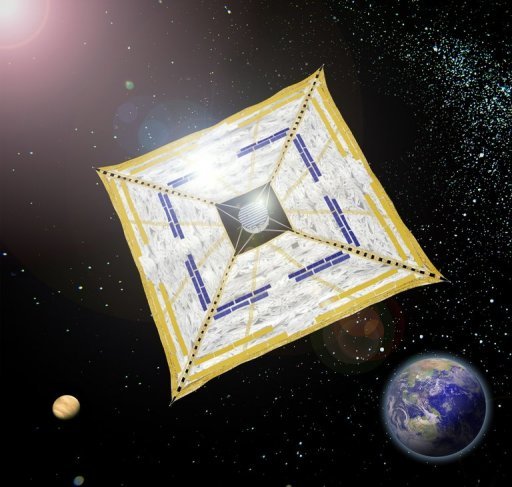
Never mind using the solar wind to power spacecraft — that’s old hat. Scientists at Washington State University want to use solar wind to power the entire world. A humongous solar sail could be used to harvest the power of solar winds, generating 1 billion billion gigawatts of electricity. The problem is figuring out how to get the power back to Earth.
A solar wind power satellite, or a Dyson-Harrop satellite, after the scientists who invented it, would provide 100 billion times as much power as the Earth currently uses, as Discovery News points out. Researchers from Washington State University published a paper describing the system in the International Journal of Astrobiology.
It involves a .4-inch-wide copper wire pointed at the sun, and attached to a solar sail. The wire — which can range in length from 980 feet to more than half a mile — would generate a magnetic field that would capture electrons from the solar wind. The particles would be funneled into a spherical receiver, which produces a current.
Some of this electricity would be used to power the electron-harvesting magnetic field. The rest would power an infrared laser beam, which would be pointed at collectors on space stations, power bases or Earth. Satellites could be placed anywhere in the solar system, and networks of satellites could combine to generate terawatts of power, the researchers say.The system would be cheaper than installing solar panels in space, because copper is cheaper than photovoltaic cells, according to International Business Times.
The main problem is getting all this energy back to the planet. Satellites would have to sail tens of millions of miles away from Earth in order to capture enough power, but even the most powerful laser beams would scatter over such great distances. The laser would spread to thousands of miles wide, according to John Mankins, president of solar power consulting firm Artemis Innovation. He is quoted in New Scientist saying you would need "stupendously huge optics, such as a virtually perfect lens between maybe 10 to 100 kilometers (6.2 to 62 miles) across," to capture the laser.
Researchers would have to design a more focused laser before solar wind satellites could be deployed, acknowledges to Dirk Schulze-Makuch, a co-author of the paper.
Still, the idea seems worth exploring — the solar wind is a vast source of energy, so why not try to capture some of it? If it could solve the world’s energy problems for good, it's worth a closer look.
Five amazing, clean technologies that will set us free, in this month's energy-focused issue. Also: how to build a better bomb detector, the robotic toys that are raising your children, a human catapult, the world's smallest arcade, and much more.


Online Content Director: Suzanne LaBarre | Email
Senior Editor: Paul Adams | Email
Associate Editor: Dan Nosowitz | Email
Assistant Editor: Colin Lecher | Email
Assistant Editor: Rose Pastore | Email
Contributing Writers:
Rebecca Boyle | Email
Kelsey D. Atherton | Email
Francie Diep | Email
Shaunacy Ferro | Email
Sounds ludicrous but totally epic.
funnel the concentrated beam into a series of telescopic satellites which boost the beam to the next next stage in the chain then back to earth.
convert to radio waves and reconvert when they get back to earth?
tough hurdle to get over
Now instead of sponsoring millions in other types of renewable energy, sponsor the race for the first scientific team to improve laser technology! Et voilà! Within a decade, thousands of minds will have worked on the problem and not only solve the 21st century energy crisis but the 22nd and the 23rd!
The problem with that being, halfway through the twenty-first, we have a working design for this and no fossil fuel left to build it. = P
@phiniusmaster
not as ludicrous when you read
http://www.popsci.com/science/article/2010-02/physicists-prove-teleportation-energy-theoretically-possible
"100 billion times as much power as the Earth currently uses"
Why are we wasting our time with wind and solar as sources of power, if something like THAT is out there. I mean really if it powered Earth (just once oven), I would think everyone would want to jump on the band wagon. You need funding for it just ask if anyone want's free power, everyone throws a buck in and BAM you have a 7 billon dollar budget.
As for getting it to Earth just use a chain of "focusing" satellites like what GTO was saying.
I think GTO has the right idea. There is no reason for having to have one super fine laser if you just have relay satellites. It is exactly what we do when we have the same problem on earth.
Of course this is thinking like a scientist instead of the a Country/business/politician. People might think that everyone would like "free" (really more like low cost) energy, but the facts is that people would kill to make sure that didn't come true not to mention using money/power to stop it, especially if you are going to try to do it for the whole world. Since when have you heard of anything that the whole world agrees on?
P.S. How many jobs are tied to the current system? What are you going to do for a job when your job is affected by this change?
Yes, this idea definitely needs to be explored. I mean really, one solar satellite would provide 100 billion times as much power as the earth currently uses......WOW.....That's alot!!!Even though there's no current way figured out in order to get the energy back to earth, this idea should definitely be explored. After this problem is solved, the world will have unlimited energy!!!Oh the possibilities then!!! Anything is possible!!!
Sounds to me like someone has the makings of The Death Star's main laser weapon. When you're aiming all that energy at Earth, what happens to the atmosphere as the beam travels through it? Even the lasers in our labs in university are strong enough to turn the air to plasma.I'd hate to be the bird that flies through that beam....
Or maybe this scenerio;
Scientist: Sorry folks, we know you all wanted all that free energy, but our sattelites were hit with a micrometeorite that turned that transmitter 1/100th of a degree. We regret to inform you that we vapourized the Atlantic Ocean. But the good news is that we don't have to go a mile underwater to drill for those hydrocarbons anymore!
This sound great in every way, except one. Yes, you can use satellites as junctions to get the energy back to Earth, but we still have the problem with beaming all that energy down.
Does anyone realize how ridiculously energy dense the beams are going to be? That much heat is going to cause problems.
In regards to absorbing the energy, there are some people working on the concept of an anti-laser which would be perfect for something like this.
@volt , an anti laser traps light, not send a lackness of light.
So how much money do we have to invest in laser technology?
Ha ha okay I think that a bit more research needs to go into this article before posting it. I mean a billion billion gigawatts? That's 10^27 watts!!! For reference the entire earth receives only 1.74*10^17 watts of sunlight. In fact the sun only gives off 3.8*10^26 watts total. So if we just trap the sun and another similarly sized star and ship them to earth we're good. Of coarse if you want a mere 100 billion times the power consumption of humans (roughly 2*10^13*100*10^9 = 2*10^24) then you only need 1/190 or about 0.5% of the sun's power. That sounds cheap and easy.
@tcolguin
Pessimism at its best.
It doesn't matter how many jobs are tied to the current system. Societal evolution spurs a change in priority. If people working for oil companies lost their jobs from the advent of this concept, it wouldn't be an altogether bad thing. Those proactive enough to see the change coming and adapt to the world of tomorrow as a result would be ready to survive economically by shaping there skill set to something that would be most useful for tomorrow's society. Robots are the reason a lot of blue-collar workers can't get traditional technician jobs. Many forms of technological advancement will make traditional/archaic occupations obsolete ("just ask your friendly elevator operator"). What we as people must do is adapt and evolve with the changes we are making for ourselves.
Do not fear change. Embrace it.
"Welcome! to the Federation Starship SS Buttcrack!!!"
pheonix1012, I find it an interest assumption that there will always be jobs for people even after we overpopulate the world, especially if this major of a change of this scope was done in a very short period of time.
I'm not worried about the change, I'm more worried about the angry mobs. For some reason the generations of today think that the revolts of the past can't happen again.
I love technology, and I love the idea presented here, but we do live in a world that doesn't always cares about it. For years as an software engineer I heard my peers talk about how great Unix was and that DOS/Windows 3.1 was a piece of junk and they couldn't understand how anyone would use it. And it was a piece of junk, but the users didn't care. They wanted it do something. Microsoft convince enough programmers to spend countless hours to make it "sort of work". They got it to do what the users wanted and that was then end of that. Not what was the better technology, but what the people supported.
People do not care about "free energy", because there is no such thing. You pay one way or another. If you have a job paying $1,000,000 a year you don't mind $5 a gallon fuel. If you have no job/income then getting power at 50 cents per 100 kilowatts/hour is still VERY expensive to you.
You do have to worry about the impact things have on people not just the science, or you will never understand why somethings are never done even if they sound so good.
It wouldn't have to be one really large focusing lens, it can be a collection of smaller, cheaper ones laid out in a large grid pattern to focus MOST or even just half the energy collected...
That's still 50 billion times more than what the Earth uses, right?
Even if the lenses only focused a fraction...10-15% of the energy back to the Earth, it's still more than we use, right?
So, we get it up and running and when we develop better lens technology or someone comes up with a better idea, we can get the efficiency up higher and higher.
PS...so what happens when the moon's orbit gets too close? Or can it even be done considering the moon tends to get in the way of the sun every now and then? Is there a way to maneuver the contraption out of the moon's way? Would the moon literally knock over our solar wind thingy? Would the gravitational pull knock the thing out of alignment or whatever? Or will it be so far out the moon isn't in the way anymore?
sending lasers down to earth from space still adds to global warming...
Hate to rain on the idiot parade, but solar luminosity is only 3.8*10^26 watts. A billion billion gigawatts is two and a half times the ENTIRE power output of the sun.
Solar wind is just ~5*10^17 W(1.9 million tonnes per second at ~750 km/s). That's only 30 000 times current world power consumption if you capture exactly all of it.
To give you a sense of scale, the Earth captures 1 part in 2 billion of all sunlight. If you capture all solar wind through a loop with the same circumference as the Earth at our distance from the sun you will get only 200 MW; same as a small nuclear reactor or coal plant or fairly large gas turbine.
Its all fun and games until a giant solar flare takes out all our power and we have to revert back to the old Coal/nuclear ways of the past. Instead of surge protector you would need a solar flare protector.
I think the best way to do it though would be to set up a receiving base on the moons face and then transmit it back to earth. Isn't Japan actually working on a radio frequency transmitter that can beam energy over radio waves to earth and be transfered back into power? I think if we all put our heads together we could find a solution.
Well, it's obvious we need to invent a "Newston's Cradle" that conserves energy equally well as the 'toy' that resides on thousands of science teacher's desk but of course which has no 'physical constraints' or distance limitations.
We need to invent something equivalent to wormholes!
Which if we did it might also have a secondary advantage of being able to transport matter as well as energy from point A to point B equally well as has often been theorized.
Of course, it might take more energy to open up the wormhole than the energy we want to transport so ugh that might be a dead end in and of itself ha.
@tcolguin
The thing is, we as humans create the mentality that we need to work our arse off to survive. Which does not have to be true.
We have enough brain power and resources to make enough food, energy and other ESSENTIALS available to ALL humans.
What we don't have is the compassion, the heart and the courage to do so.
We should work to ensure we all survive, but not to SLAVE to make the 10% of the world that control 90% of its wealth rich.
And that is our problem as a planet. Not global warming, but our greed and selfishness as humans.
remember when 1.21 gigawatts was just a made up number?
There is no reason for having to have one super fine laser if you just have relay satellites. It is exactly what we do when we have the same problem on earth.
http://www.cirurgia-plastica.com/lipoaspiracao/
maybe instead of light they could use something that wouldn't refract on the way down, like, say, radio?
This project will be quite the feat.. The biggest challenge will be protecting the sail from all the projectiles hurtling through space.
p.s.
Soylent- Loved the physics lecture..
With regards to funding, if we were to relabel this as a giant super-powered weaponized space laser/ asteroid destroyer, then I am sure the DOD would throw money at it like it was dancing on stage at a strip club.
Rather than aiming the laser at the Earth, why not aim it at the moon? The moon's atmosphere is virtually a vacuum, so no vaporization risk. Build substations there that can either redirect the energy from a more stable platform (the moon) or use it to power machinery that can harvest nuclear fusion fuel and UPS it back Earthside.
The power could be transmitted down the cable of a space elevator.
If every woman on earth would castrate one man in her lifetime, all our energy issues will be resolved over a short time. And all other issues as well.
An unthinkable suggestion of course.
But one that is true, and one that could be implemented immediately - in just one hour.
Think about it: Just one - very decisive - hour would rid the world of all problems, without killing anybody.
Not that I would suggest it. Of course not.
;)
Does solar wind include any hydrogen? You could bundle that up and send it somewhere to use in a fusion reactor... I assume if solar wind was just light this wouldn't be different from regular solar power. :P
if solar wind can give us 100 billion times the amount of energy we currently use, whatever system of energy transport we decide to implement will pay for itself, right?
let's do this!
1) Note that one sail would not produce that much power - but a framework of sails. So it is not an river of power, but a million little trickles.
2) The cost and functionality of (1) getting all that up there, (2) keeping it in position, and (3) getting the power back down add up to current impossibility due to complexity.
3) Adding power to the Earth system is, in general, a bad decision. Even if you get the power in without burning a hole through the atmosphere - that power will be used - generating a lot of heat that the atmosphere would have shielded us from. (Net global temperature change from carbon drop = nil).
4) There is no shortage of near-clean power here on Earth: hydro, tidal, geothermal, wind, and solar (in that order).
If the sail can harness a billion billion times what the earth use, how would we be able to store the overage ? (Saying it was possible to do so)
The prospect of an end to virtually all jobs is awesome. Ignore what the others say, sure there'd be turbulence first, but robots using the energy to work for us (manual jobs anyway) would allow us to live life the way we want without being tied down by jobs. Yet, I guess it could either lead to unfair distribution of wealth or and end to our monetary system--doesn't sound bad to me, after everything is stable again. And all of this is assuming they can 'harvest' as much as they claim. Hoping, if this will ever go through, that they could achieve a reasonable amount of efficiency to pay off its cost to build and put up there and also have enough to be satisfied with charging very little for it.
Let met get this straight. they want to capture light energy then transform that energy then transmit that energy then re-transform that energy. Anyone else seeing the loss of energy here aside from the whole light diffusion thing already mentioned? Wouldn't that sort of diffuse the light energy to an even lower value than what it is now when it gets here naturally?
While we are at the out there ideas how about this one.:
First build a large halo ring like that built in the video games around the earth the then somehow balance it to stay in orbit around earth and keep up with us as we pass around the sun. Infuse the ring with the proper magnetic strength and have it act as a rotor around the magnetic core of earth thus making the earth a large generator.
I mean not a bad sci fi idea if you ignore the magnetic resistance of the generator system slowing the earth rotation even faster, and the fact that the materials and work needed would be a near impossible feat, as well as maintaining all of the needed orbits to work.
Just thought I would toss out another crazy idea that likely can't work. Maybe someone can twist that into a working story.
I hope you chuckled at this as much as I have.
Aside from the beam's effects on the atmosphere, the location of the beam receptors on earth could ONLY be located at the poles. Precisely the worst locations to aim a high powered, heat generating laser. Everywhere else on earth would be moving far too often for any space borne beam to keep steady contact.
@twobrain the halo ring idea would indeed be an impossible feat. Regardless of construction of such a device, the simple orbital mechanics and gravitational pull factors make it an utter impossibility to have such a device encircling earth. The net gravitational pull on the ring's center of mass would be zero, allowing it to float free of earth's movements and have all other gravitational forces move it slightly different than earth would. Eventually causing earth collision. The mechanical stresses such a creation would have to survive are another issue entirely.
Some problems with this. First it seems ten digits were added to the power figures. A blatant mistake or a huge goof from academic concept to news blurb. Either way that number is close to the *total* output of the sun.
The sun shines mostly in all the directions that don't point our way -that's a big goof. We should remember the context. The original paper is about SETI. Detecting advanced ETs. A super-race wouldn't need to totally enclose a star. They might build these. Harder to spot apparently.
@Scythelord- Nobody in their right mind would direct an extra billion gigawatts at Earth. Or a "billion billion gigawatts" possible or not.
Even a 'small' version needs to be 90 million miles away. They say the solar wind is more intense and steady far above the ecliptic, where the planets orbit. That's why the laser spreads so much.
But the Earth has a BIG magnetic field collecting the solar wind at the poles. A small version might work there. And sited way closer. Closer, less beam-spread. Possible?
Seems like dumb not to use it to power space missions. Mars in a week, probes to Alpha Centauri at half the speed of light. This is *a lot* of power here, even for a 10km one.
Sorry about the long comment.
The "solar wind" is mostly protons, not electrons, but in any event capturing either + or - charges requires dealing with the reality that charge buildup on the capture unit will gradually cause new particles to be repelled. This is why ion engines need an electron generators to neuralize th e+ ions accelerated out the rear of the engine. This takes power.
But, perhaps the silliest thing about this is that power density is the key to our future, which is why solar thermal, wind, wave, etc. are of no great value -- solar electric can at most generate 3.1MW/acre on earth (30% more in orbit), so sending a spreading light/microwave beam at earth from many, ,amy miles away will require a truly massive reception area. Far better to do what's simple & commonsensical -- solar collectors on existing human structures, of which there are plenty. Coupled with efficient storage (e.g., Velkess, ultra-capacitor or advanced battery) and we've plenty of peak power down here, especially if we start saving a bit of the 58% of present generation we now waste.
The silliest thing about the idea of beaming many Terawatts of unnatural power at earth is that because it's unnatural, we drive the radiative balance of earth even further into global warming. The sun gives us 86,000TW each second. We now generate 16TW, most of which is wasted & most all of which ends up as heat. One can estimate that we haven't far to go in dissipating more unnatural heat before we've far more serious global warming than just due to GHGs. In fact, since present GHG levels will last about 1000 years, we should realize cute ideas like this one are truly science fiction that never should be attempted.
Efficiency, plus distributed solar/storage on existing structures, plus already-researched safe nuclear power solve our energy needs, cheaper than coal, and for millennia...
www.youtube.com/watch?v=XhAsow4ROfA
www.youtube.com/watch?v=EHdRJqi__Z8&NR=1
www.youtube.com/watch?v=XhAsow4ROfA
www.thoriumenergyalliance.com/downloads/ThoriumSummary_Alex_Cannara.pdf
With another 3 billion folks arriving on earth by 2050, we don't have an option to waste land on anything but food, etc. The situation we've created is very serious and not solved by spacey trickery -- the editors should know this.
For the real scoop on how far behind we are (despite Arrhenius' warnings in 1896 & 1905)...
www.copenhagendiagnosis.org/
www.nap.edu/catalog.php?record_id=12877
And, most sobering...
AAAS Science, 9/10/2010, Vol 329, p1292 (Hoffert) & p1330 (Davis et al)
You may contact me for info -- our kids & grandkids are looking back at us from their futures (the ones we're making for them without their consent).
