How It Works: The Flying Laser Cannon

How It Works
Boeing's new laser cannon can melt a hole in a tank from five miles away and 10,000 feet up—and it’s ready to fly this year
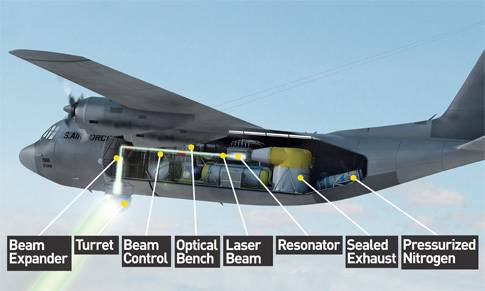
Inside the Advanced Tactical Laser : Photo by Bob Sauls (Illustration)

Creating a laser that can melt a soda can in a lab is a finicky enough task. Later this year, scientists will put a 40,000-pound chemical laser in the belly of a gunship flying at 300 mph and take aim at targets as far away as five miles. And we’re not talking aluminum cans. Boeing’s new Advanced Tactical Laser will cook trucks, tanks, radio stations—the kinds of things hit with missiles and rockets today. Whereas conventional projectiles can lose sight of their target and be shot down or deflected, the ATL moves at the speed of light and can strike several targets in rapid succession.

Last December, Boeing, under contract from the Department of Defense, installed a $200-million prototype of the laser into a C-130 at Kirtland Air Force Base in New Mexico in preparation for test flights this year. From there it will go to the Air Force for more testing, and it could be in battle within five years.

Precise control over the beam’s aim allows it to hit a moving target a few inches wide and confine the damage to that space. The Pentagon hopes such precision will translate into less collateral damage than even today’s most accurate missiles. Future versions using different types of lasers could be mounted on smaller vehicles, such as fighter jets, helicopters and trucks.

How to Melt a Tank in Three Seconds Or Less

1. Find Your Target
When the C-130 flies within targeting range (up to five miles away), the gunner aims using a rotating video camera mounted beneath the fuselage. The computer locks onto the object to continually track it. A second crew member precisely adjusts the laser beam’s strength—higher power to disable vehicles, lower power to knock out, say, a small power generator. The gunner hits “fire,” and the computer takes over from there.

2. Heat Up the Laser
In a fraction of a second, chlorine gas mixes with hydrogen peroxide. The resulting chemical reaction creates highly energetic oxygen molecules. Pressurized nitrogen pushes the oxygen through a fine mist of iodine, transferring the oxygen’s energy to iodine molecules, which shed it in the form of intense light.

3. Amplify the Beam
The optical resonator bounces this light between mirrors, forcing more iodine molecules to cough up their photons, further increasing the laser beam’s intensity. From there, the light travels through a sealed pipe above the weapon’s crew station and into a chamber called the optical bench. There, sensors determine the beam’s quality, while mechanically controlled mirrors compensate for movement of the airplane, vibration and atmospheric conditions. Precise airflow regulates the chamber’s temperature and humidity, which helps keep the beam strong.

4. Stand Clear
A kind of reverse telescope called the beam expander inside a retractable, swiveling pod called the turret widens the beam to 20 inches and aims it. The laser’s computer determines the distance to the target and adjusts the beam so it condenses into a focused point at just the right spot. Tracking computers help make microscopic adjustments to compensate for both the airplane’s and the target’s movement. A burst of a few seconds’ duration will burn a several-inch-wide hole in whatever it hits.

FAQ

  • How hot is the beam? The laser itself isn’t hot, but it can heat its target to thousands of degrees.
  • Does the laser sear everything in its path? Yes. If a bird flew into the firing laser’s line of sight—
    well, no more bird. Fortunately, the weapon will fire for only a few seconds at a time, minimizing the risk.
  • Does it melt its target or just set it aflame? That depends on what it hits. It will melt metal, but if
    the target is combustible, it will burn.

More How It Works:

23 Comments

Comments

valprest
Article Rating:
1
2
3
4
5

Can the Laser Cannon be tuned to drill holes into the earth as an alternative to drill bits and shafts? My thought is YES, it could. It would drill straight assuming no reflective surfaces en route and drill fast so that going down several miles would be rapid, the molten soil and rock seeping off to the sides of the hole into more porous material perhaps creating a solid shaft so piping isn't needed. Pipe material and coating selections are difficult when dealing with soils' acids, caustics and very high temperatures and temperature changes internally and externally.

To what purpose? To tap geothermal energy from magma deep within the earth and bring it to the surface in the form of steam from circulated water and then use it to drive generators or heat buildings as happens now in Iceland.

Using a closed steam loop reduces Carbon Dioxide emissions to zero, something that no fossil fuels can claim. Using the steam in an open loop system reduces Carbon Dioxide emissions to 10% of what fossil fuels create.

5 out of 5 people found this comment helpful
OBloody Hell
Article Rating:
1
2
3
4
5

Sorry, valprest, but that isn't really all that likely to work

As you vaporize the "dirt" (rock, whatever) it will create a gaseous form of the former dirt which will obscure the target from further heating. You might be able to do something by pulsing it, but the amount of energy needed to vaporize that much earth would be anything but trivial. You might be able to do something like this (maaaaybe) with a satellite and solar cells to drive it, but such a thing would be just as usable as a weapon and weaponizing space, while I'm sure it eventually will happen, isn't on anyone's "Hy, Great Idea!" list right now.

The other obvious issue is how, exactly, did you plan to maintain a constant position over the hole looking straight down? Might be doable with some sort of balloon/dirigible object, but even there you'd still need to secure it using lines over a fairly fixed location, something which has been one of the chief banes of lighter-than-air travel for a century now -- mooring and docking issues. A plane would be impractical for this, as it couldn't perform the sort of tight circle needed to keep the weapon even vaguely close to the vertical line required.

The application specified works well because you presumably don't need a sustained beam on-target, and, if you did, you can fly for more than a minute in the direction of the target object

3 out of 4 people found this comment helpful
valprest
Article Rating:
1
2
3
4
5

Thanks OBloody Hell but I dismounted the drill and put it on an overhead crane so it wasn't flying. However I think the presence of water would be more of a problem than melting or spraying soil and rock. Thanks for your thoughts.

Val Prest

0 out of 0 people found this comment helpful
Poophead
Article Rating:
1
2
3
4
5

Oooooh, cool...If this thing can burn a hole thru a tank, think what it could do to an ammunition bunker...I was going with the idea of using microwave energy to set off the ammo, but this thing would work as well...Kinda hard to fight without ammo, I would think, plus it would be rather demoralizing to know that your own ammo is going to take you out of the action...Just a thought...

1 out of 1 people found this comment helpful
DulcetTone
Article Rating:
1
2
3
4
5

"If a bird flew into the firing laser’s line of sight— well, no more bird. Fortunately, the weapon will fire for only a few seconds at a time, minimizing the risk."

I'm glad we've minimized risk to small birds while frying human beings. I'll reset easier now!

tone

1 out of 1 people found this comment helpful
alexgumby
Article Rating:
1
2
3
4
5

I'll admit the technology is cool and brings back memories of teenage sci-fi fantasies but there needs to be some perspective here. Sure, the author is clearly being politically correct to avoid the part about melting/boiling people in the process (never mind the birds). Everyone seems to think the soldiers are "just following orders" - just like our boys are and we are supposed to "support our troops" just as our opponents are supposed to support theirs. Everyone seems, conveniently, to forget the hypocrisies of their tepid mottos and slogans or did we all forget the typical Nazi soldier was also "following orders"? What has happened to personal accountability and doing the right thing at the right and wrong time? How about if all this energy and thought processes went into actually trying to find resolutions and peaceful solutions instead of Darth Vadering everyone to death? Think people. Think.

1 out of 1 people found this comment helpful
saxonhawthorn
Article Rating:
1
2
3
4
5

If I were a tank commander, I'd be checking my kit right now to make sure I had packed my shaving mirror!

0 out of 0 people found this comment helpful
AlexP
Article Rating:
1
2
3
4
5

5 miles away and 10000 feet high? You can take down that plane with a slingshot. To burn holes in a tank on the firing range no problem, to touch a "live" tank with all defence systems from 5 miles away sounds like a challenge.

0 out of 0 people found this comment helpful
Aetherstrike
Article Rating:
1
2
3
4
5

Why not just mount a bunch of mirrors (not glass ones) on top of the tank?

0 out of 0 people found this comment helpful
ChuckHarding
Article Rating:
1
2
3
4
5

Doesn't this sound like the plot of "Real Genius"?

1 out of 1 people found this comment helpful
Page 1 of 3 123next ›last »

PPX: The PopSci Predictions Exchange

RSS Link

Military, Aviation & Space

Ready to bet on the future? Start here!

Subscribe for 2 free issues!

may2008_cover.jpg