
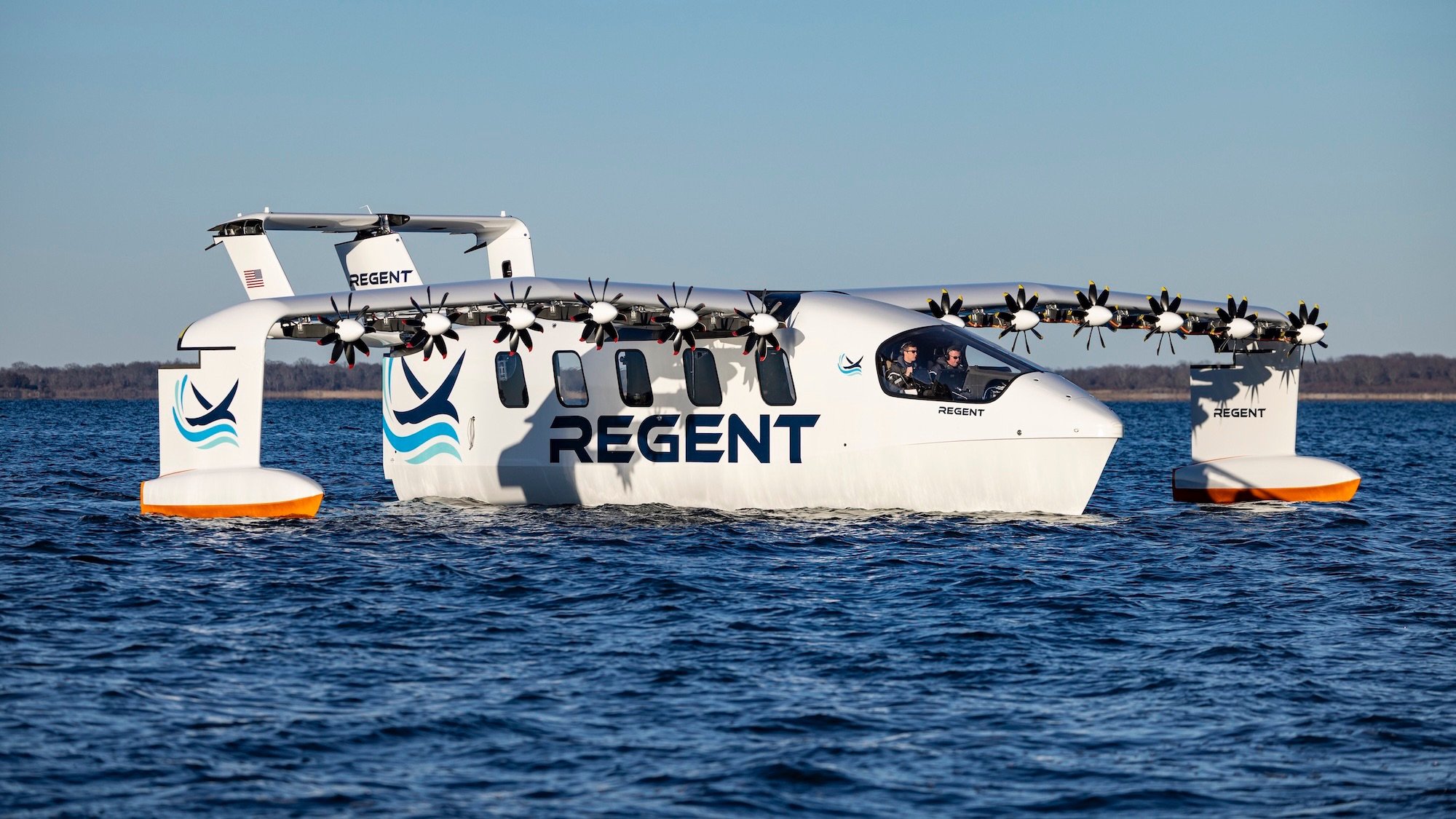
Visitors traveling across Rhode Island’s Narragansett Bay earlier this month may have seen a strange-looking boat with wings and a whale-like tail floating in the estuary’s calm late-summer waters. Eventually, the vessel’s 12 electric propellers, six on each side, spun up and sent it churning forward. The “boat” advanced across the bay, faster and faster, rising onto hydrofoils until its hull cleared the surface. Then the foils lifted free, and the ship took to the sky, gliding low over the water like a pelican skimming the waves. It remained airborne, flying about 33 feet above the bay for another 30 seconds before gently landing back down on the water’s surface. In all, the flight covered 1,956 feet.
This marked the first crewed flight of the Viceroy Seaglider, a prototype part-plane, part-boat craft built by a Rhode Island startup called REGENT. The company hopes to bring to market a modern wing-in-ground-effect craft that combines the convenience of a boat with the speed and power of an aircraft. As currently designed, REGENT says their ship can carry 12 passengers at up to 180 miles per hour, or alternatively transport up to 3,500 pounds of cargo. The startup hopes this speed and flexibility could make it an attractive option for travelers looking for a breezy ride between coastal towns. It’s also already courting attention from the US military, which sees an opportunity to utilize the seagull glider for stealth missions and naval resupply efforts.
“Completing this flight test validates years of rigorous engineering and operational work and gives us the confidence to move into full-rate production,” Regent co-founder and Chief Technology Officer said in a statement. “We showed today that flying a Seaglider is every bit as smooth and safe as we designed it to be.”

REGENT Viceroy Seaglider First Flight
Resurrecting Soviet ‘flying ships’
The Viceroy follows in the footsteps of the Soviet Union’s “ekranoplans,” massive Cold War-era craft that took advantage of an aerodynamic phenomenon called ground effect. When a winged vehicle flies within about one wingspan of a surface, air gets trapped beneath it, creating extra lift and reducing drag. The result is a craft that can carry more weight than a similarly sized plane flying higher in the sky. The Soviets built several of these types of craft, with the most famous amongst them being a 380-ton vessel referred to as the “Sea Monster of the Caspian.” That giant part boat, part ship stretched out longer than an Airbus A380 super jumbo jet and could reach a top speed of 340 miles per hour. But ekranoplans were more bark than bite. They generally struggled to take off in rough water and were notoriously hard to dock.
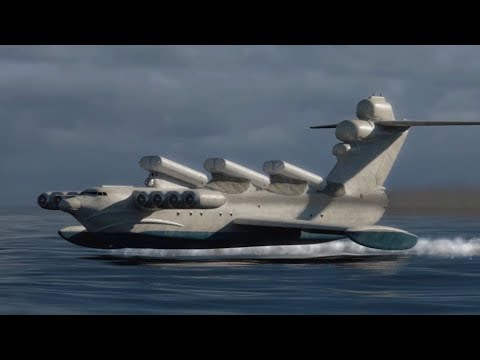
Lun-class Ekranoplan Launching a P-270 Moskit
REGENT hopes to address those handling problems by introducing hydrofoils, which are essentially underwater wings that lift the hull out of the water as the craft speeds up. The resulting reduced drag from waves should make takeoff fast, smoother, and more stable. Those foils then retract once the ship gets airborne.
While operating on the water, REGENT pitches the result as a high-speed electric ferry, designed to cover up to 180 miles on a charge. The company is also building a smaller, sibling craft for the military called the “Squire.” That more nimble vessel operates autonomously and is designed to quickly carry a payload of 50 pounds.
REGENT sees its vessel as “dual use” with both commercial and military application, but the latter is the one already drawing checks. The company has secured $15 million in contracts with the US Marine Corps and has development agreements with US Special Operations Command, as well as the Coast Guard. Last year, the Viceroy completed several field demonstrations showing how the vessel might be used in a combat zone. In those demos, the Viceroy was used as a part of a beach extraction simulation, removing an injured person from the shore as well as an open water life raft rescue.
Though ambitious in design, in practice the Viceroy looks like it is filling many of the roles already occupied today by helicopters. Still, its larger carrying capacity sets it apart. And while not the most obvious sell, its all electric motors also means it’s considerably quieter than notoriously loud choppers.
