
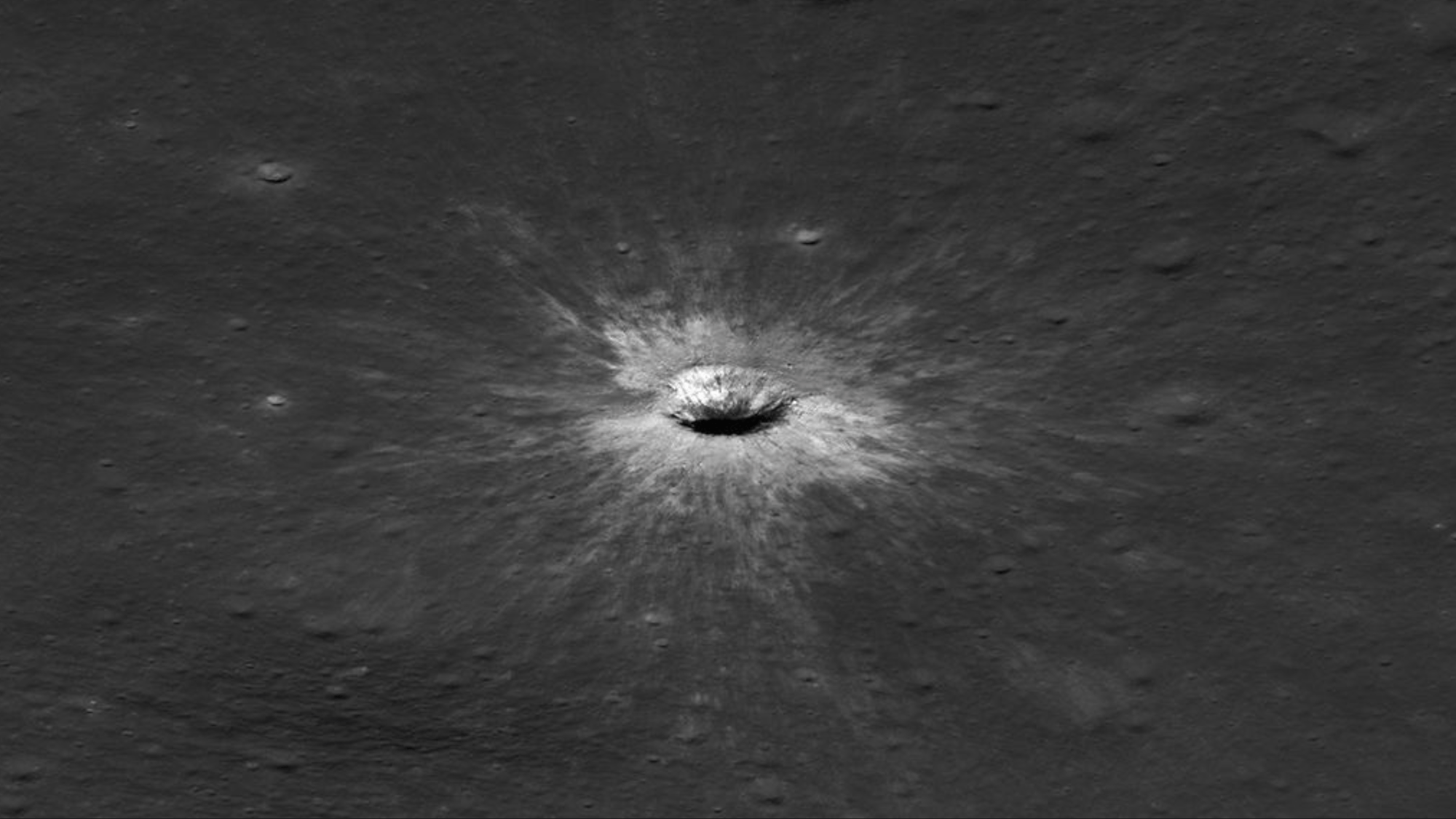
The moon may look desolate and calm, but a lot happens on that dusty landscape. With zero atmosphere, space rocks of all sizes regularly bombard the lunar surface. Most of the debris is microscopic, but astronomers estimate around 140 coffee table-sized asteroids and comets also slam into our moon every year. When they do, the impact is powerful enough to produce a 30-foot-wide crater.
Every so often, however, a monstrous visitor arrives. And based on observations from NASA’s Lunar Reconnaissance Orbiter (LRO), one of those much rarer rocks gave the moon an impressive new battlescar. As researchers recently reported in Science Advances, an asteroid or comet the size of a three-story building has generated a crater measuring the length of two football fields on the moon’s eastern edge. As the largest newly formed crater ever spotted in the solar system, it presents astronomers with a once-in-a-century opportunity to study the immediate aftermath of such a sizable impact.
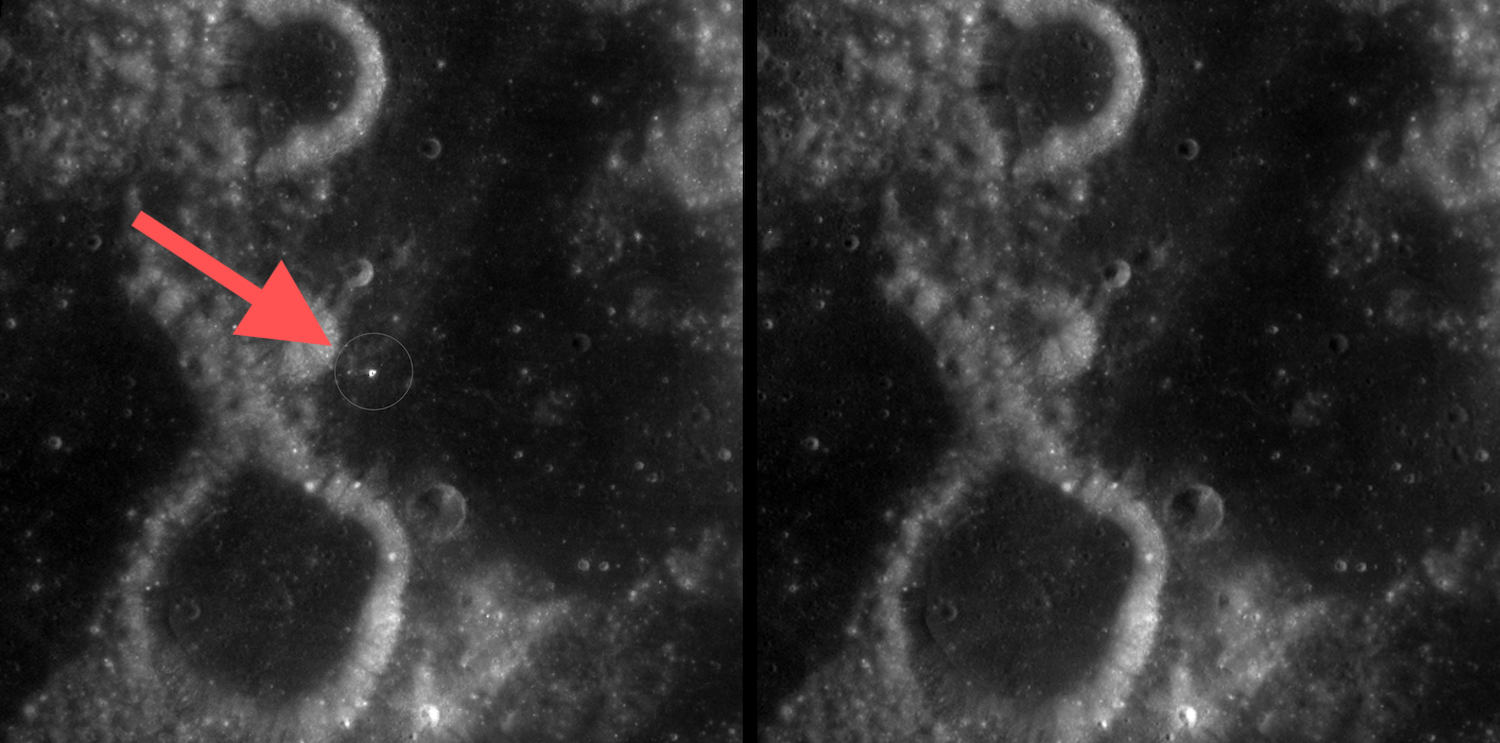
The discovery occurred during a standard data-quality review of images collected by the LRO between April 11 and May 22, 2024. Since launching in 2009, the LRO has helped astronomers pinpoint at least 1,000 newer craters, as well as 100,000 lunar surface changes formed by either direct impacts or secondary strikes from flying debris. But when image-processing specialist Robert Wagner noticed a huge bright circle encased by a darker halo on October 24, 2025, he immediately knew it was unlike anything he’d previously seen.
“I just stopped, dropped everything, and started looking into what that spot was,” Wagner recalled.
Assessing a new crater isn’t as simple as flipping between before and after photos. Specialized software is designed to highlight tiny changes in shadows or lighting, which results in hundreds of false leads. To ensure this was the real deal, Wagner examined images by individual pixels to pinpoint signs of small regolith smatterings around the crater. The sleuthing still confirmed his suspicions—the moon had been hit by a very large space rock.
“It was by far the most obvious impact debris pattern I’ve ever seen in one of these images,” said Wagner.
Named McGetchin after the renowned lunar scientist Tom McGetchin, the crater is 728 feet wide and extends 141 feet deep. Follow-up scans from the LRO’s thermal instrument, Diviner, also showed a four-mile-wide region around the crater measuring around 16 degrees Fahrenheit cooler than its surroundings at night. This temperature dropoff occurs when an impact disturbs nearby surface layers of regolith, loosening the dirt so much that it retains less heat.
Researchers are still determining the space rock’s size as well as its impact force, but the LRO is well-equipped to assist in this next phase. Imagining using its Narrow-Angle Camera will allow astronomers to examine the crater at a resolution of three feet-per-pixel. Those results on their once-in-a-lifetime discovery are set to publish in a forthcoming study.
