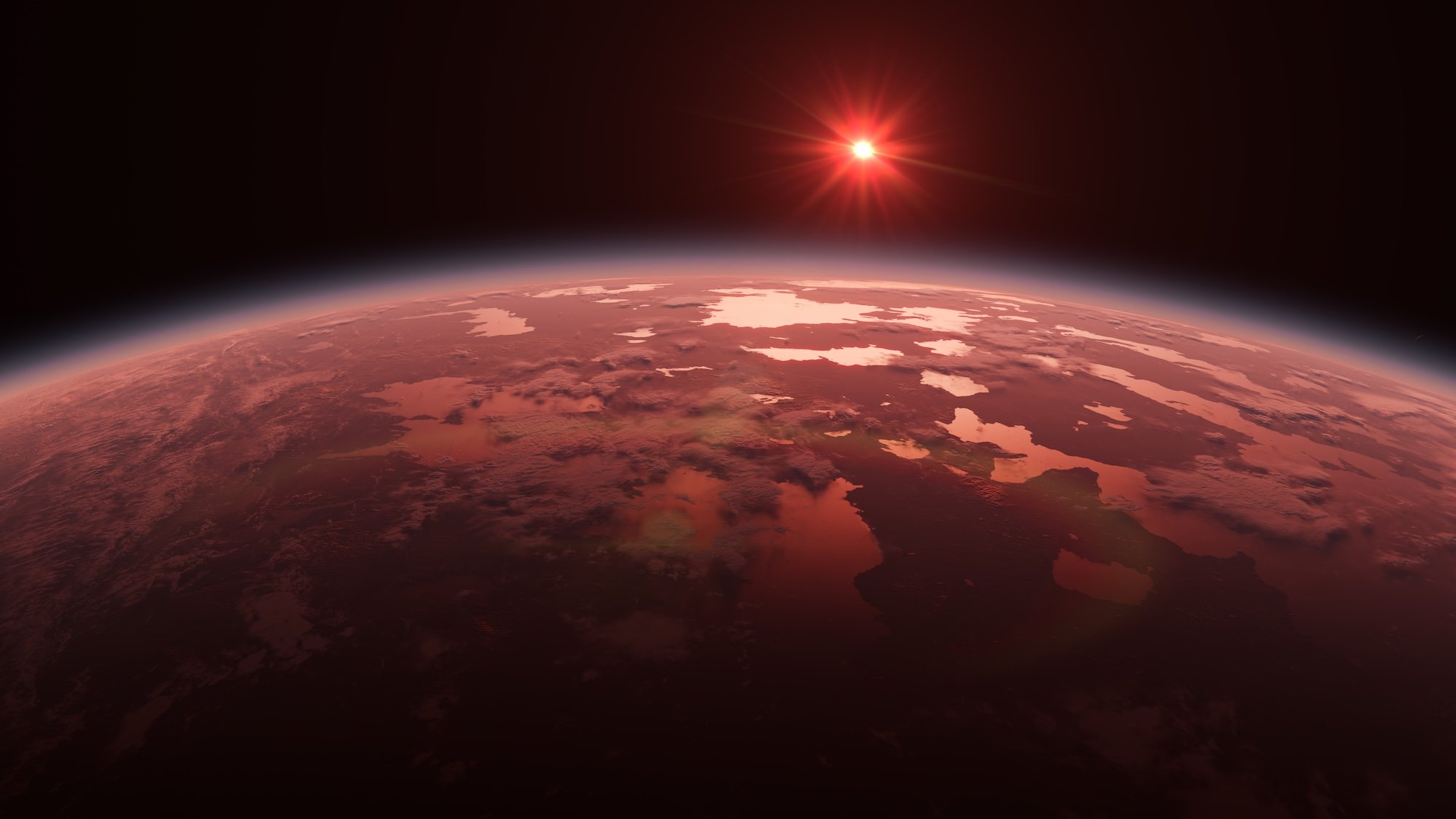
The sheer scale of the universe strongly suggests Earth isn’t its only life-hosting planet. But do distant worlds harbor the types of advanced spacefaring civilizations depicted in science fiction, or just far simpler microbes?
Astrobiologists consider a planet’s age when searching for extraterrestrials. The standard logic implies that older planets had a longer time to develop advanced lifeforms. But while Earth is billions of years younger than many nearby exoplanets, one research team isn’t particularly worried about any impending visits from hyperadvanced aliens. As they recently explained in the International Journal of Astrobiology, their reasoning is more about plants than the planets themselves.
“Physicist Enrico Fermi famously asked, given the high likelihood of intelligent life in the galaxy, ‘Where are they?’” said study co-author and Northern Arizona University ecoinformaticist Chris Doughty. “This paper suggests that our exoplanet stellar neighborhood may be quiet because most Earth-like planets near us are likely to be evolutionarily behind us and still at the microbial stage.”
Doughty and his colleagues base their argument on how much cumulative photosynthesis can hypothetically occur on exoplanets with more hostile conditions. It’s not that life couldn’t develop on these worlds, but it would take a much longer timeframe to evolve into anything particularly complex.
They point to Earth for comparison—warm, wet regions see more plant growth and species diversity than colder, arid ecosystems. In comparison, the likeliest exoplanets to host life orbit red dwarfs, the galaxy’s most common stars. These planets are not only much older than Earth. They also receive far less light and are frequently tidally locked, which means only one side ever faces its host star.
“The total annual photosynthesis is likely lower because there is less light and half the planetary surface area available for photosynthesis,” summarized study co-author and NAU informatics researcher Michael Gowanlock.
To test their theory, the study’s authors examined 29 exoplanet neighbors previously flagged for potentially fostering liquid water. These candidates include TRAPPIST-1e, a planet located about 40 light-years from Earth widely regarded as one of the most promising locations for alien life. They then incorporated recent exoplanet climate simulation maps developed by University of Bristol astrophysicist Denis Sergeev that detail variables like light, precipitation, and temperature.
The team’s calculations didn’t bode well for anyone hoping to spot spaceships docked on TRAPPIST-1e. While their overall assessment hinges on some complex measurements, the simple takeaway is that even when billions of years older than Earth, TRAPPIST-1e hypothetically possesses only 21 percent of Earth’s total fixed carbon.
“We estimated that TRAPPIST-1e may only be at the microbial stage of evolution,” explained study co-author Cameron Hrabak. “That’s well behind Earth.”
Other surveyed planets may be further along in their evolutionary journeys, however. Three of the worlds might possess enough carbon from plants to imply Mesozoic conditions that saw dinosaurs here on Earth. Only GJ 1061c and K2-3d, two planets that are larger, brighter, and hotter than Earth, may sustain life that has evolved beyond Earth’s timeline.
The study’s authors stressed their approach is only one way to examine exoplanets for potential life. Meanwhile, planets like GJ 1061c or K2-3d may have older evolutionary histories, but that doesn’t correlate to highly advanced inhabitants. Rgardless of who lives where in the galaxy, approaching the topic from unconventional starting points may be the best way to one day locate nearby cosmic residents—before they locate us.
“Who is ahead? That is the mystery we are quantitatively trying to solve,” said Gowanlock.