
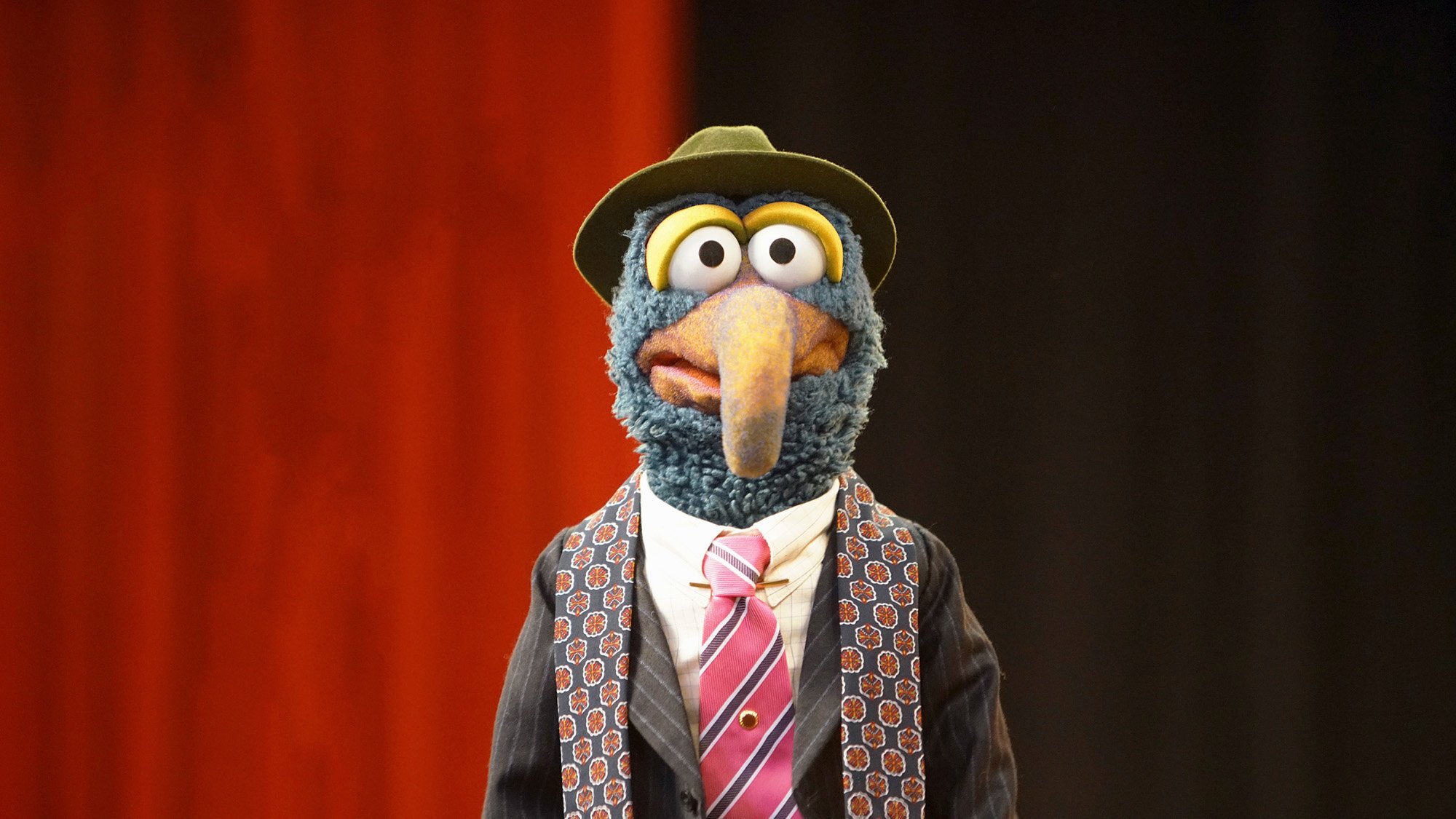
In the 1981 film The Great Muppet Caper, the Muppets get shipped across the Atlantic in crates stenciled with the species inside. Kermit’s says FROG. Fozzie’s says BEAR. Gonzo’s says WHATEVER.
If you’re unfamiliar, Gonzo is the blue one with the long drooping nose. He’s covered in fuzz, has a feathery tuft on his head, three fingers on each hand, and a girlfriend named Camilla, who is a chicken (obviously). What does that all add up to? Nobody knows.
Muppet writers have dodged that question for 50 years, so we asked three biologists to weigh in. Their answer is far weirder than “some kind of funny-looking bird.” Look closely enough at the anatomy and Gonzo stops being a bird at all. He ends up on a branch that split off tens of millions of years before the first modern feather, back to the dinosaurs. And none of the scientists could match his distinct nose to anything alive or extinct.
Where Gonzo came from
Gonzo began as something else. On December 20, 1970, CBS aired a Muppet Christmas special called The Great Santa Claus Switch, written by Jerry Juhl and narrated by Ed Sullivan. One of the villain’s henchmen was a small, shaggy blue creature with a long drooping snout and a sour expression that lived in a cigar box. He was called Snarl, the Cigar Box Frackle, and that puppet was later remodeled into Gonzo.

The Frackle label didn’t stick, though. Gonzo arrived on The Muppet Show on the same day the Christmas special aired. Dave Goelz has operated the puppet and voiced him ever since. But the writers gave Gonzo no species. What they gave him instead was a personality, built on Juhl’s idea of a character who does appalling things and thinks of them as art. Gonzo caught cannonballs, ate tires, and recited poetry while things exploded around him.
However, Gonzo never was classified as a specific animal, and the joke turned into a running gag. In a 1977 episode in which English actor and comedian John Cleese guest-starred, Gonzo introduced himself with his job rather than his species: “I’m the ugly disgusting one who catches cannonballs.”
The 1999 film Muppets from Space has a scene set aboard Noah’s ark. While Noah records all the animal pairs aboard his ship, he asks Gonzo, “What are you, anyway?” Gonzo replies, “Oh, uh… Good question. Now, technically speaking, uh, let’s say, put me down as a ‘whatever.'”
That same film then answered the question, revealing Gonzo as an extraterrestrial. But later films and shows mostly went back to treating him as “a whatever.”

One paleontologist says Gonzo is a flightless ibis
In order to classify the Muppet, Darren Naish, who studies the anatomy and relationships of extinct backboned animals, looks at Gonzo’s most obvious characteristics. Gonzo is fuzzy, Naish says, so he’s probably warm-blooded. His snout looks like a beak, he has no teeth, and he’s a four-limbed animal with a backbone.
“If you add all those things together, there isn’t anything else he can be,” Naish explained. “He can’t be anything other than a bird.”
Two other details suggest Gonzo is a bird. The tufts on Gonzo’s head have always been called feathers rather than hair, and his longtime girlfriend, Camilla, is a chicken.
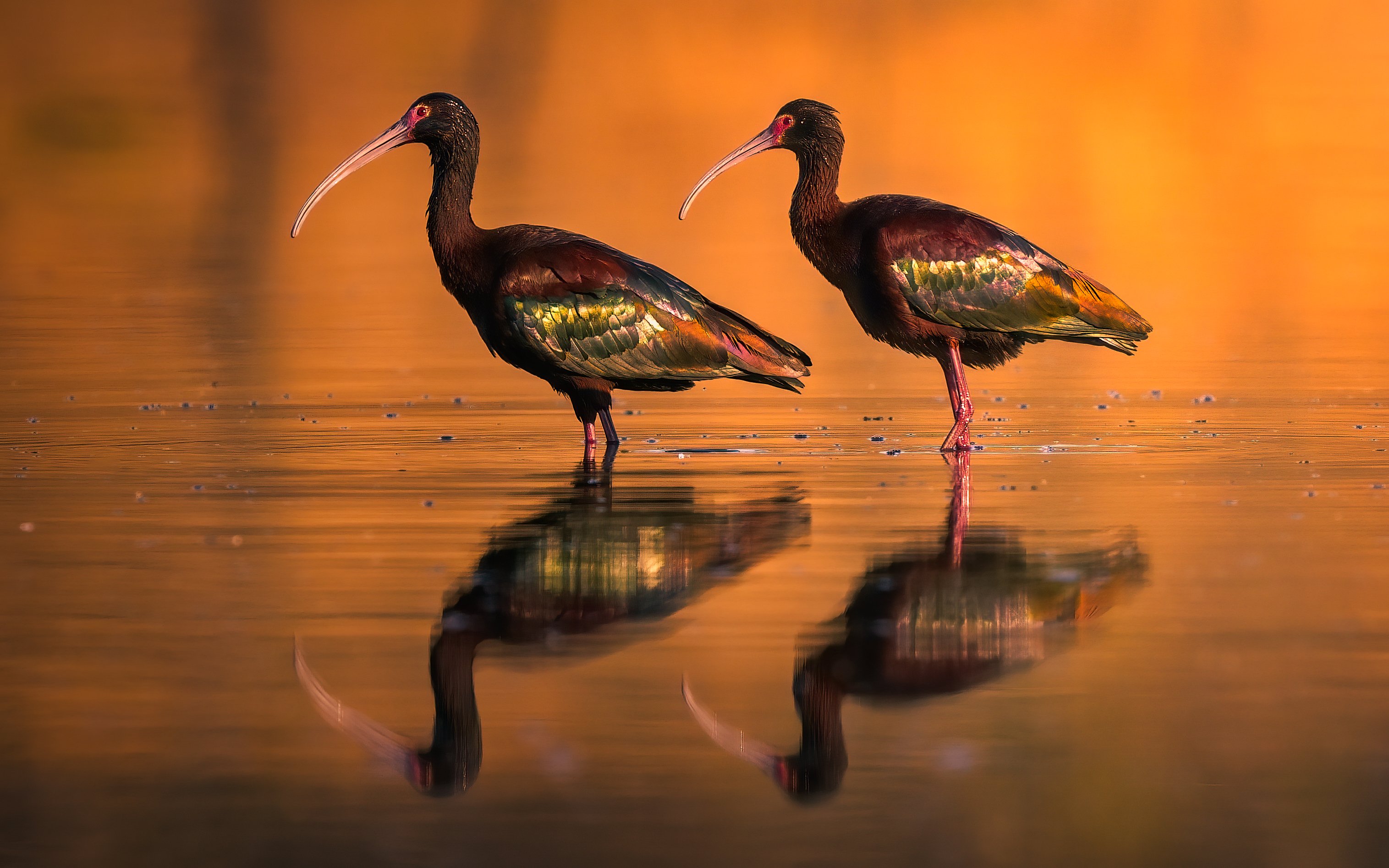
Then there’s his face. Naish looks at that long curved snout and sees an ibis, one of the wading birds with a slender downcurved bill.
However, ibises fly, and Gonzo doesn’t. But that’s no obstacle; ibises have lost flight before. A Jamaican ibis, extinct for around 10,000 years, had wings so heavy that the hand bones swelled into clubs. The extinct bird seems to have swung their club hands in fights. If an ibis ancestor couldn’t fly, a modern Muppet bird creature is not hard to imagine.
“Could be that he might be a highly derived, a very evolutionarily modified ibis?” Naish said.
Gonzo isn’t a modern bird at all, says a second paleontologist
Thomas Holtz, a University of Maryland paleontologist who studies carnivorous dinosaurs, landed much deeper in time.
Holtz notes that Gonzo has three working fingers on each hand, and a body covered in simple down-like fuzz with a few more complex feathers only on the head. Both traits, he says, show up together in early carnivorous dinosaurs from a group called Tetanurae, which eventually produced raptors and true birds and also includes fuzzier earlier animals like Tyrannosaurs. (Yes, T. rex was fuzzy.)
Holtz then pointed at the show’s own cast. The Muppets who are clearly bird-like look nothing like Gonzo. Big Bird, Camilla, and the other chickens have modern vaned feathers and beaks with an obvious keratin shine. Gonzo has neither.
“This suggests that if he is a bird or bird relative, Gonzo is from a group that evolved prior to the evolution of modern feathers,” Holtz says.
Gonzo’s hands indicate the same. Modern birds have a fused hand with greatly reduced fingers.
Gonzo’s hands are nothing like that. Holtz counts three separate fingers on each one, unfused and free-standing. Holtz thinks that might again put Gonzo before the origin of modern birds, which would make him far older than an ibis.
The tuft on Gonzo’s head could provide a big clue
Michel Milinkovitch, whose lab at the University of Geneva studies how hair, feathers, and scales develop, didn’t narrow Gonzo’s species to a single answer. Gonzo could be a mammal or something on the evolutionary line that led to theropod dinosaurs and birds, Milinkovitch says, and which one depends on a single question: What is that tuft made of?
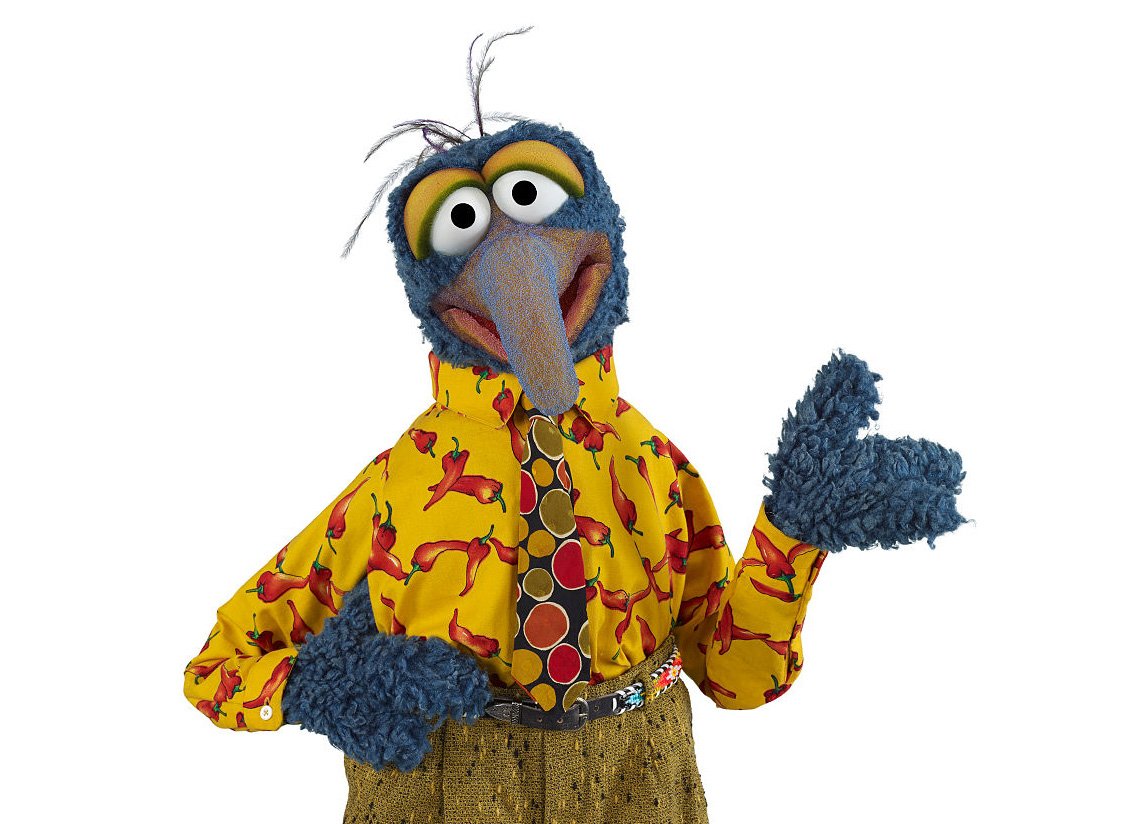
Real hair is a follicle growing down into the skin, with a shaft growing out from inside it. “If Gonzo’s fur is made of real hair, he must be a mammal, because hair is a distinguishing character for mammals,” Milinkovitch says. The tuft would be specialized hair rather than feathers. And the snout would have nothing to do with birds at all—a beak-like structure that evolved separately from birds, similar to the way the platypus arrived at its bill.
If the tuft is real feathers, with barbs around a shaft, Gonzo sits on the lineage that produced theropod dinosaurs—two-legged carnivores like Tyrannosaurus—and eventually birds. The fuzz all over his body would then have to be feathers too: down, like a chick’s, or the loose shaggy plumage of a kiwi bird.
Blame the snout
Gonzo’s most distinct feature is also perhaps the most baffling to scientists: his beak.
For birds and turtles, the beak is the mouth itself—the jaw bones, with a keratin sheath over them. But Gonzo’s snout isn’t his mouth. Holtz describes it as an extension sticking out in front of the mouth rather than being the mouth. A structure like that, he says, is a bit odd anywhere among vertebrates.
It doesn’t bend like a trunk. It also lacks the shine of chicken beaks, so Holtz isn’t even sure it’s covered in keratin. And a beak without keratin isn’t really a beak.
Related 'Ask Us Anything' Stories
Gonzo invites questions
Two of the three biologists ended up putting Gonzo on the branch that produced theropod dinosaurs and birds, but by different routes. Milinkovitch got there from the tuft on Gonzo’s head, Holtz from the shape of his hands.
Holtz went a step further, saying Gonzo split off long before modern birds appeared.
For Naish, questions like “what is Gonzo” could help people understand more about evolutionary biology. He also has a theory about why nobody will let the question go. Most Muppets are either obviously something—Kermit is a frog, Camilla is a chicken—or don’t give any clues to raise the question at all.
With characters like Grover and Elmo, Naish says, there is no feature that makes you stop and wonder what animal you’re looking at. But Gonzo has several such features. His snout has a shape. His tufts are called feathers. His girlfriend has a species.
The rule, according to Naish, is that specificity invites scrutiny. “The more precise, the more defined you make a character,” Naish says, “the more inclined people are to ask questions.”
All that said, 50 years on, the answer “to what really is Gonzo” is still whatever.
In Ask Us Anything, Popular Science answers your most outlandish, mind-burning questions, from the everyday things you’ve always wondered to the bizarre things you never thought to ask. Have something you’ve always wanted to know? Ask us.
