
This article was originally featured on Knowable Magazine.
In 1847, the British company J.S. Fry & Sons unveiled a new product: a solid block of cocoa powder, sugar and cocoa butter. While people had sipped on chocolate beverages for thousands of years, chocolate had never been mass produced in bar form.
Since Fry & Sons’ innovation, food scientists have continued to improve upon the ingredients and techniques of chocolate-making. In the late 19th century, for example, confectioners started adding powdered milk to chocolate for a creamier mouthfeel.
Today, chocolate is big business: Estimates suggest that in 2026, the industry will take in some $147 billion. Whether it’s cheap chocolate or a high-quality treat, research is leading the way to more consistently tasty products. To better control the chemical and physical changes that give chocolate its unique flavor and structure, scientists are probing subjects like the role of microbes, crystallization and the mystery of bloom.
Chocolate is “incredibly complex,” says Caitlin Clark, a food scientist at Colorado State University. Even a century and a half into chocolate-making, there’s still more to discover. Here’s some of what research is revealing about the latest science behind a favorite cocoa-based treat.
Fermenting flavor
Scientists have long known that cacao-growing regions have distinct terroirs, like wine: Chocolate’s fruity, floral or nutty notes are linked to the location in which the cacao beans are grown. (Generally, cacao refers to the plant and plant material before processing, while cocoa is used for processed ingredients and products.)
This terroir has been mainly attributed to a combination of cacao plant genetics and the local soil types, climate and other environmental conditions. But in 2017, while working at Trinidad’s International Cocoa Genebank, plant geneticist David Gopaulchan began to suspect that the fermentation of the cocoa beans might play a larger role in the local flavor variations than scientists thought.
After the football-shaped cacao pods are harvested, their innards — 30 to 50 beans nestled in a white pulp — ferment for about a week in wooden boxes. During that time, yeast liquefies the pulp, consuming its sugars and producing ethanol. Then more microbes swoop in, converting alcohol to acids. All this activity leads to chemical byproducts called metabolites that become sprinkled throughout, lending unique flavor notes. By the end, the strong vinegary scents that characterize the initial stages of the process have waned and the beans smell “very close to wet socks,” a scent that subsides after drying, says Gopaulchan.
Yet unlike wine or beer, cocoa’s fermentation is not controlled by farmers beyond occasional stirring: All the various microbes come and go freely. “It’s a very unpredictable outcome,” says Gopaulchan, now a research fellow at the University of Nottingham in England. The fermentation process has largely been “like a black box.”
Gopaulchan and his team analyzed the genomes of the microbes most crucial to each step of fermentation across three Colombian chocolate farms. Then they trained a computer model to identify the different microbial groups that contribute to various chocolate flavor notes. Some acetic acid-producing bacteria, for example, were associated with some of the fruitier notes, while the yeasts Torulaspora and Saccharomyces were linked to the classic cocoa flavor.
Next, the researchers were able to reproduce these flavor notes through controlled fermentation in the lab. Gopaulchan says this work may lead to a fermentation “toolbox” that will produce more consistent results.
Fermentation is at the core of chocolate’s taste, says Gopaulchan. He knows; he’s made unfermented chocolate before. “It’s like eating leaves,” he says. “It’s very green.”
Snappier, shinier, silkier
Perhaps equally important to taste is chocolate’s texture — that’s where cocoa butter comes in. “Chocolate is thicker than most things that you could imagine,” says Richard Hartel, a food scientist at the University of Wisconsin-Madison who, with colleagues, explores chocolate’s microstructure in the 2025 Annual Review of Materials Research.
Cocoa butter is typically added to the refined chocolate mix of cocoa, sugar and milk powder right before tempering, a carefully engineered series of melting and cooling stages that make up the final (and often finicky) step in chocolate making.
Different chocolate products call for more or less cocoa butter, which helps to disperse particles within the blend and lower its viscosity — the internal friction between particles — making it flow more easily. If thickness is what’s needed, the chocolate mix might have less cocoa butter and more sugar and milk particles, which interact strongly with one another, inhibiting flow. This keeps the upright drop shape of Hershey’s Kisses and chocolate chips steady as the chocolate transitions from liquid to solid during pouring and cooling. But for a fancy square scrawled with a cursive logo, higher levels of cocoa butter help flow “and fill all the cracks and crevices,” Hartel says.
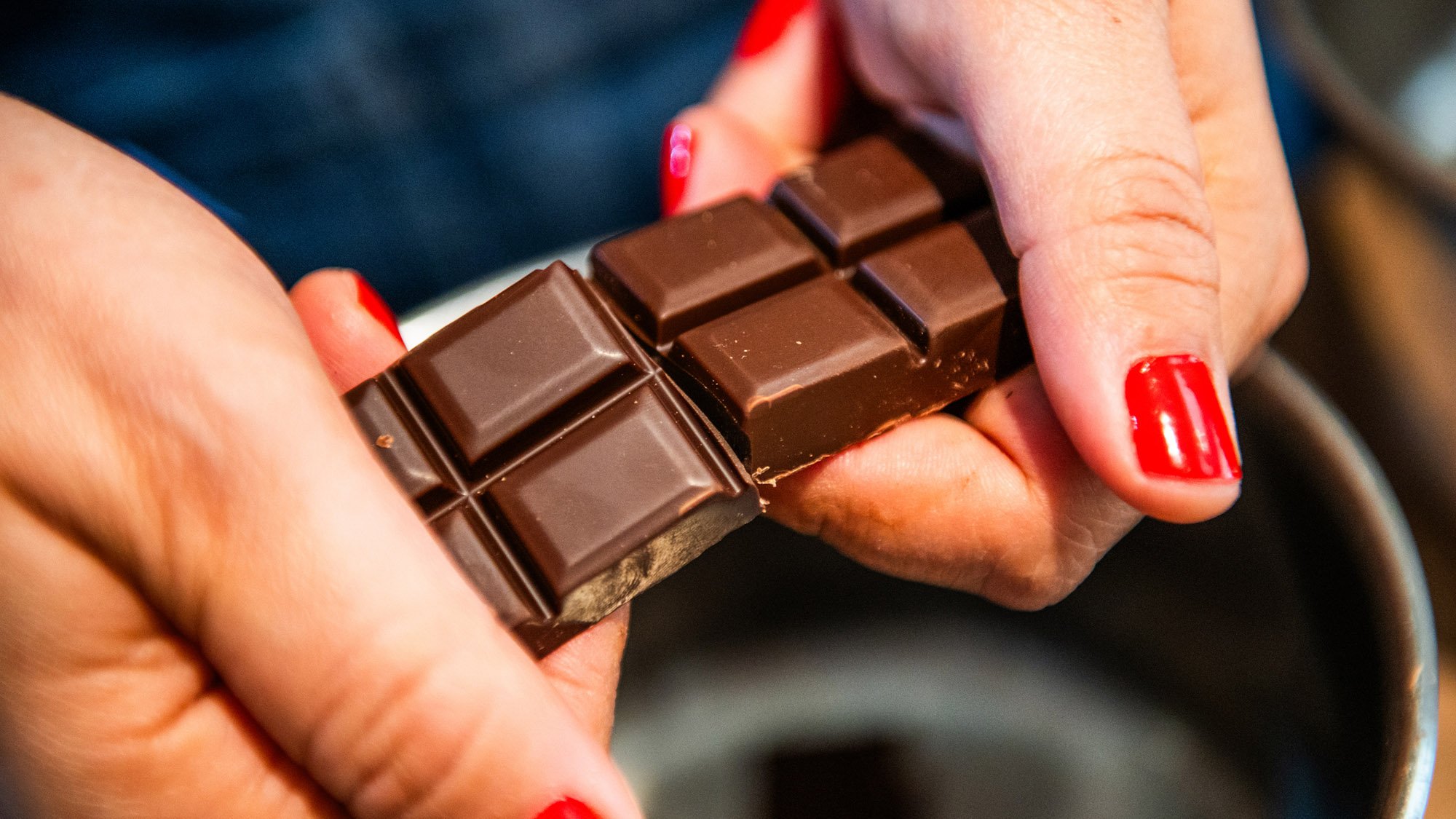
Cocoa butter also contributes to the snap, shine and mouthwatering melt of chocolate — but its solid crystalline structure must form in just the right way. During tempering, the liquid fats within the cocoa butter align into a matrix, forming a solid crystal network. “When the fats crystallize together, they’re linking arms, forming a chain,” Clark says. This traps flavor particles within the network structure.
Tempering helps solidify the cocoa butter into a very specific crystal shape. Of the six possible forms the fat molecules could take, “only one of them gives us the shiny chocolate that snaps when you break it, and melts right at your mouth temperature,” Clark says. If crystallization goes wrong, the chocolate will have a different melting point, so it “won’t taste right.” In addition to these high stakes, tempering is also complex and time-consuming, leading scientists to experiment with shortcuts.
Shooting ultrasound waves through cocoa butter, for example, causes localized temperature and pressure fluctuations that can rearrange molecules. This can nudge the liquid fat molecules into a crystal structure without tempering’s heating and cooling rounds, recent research suggests.
Other scientists have experimented with mixing in different lipid molecules, such as phospholipids, which are already found naturally in cocoa butter in small quantities. Adding more of these fats into the cocoa butter appears to speed up the crystallization by seeding additional sites for crystal growth to spring from. When researchers mixed a small amount of these molecules into both cocoa butter and remelted commercial chocolate, then quickly cooled each to 20 degrees Celsius, it yielded chocolate with the desired snap, gloss and texture, without the many stages of traditional tempering.
Battling bloom
While cocoa butter’s particular crystal configuration is crucial in creating a tasty product, there’s a potential downside to this structure: fat bloom, the white splotches that can form on chocolate’s surface.
This isn’t mold, it’s cocoa butter that has recrystallized in a different shape — but the mold misconception has long plagued the chocolate industry. In addition to its unsightly appearance, bloom also slows the rate at which chocolate melts in your mouth, which can make it taste a bit chalky.
The cloudy sheen often emerges during storage or transportation, especially in warmer or fluctuating temperatures, and scientists don’t fully understand why. “There’s still a lot of debate about it,” Hartel says.
Hartel believes cocoa butter’s molecular structure is to blame. Amid the fat matrix that makes up solid chocolate, some cocoa butter molecules remain liquid. One longstanding hypothesis is that as outside temperature fluctuates, these fat particles migrate to the surface and crystallize into a more stable form — a less glossy and delectable variation.
To study these crystals in greater depth, Hartel’s lab runs an “accelerated shelf-life test,” placing chocolate samples in petri dishes in a chamber and cycling them through temperature regimes — usually between 20 and 30 degrees C. While the white sheen will emerge naturally after long periods of time, “we can make bloom happen in a month,” he says, enabling more detailed explorations of why and how it occurs.
One of Hartel’s former students, Jiayang Jin, now at East China University of Science and Technology, investigates how chocolate composition affects fat bloom. In a recent study, she and her team polished the spiky surfaces of sucrose crystals — table sugar — by taking a step generally avoided in chocolate-making: adding moisture to the mix. The researchers created a white chocolate mixture, then added in water, which helped smooth the sugar molecule’s edges. Then, they heated the chocolate until the moisture had evaporated.
Jin’s team discovered that chocolate made from these rounded sugar molecules experienced slower fat bloom. This suggests that the circular sucrose molecules could pack together more tightly, inhibiting liquid fat molecules from migrating easily to the surface.
“Consumers generally don’t want to see their milk and dark chocolate with white spots,” says Rebecca Kuehn, director of research and development at Guittard Chocolate Company. Slowing bloom would extend chocolate’s shelf life, leading to a more consistent customer experience and a less wasteful supply chain, she says.
Fat bloom can be delayed by good practice: consistent temperatures within factories and high-quality tempering. The far-less-studied sugar bloom (when sugar particles wick out due to humidity) can be countered by a controlled operating environment and moisture-resistant packaging. But the specifics of why and how bloom occurs still remains “sort of a mystery,” Hartel says.
As for the science behind how to enjoy chocolate, it’s more of an art. When food scientist Clark does tastings, she suggests a maximalist approach: some melted, some unmelted, along your tongue and down your throat. “Really, the more states and phases you can have it be in your mouth at the same time, the better,” she says.
Editor’s note: This article was updated on August 4, 2026, to correct the spelling of the name of the company where Rebecca Kuehn works; it is the Guittard Chocolate Company.
