

We may earn revenue from the products available on this page and participate in affiliate programs. Learn more ›
I’m watching Oslo wake from Vigeland Park, the grass and granite glazed by a North Sea sigh. Hundreds of figures hold poses around me. Angry children, entwined couples, and elders all wear features smoothed by 80-plus winters … and nothing else. Carved and cast by namesake Gustav Vigeland, these nude statues are stripped of uniforms in favor of unifiers. They display no decorations or discernible hierarchies. Yet they share textured stone expressions of unshielded experience. This mineral musculature exists to remind those bearing witness that we are born bare, equal before weather and time. It renders Norwegian humanism into a physical manifesto celebrating intrinsic dignity and communal resilience.


It’s a philosophy that follows me from Oslo’s bustling Havnepromenaden west to the wonky timber alleyways of Bryggen and the rain-varnished, pine-lined Mount Fløyen switchbacks above. It accompanies me north along the rocky slopes and 360-degree fjord views at Bruviknipa.
It’s a mindset that seems stitched into the design details coming out of Norwegian technical outerwear company Helly Hansen’s waterfront headquarters. It becomes the lens through which I experience several stimulating days in June 2025, learning about hydrophobic face fabrics, RECCO reflectors for searchability, friluftsliv (“open-air living”), and the annual Open Mountain Month. [Disclosure: Helly Hansen provided travel accommodations during the creation of this story.]
Founded in 1877 by sea-captain Helly Juell Hansen, the brand’s first products were coarse-linen slickers soaked in linseed oil. This workwear was makeshift armor against squalls that could soak sailors and sink fortunes. Today, Helly Hansen patterns that same survival instinct into performance textiles with 3L HELLY TECH membranes and LIFA waterproof/breathable fibers.
In a building staring out at the harbor, nestled roughly 70 km north of its origins, the company produces garments that are pressure-tested by lab scientists and professional partners before they ever reach storefronts. These include Search-and-Rescue (SAR) organizations like the Norwegian People’s Aid (NPA), alpine medics, and mountain guides who can’t afford a single wardrobe malfunction.
Whereas Vigeland’s frozen choreography memorializes the cycle of life, Helly Hansen’s taped seams and articulated sleeves celebrate the comfort to go about daily life. From commuting to summiting, a hardshell makes endurance something achievable. From contemplating cultural psychology in a drizzle to a simulated helicopter rescue demo, this clothing enables my curiosity.
My private thoughts on Oslo’s public spaces are echoed in Helly Hansen’s introductory presentation. The company declares its guiding light to be producing professional-grade gear “to help people stay and feel alive.” But its protective gear isn’t meant to separate you from the elements so much as allow you to endure nature’s power.


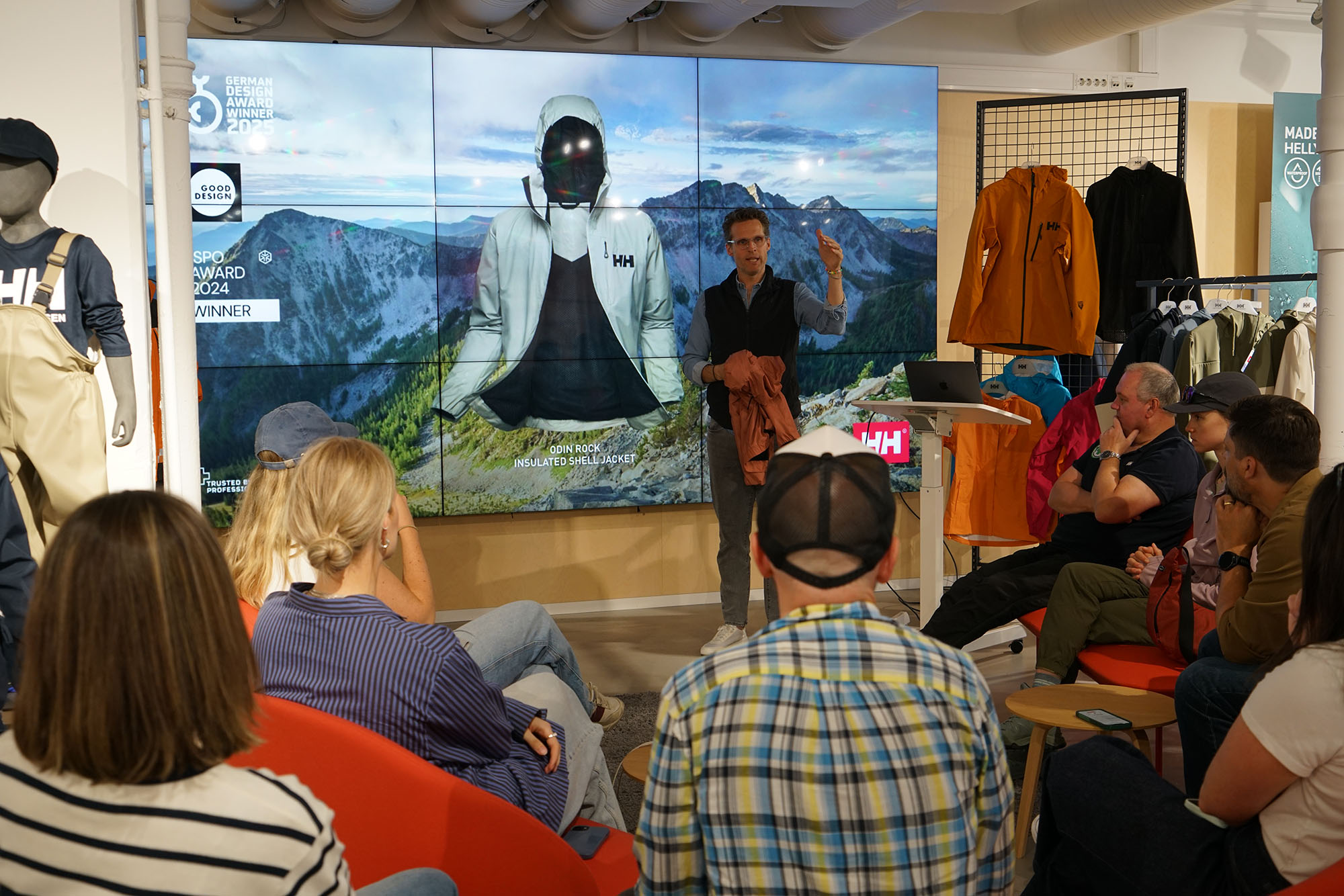

We proceed to a product overview with Philip Tavell, then-vice president at Helly Hansen. He gives us insight into how Helly Hansen delivers its “Trusted By Professionals” promise to 55,000 of them worldwide. It’s a process built on conversations and observations. “Sometimes people say [they need] something but act differently when they actually use the product,” Tavell explains.
“They make us improve. They make us be curious. They force us to find solutions that we didn’t know existed.”
When Helly Hansen designs a product, the company asks ski patrol, sailors, SAR volunteers, and other sleet-proof stoics to complain about what exists and what doesn’t. They try prototypes, destroy prototypes, and in the process expose what a garment should and could withstand. Their worst-case scenarios inform everyone else’s everyday rainwear.
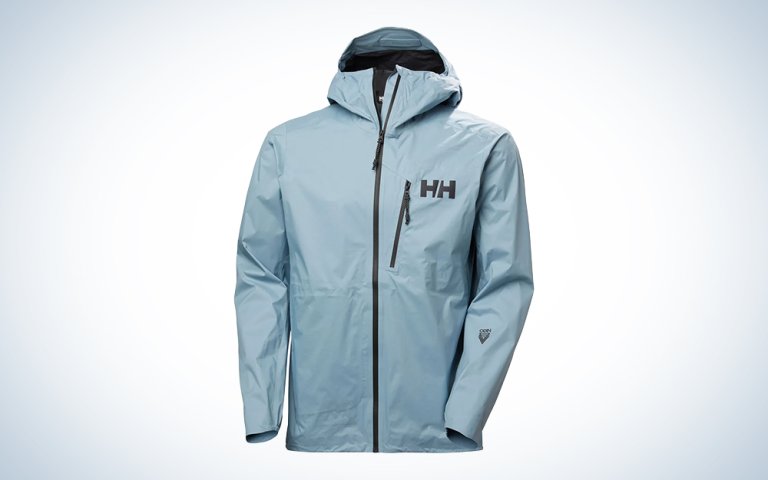
Helly Hansen ambassador Izzy Holmes gives a professional’s perspective on the input that goes into something like an Odin Infinity Minimalist Jacket. Mountain guides were searching for a waterproof, windproof shell in their pack that they “don’t even want to be able to feel,” Holmes explains. But they also needed something they could always count on when fast-moving alpine weather turns. What they (and us) got is just 7.6 ounces but still 3.5 layers, breathable and packable for high-output adventuring.
And Tavell acknowledges the women’s shell must be built with the same technical ambition as the men’s. Women in the field are doing the same work and facing the same hazards, so they voiced frustration that brands thought they should get a “dumbed-down version.”
Helly Hansen Odin Infinity Minimalist Jacket
An NPA representative reinforces the stakes: when conditions have everybody heading home, volunteers have to go out and help those who can’t get in, and at that point, “we can’t discuss if the clothing is good enough; it should just work.” For this reason, zippers are shortened because a waist belt needs space, and a pocket is removed because a harness makes it ornamental.
The accumulated failures that inform successful workwear then trickle down to aestheticized rainwear, even if the reflective details that make a SAR uniform recognizable are less likely to. But one thing that’s shared is a repairability focus when new products are constructed. Replaceable zippers, snaps, Velcro, and other mechanical spare parts that can keep a jacket in service are a cornerstone of sustainability.
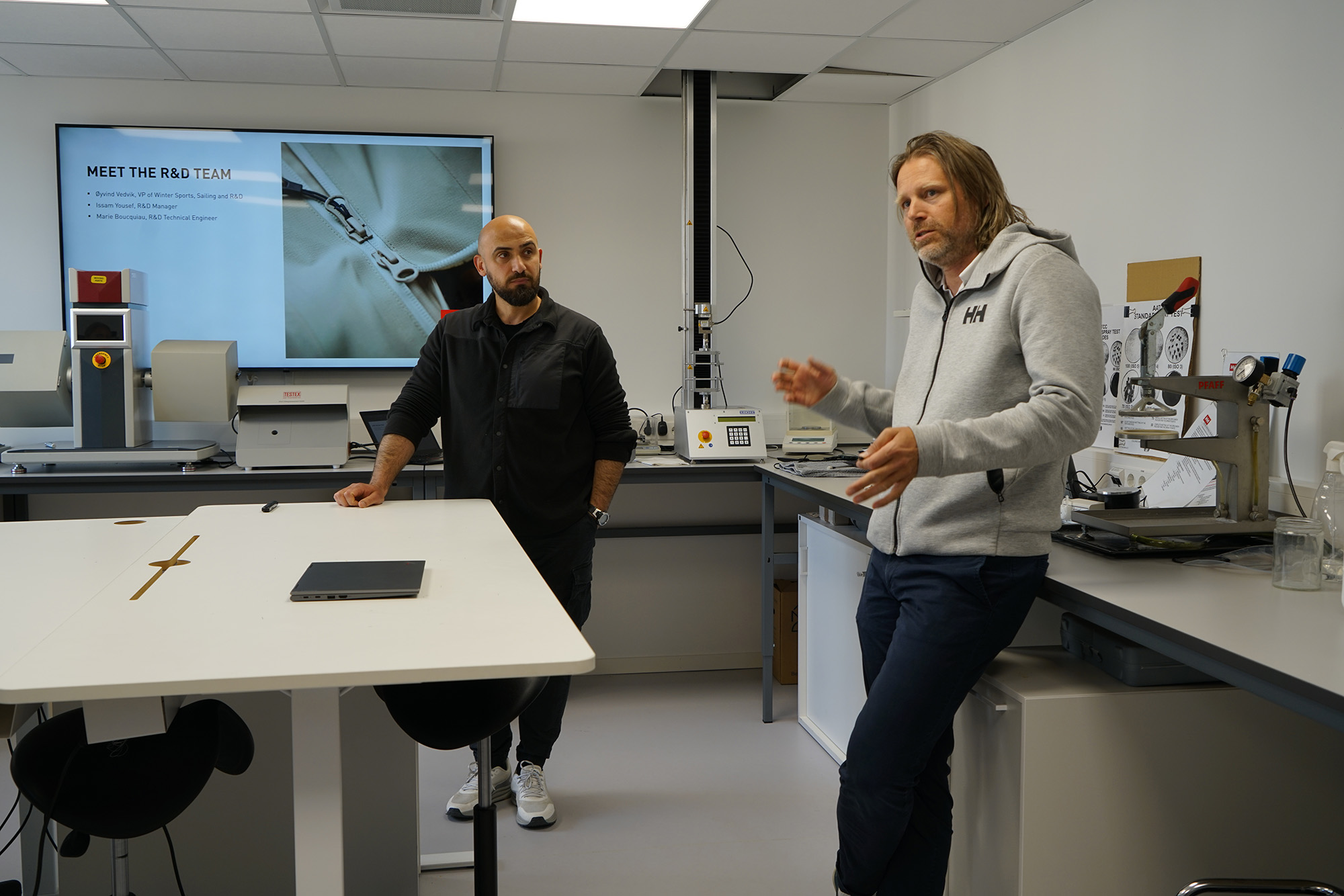
In-the-field anecdotes and accidents make for dramatic scenes and adjusted seams, but the stress tests begin way before fabric sees any vistas for validation. Off an unassuming corridor, Helly Hansen’s lab is where the indignities begin. Here, passing a standard test is merely a starting point. Shedding water for 30 seconds in controlled intervals doesn’t answer the questions asked by real-world exposure, which can last for hours. Something needs to address the grind of rain-soaked backpack straps on shoulders or the rub of salt-stiffened sleeves on sides. Somebody needs to account for the drag of oily hands on zippers or being dried badly, then stuffed into/pulled from a pack repeatedly.
The lab does its best to recreate and stretch past the conditions most clothes encounter. That means withstanding pressures, wet and dry abrasion, and punctures that bridge the gap between industry expectations and real-life weather, friction, and sweat, not to mention the lazy violence of daily use. We’re shown a waterproof test of the HELLY TECH Professional system that goes up to a 50,000-millimeter hydrostatic-head (HH) rating, though the promise communicated is an expedition-grade 20,000mm to be on the safe side.
Next to more traditional ways of measuring prolonged hydrostatic pressure or air permeability sit the custom chambers. There’s the cut-testing machine built around an actual ski edge, inspired by real Norwegian national team incidents. And then there’s the shock box. First, fabric samples, new and old, are turned into small bags loaded with tennis balls. Then, they are soaked, dropped, tumbled, scraped, contaminated, and just rudely treated with salt, sand, Velcro, sandpaper, and metal edges to watch the material age in fast-forward.
This accumulated abuse is all part of the proving ground for Helly Hansen’s signature waterproofing technologies. It’s also part of addressing the larger PFAS puzzle facing every shell maker. A waterproof jacket has to keep liquid out and let body vapor escape. And it has to do it through a laminate whose face fabric is absorbing physical punishment. So, it’s the lab’s job to make that contradiction measurable. They take field feedback and provide product managers with data that shows the full picture of what’s achievable.
Resisting wet-out used to be achieved in part with Durable Water Repellent (DWR) chemistries that repelled both water and oils. Per- and polyfluoroalkyl substances (PFAS) treatments moved surface energy down to roughly 6-12, good for both water and oils, we’re told in the lab. But the regulatory and industry-wide transition to PFAS-free hydrocarbon finishes hit roughly 25-30, enough for water repellency but only moderate oil resistance.
Helly Hansen’s top-tier no-added-DWR solution, LIFA Infinity Pro, took proprietary fibers developed in the 1970s for base layer moisture management and applied advanced textile engineering to heat and stretch them into a waterproof/windproof membrane. They then paired this sweat siphon with a highly breathable backer and a woven, inherently hydrophobic LIFA face fabric. In the lab’s language, the goal is to “let water-hating fabric do all the work by itself,” rather than overloading it with chemical treatments. That system came to market in 2020.
A newer iteration of LIFA Infinity is found in the Odin Infinity Minimalist Jacket. It utilizes a bicomponent ePP microporous membrane made without solvents and a recycled face fabric with a PFC-free DWR to facilitate an even softer, lighter, more pliable product. It’s a lot of invisible engineering … putting chemistry and construction and thought into a garment so reliability is the thing you don’t have to think about.
If Oslo supplied philosophy, and headquarters provided proof, the next stop offers perspective.
Pack on my back, To Helly & Back playlist of black metal and blackened rock in my ears, we shuffle to early a.m. shuttles. A short flight to Bergen and we’re back on a bus heading to Osterøy, one hour northeast and Northern Europe’s largest inland island. We’re welcomed at Klyvvikje, a greeting complete with folk costumes and hand-hammered artistry made in a blacksmith’s forge on the farm, a property in our hosts’ family for over 100 years. We’ll stay here overnight, not far from the village of Bruvik—though we only see that from above.
We have just enough time to snack and repack before we hit the trail. We arrive expecting one of the 200 to 240 days of downpours that annually sweep Bergen, the rainiest city in Europe, then continue into the nearby fjords. What we encounter is balmy, suspiciously kind. It’s downright disorienting. Temperatures pushing the 70s, out go the rain layers and out comes the Solen UPF 50+ sun protection. We’re only going on a day hike, but ounces matter when you’re ascending over 500 meters (1,873 ft). We head relentlessly uphill until we summit the Bruviknipa massif at 822 meters (2,697 ft).


After many, many stone steps and stacked curves, we’re greeted by a Norwegian flag at the summit register, plus a panoramic view of the Sørfjorden’s deep blue mountain mirror [shown above]. My Cascade Mid-Cut Hiking Boots maintain stability, and Helly Hansen Blaze Softshell Hiking Pants stretch stylishly as we complete our trek, around five hours and 9 kilometers (5.76 mi) round-trip.
Back at the farm [shown below], we set up our tents along the edge of the property, guests appreciating the hospitality you don’t get hut-to-hut hiking. But if there had been any more space between the farm and the water, we might not have even had to ask permission. Norway’s 1957 Outdoor Recreation Act codified that anyone and everyone has the right to hike through and camp on any land at least 150 meters from an occupied structure. Just leave no trace. This makes it easier to access the 20,000 kilometers of marked hiking trails and over 500 cabins maintained by Den Norske Turistforening, the Norwegian Trekking Association.
The mountains’ lavender silhouettes soften against the luminous half-light sky as we crowd around a fire and raise Aquavit to a rewarding day of good weather and goodwill. Skål! (“cheers!”) rings out repeatedly alongside the would-be clink of our paper cups. The sun may not want to go to bed, but I do.


We wake up to homemade waffles and dockside yoga, all safely recovering from yesterday’s calf-burning climb.
But what if we hadn’t? That’s the question posed as part of the morning’s dramatic RECCO demo.
Using a makeshift fjord-side landing pad, pilots from a SAR team based in northern Norway land a helicopter [shown below]. With them are representatives of the Swedish reflector-and-detector system, which is incorporated into several products we’ve been carrying, like the Odin 9 Worlds 3.0 Shell Jacket and Resistor Backpack, and could be key to a successful recovery mission.
But the product’s origin story begins with tragedy: founder Magnus Granhed lost a friend in an avalanche and, according to RECCO’s Gustav Crenér, “just sort of walked around with a ski pole trying to locate his friends.” From that helplessness came a mission “to make people in the outdoors searchable and help organize rescue, to save lives.”
Developed with friends at Stockholm’s Royal Institute of Technology, the technology [shown below] is almost disarmingly simple at the wearer’s end. The reflector is “a piece of copper, pretty much, with a diode in the middle,” Crenér explains. It weighs about 4 grams, contains no battery, and is “100% passive,” meaning it is always functional unless physically destroyed. These thin metal wafers are easily sewn into garments and equipment: jacket brims, pack top lids or haul handles, near sleeve cuffs or lower legs. They are not typically placed against the chest, however, because the water content of the human body can block effectiveness, especially if a buried wearer is face down.


A detector sends out a radio signal that, when it hits the reflector, echoes back an audio cue rescuers can follow. A handheld version, used by ski patrols, police, military, ambulance personnel, and other professional responders, weighs roughly 950 grams. Crenér describes it as standard avalanche-rescue kit alongside transceivers, dogs, and probes, but he is careful to frame RECCO as “an additional layer of safety,” not a replacement for comprehensive gear or common sense.
The helicopter serves as the ultimate extension of the RECCO detector. An airborne detector, which hangs roughly 10 meters below the helicopter to send energy downward, is about “100 times more powerful” than the handheld unit. Crenér explains that its mass, about 80 kilos, helps hold it steady as it operates about 100 meters up and 100 kilometers per hour, scanning a corridor roughly 100 meters wide. This allows it to cover a square kilometer in six minutes.
All of this is weather permitting, of course. The helicopter system is best deployed for bigger summer searches, like finding a mountain biker, mushroom picker, or hunter. Or for finding a hiker, as we soon see simulated. While the trail we took the day before seemed benign on our idyllic afternoon, that same path could be dangerous once the light dips or someone slips. Taken up in small groups, we do a sweep in the direction of the mountain we traversed. In our headsets, we hear quickening feedback and watch a meter flash red [shown above] as we approach a reflector stashed strategically in a gully.
Helly Hansen Loke Jacket
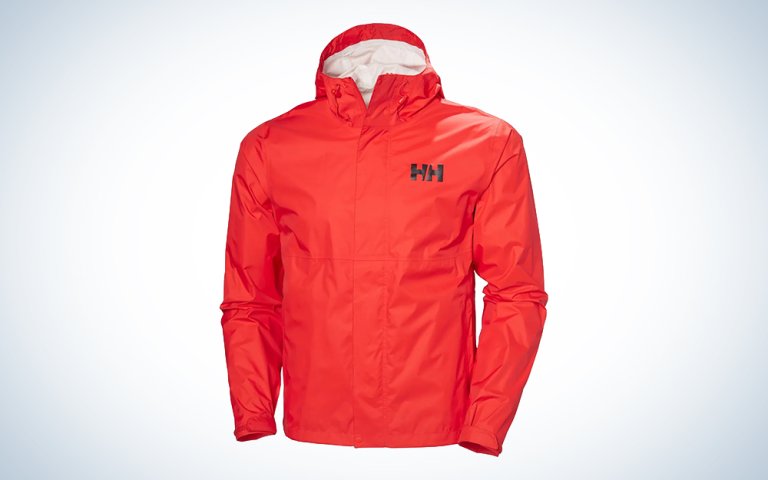
A RECCO-equipped jacket plays an important role for both the wearer and SAR organizations, as reflector sales help place detectors and train personnel without cost to rescue teams. Typically, however, the RECCO badge has been associated with winter and ski wear. Or, at the very least, a premium price point, like the $400+ Odin 9 Worlds or Odin Infinity Minimalist jackets. Helly Hansen, however, saw an opportunity to make more people searchable and fund more detectors in the market, so they started putting RECCO in the 2025 Loke Jacket, its most affordable, high-volume shell.
After all, Helly Hansen’s annual Open Mountain Month events encourage and empower people to connect with the outdoors and each other (with guidance from professionals). And if you’re going to push for that, part of the social contract is making safety feel less like a luxury upgrade and more like a shared responsibility.
Two days later, back on land and back in Bergen, it’s finally rainy enough to put the Odin 9 Worlds 3.0 Shell to good use. Taking advantage of my limited time and growing tolerance for precipitation, I wander the harbor’s cobblestone contours, secure in a garment that will hold up. And, should curiosity carry me into some troll-infested, goat-inhabited forest beyond city limits, it could also help a rescue team narrow the search. Helly Hansen can’t make the elements disappear, but it can minimize the messiness of meeting them head-on, a technical expression of the old Scandinavian conviction that there’s no such thing as bad weather, only bad clothing.


