
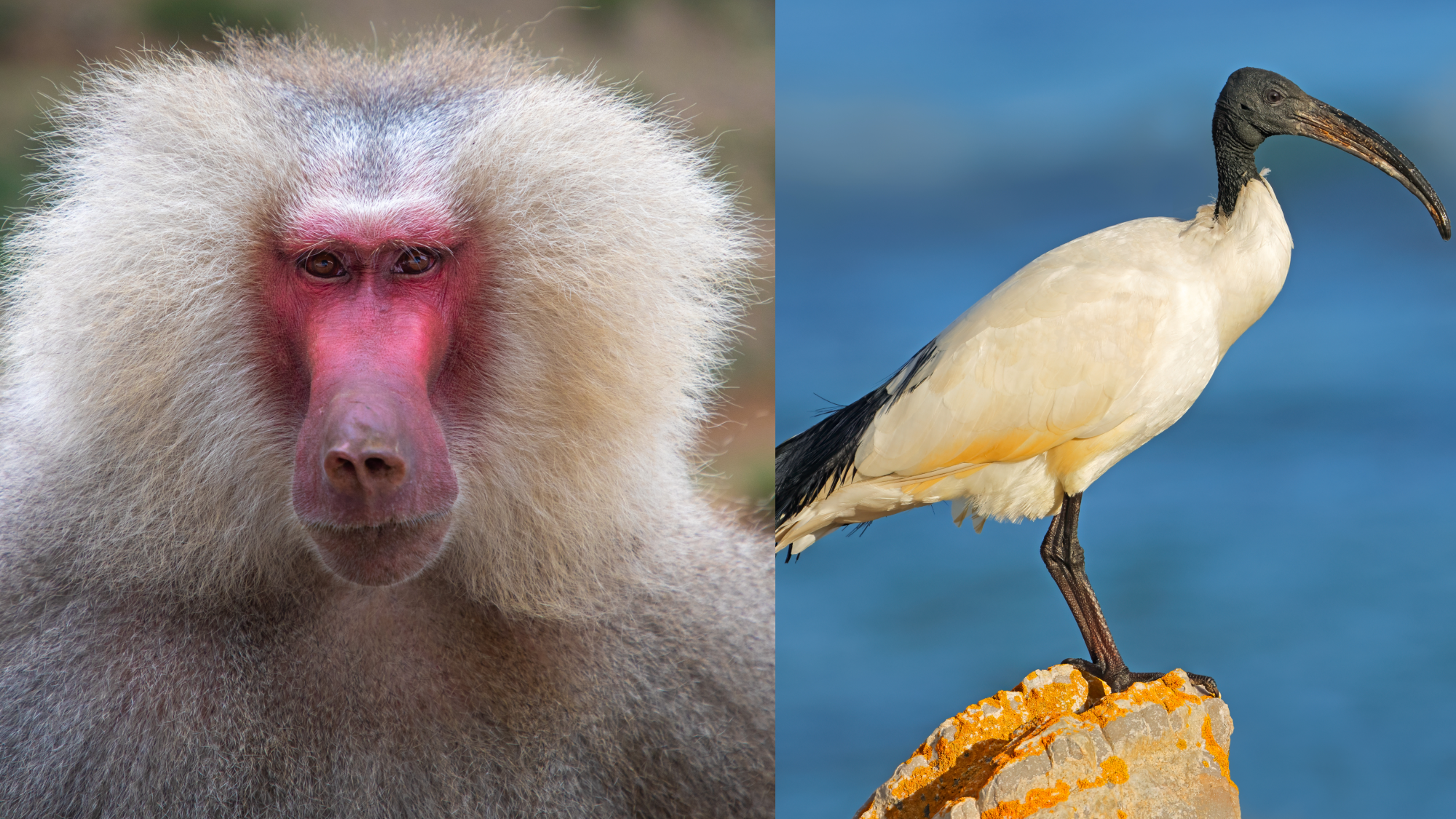
Why do ancient deities appear as certain animals? In the case of an ancient Egyptian god named Thoth, the relation to its animal might be related to moonlight. Thoth was a god of magic, writing, wisdom, and the moon, and frequently appears either as a baboon or with the head of a large bird called an ibis. But we don’t really know why.
Recent work has tracked the roots of Thoth’s Egyptian name back to “bright/white thing” in North African linguistic terms and made associations with the bright white feathers of African sacred ibises, several of which have been found mummified in several ancient Egyptian burials. Furthering this line of research, a team of scientists has now investigated the colors of both animals and found that they both reflect light very similar to moonlight.
“We examined the two species of baboon accessible to ancient Egyptians, P. anubis [Papio Anubis] and P. hamadryas [Papio hamadryas], along with T. aethiopicus [Threskiornis aethiopicus], and found that the grizzled hair of P. hamadryas and plumage of T. aethiopicus have spectral profiles indistinguishable from moonlight,” the authors wrote in a study recently published in the journal Time and Mind.
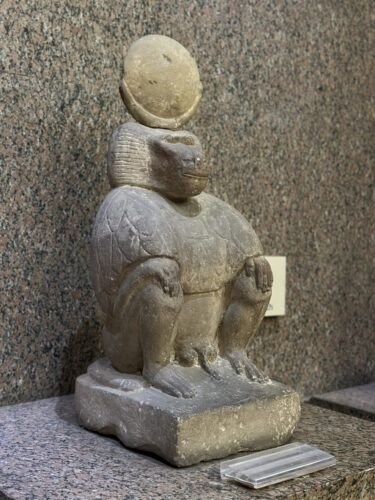
The team measured the light wave frequencies reflected from the animals using an approach called spectroscopy. With this technique, researchers can avoid depending on subjective color perceptions. They ultimately found that the colors reflected by both hamadryas baboons and sacred ibises are just like moonlight, adding credence to the theory that these animals were made godly because of it.
“Why would two such different animals be used to represent one deity? Most other Egyptian deities are represented by just one type of animal. Ancient Egyptians were familiar with at least three species of ibis, but they chose the white one for embodying Thoth. They were also familiar with two species of baboon, along with vervet monkeys and patas monkeys, but again they chose the silver-white species,” Catherine Hobaiter, a primatologist at the University of St Andrews and lead author of the study, said in a statement. “So, sacred ibises and hamadryas baboons are different in many ways, but one thing that unites them is their moon-like colour.”
Many African cultures today dislike baboons, according to the statement, mostly because these primates destroy crops. Ancient Egyptians, however, went as far as to deify them, perhaps because they are moonlight-colored.
