
Fixing a Burn Injury PNAS

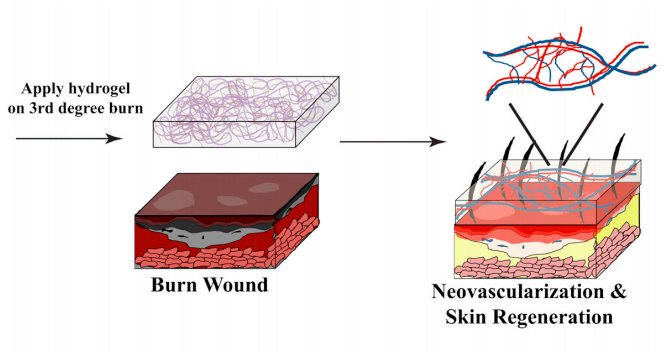
Tissue engineering and tissue healing have a common complication — it’s difficult to build new blood vessels throughout the rebuilt skin, but vasculature is required to keep the skin alive. This is especially problematic for victims of severe burns. A new customized sugary gel substance can work wonders to re-grow skin and the associated blood vessels, according to researchers at Johns Hopkins University.

The method involves a specially designed hydrogel, a water-based polymer. This one is made of mostly water with dissolved dextran, a type of sugar, and polyethlyene glycol (a common substance found in everything from antifreeze to laxatives).

We have seen hydrogels used before in creating artificial skin — last winter, Rice University researchers used a PEG hydrogel, doped with human growth factors and platelets, to induce the growth of artificial vessels. But this new one is interesting because the researchers didn’t add anything — no growth factors or anything else. This particular hydrogel’s physical structure apparently rendered that unnecessary. The researchers aren’t even certain how this happened.

Sharon Gerecht, an assistant professor of chemical and biomolecular engineering, and her postdoc Guoming Sun set out to use their hydrogel as a wound dressing for severe burns. An artificial skin dressing offers greater protection against infection and promotes healing better than other types of wound coverings, they say in their paper, published in this week’s edition of the Proceedings of the National Academy of Sciences.

In a study involving mice, the researchers removed badly burned skin from the center of a burn wound, and covered this opening with the hydrogel. As a control, they covered some wounds with a material derived from cow collagen, which is currently used to treat human burn victims at the Hopkins Burn Center. The other wounds were left alone with just the hydrogel.

After three weeks, the hydrogel worked even better than the control, the researchers say. This was a surprise, so the team worked out a supplementary study to determine why the hydrogel breaks down so readily and how the animals' bodies were able to use it to generate new dermal tissue. It turns out that the body’s natural inflammatory response — involving neutrophils and macrophages — accumulated easily inside the hydrogel. Its physical structure enabled their easy entry, which promoted the breakdown of the hydrogel and enabling blood vessels to fill it in. Gerecht also believes the hydrogel might recruit bone marrow stem cells, which are naturally induced to differentiate into skin and blood vessel cells.

This is good news, because the faster this process happens, the less chance there is for scarring, Gerecht said in a Hopkins news release.

“Our study clearly demonstrates that dextran hydrogel alone, without the addition of growth factors or cytokines, promotes rapid [vessel growth] and complete skin regeneration, thus holding great potential to serve as a unique device for superior treatment of dermal wounds in clinical applications,” they write.

[ScienceDaily]

13 Comments

This is wonderful good news medical science! I look forward to its future development! YEA!

I hope the cosmetic (the vane peoples) industry does not drive up the price of this.

I like to see people of serious need get the help they need at low cost.

.............................
Science sees no further than what it can sense.
Religion sees beyond the senses.

Bacta!

@Robot, I would almost assume the cosmetic industry would be the number one user of this. Remember, cosmetic surgery is not always about vanity. It's utilized to fix deformities, injuries and improve the way of life for children and adults. It's not always about ego, or making yourself prettier. Also, if Rich Vain people want to be early adopters and help push this into the realm or the common man, more power to them.

@robot: Broader use of this in "cosmetics" such as healing without scars after surgeries, will increase the amounts used, increasing production, increasing economies of scale and profitability of production allowing prices to go DOWN. More use means cheaper!

It must suck to be a mouse.

@everyone getting on Robot

not sure thats what they were trying to get at but good job trying to troll them and twisting their words

@racinjetford, you are correct in your reasoning for a competative product where lower cost means higher market share. What you don't take into account is the desirability factor - you would be happier selling 500 for $25 rather than 1000 for $10. Obvioulsy this is exagerated

Granulated sugar has long been used to treat pressure sores on bed ridden patients. Studies have shown that honey is even more effective than sugar. In this age of technology and modern pharmacueticals we shouldn't be so quick to discount the "old wive's tales" and traditional remedies.

woundsinternational.com/case-reports/the-use-of-granulated-sugar-to-treat-two-pressure-ulcers

I wouldn't worry about the cosmetic industry driving up the cost. If anything the pharmaceutical industry will.

Science always asks "can we," but doesn't seem to ask "should we."

I'm looking forward to the day when technology like this comes in a $20 first aid kit from Walmart. Bring on the medical nanobots!

Science always asks "can we," but doesn't seem to ask "should we."

I'm with democedes

BACTA!

I had a closing statement above and I still very much stand by it.

"I like to see people of serious need get the help they need at low cost!"

.............................
Science sees no further than what it can sense.
Religion sees beyond the senses.

sweet, breat implants without the scars, deliciously doable


138 years of Popular Science at your fingertips.

Innovation Challenges


Popular Science+ For iPad

Each issue has been completely reimagined for your iPad. See our amazing new vision for magazines that goes far beyond the printed page


Download Our App

Stay up to date on the latest news of the future of science and technology from your iPhone or Android phone with full articles, images and offline viewing


Follow Us On Twitter

Featuring every article from the magazine and website, plus links from around the Web. Also see our PopSci DIY feed


March 2012: The Future of Medicine

A 10,000-rpm, no-pulse heart is completely revolutionizing how we think about transplants. Plus: rapid-response virus hunters, a shocking cure for migraines, the world's youngest person to have achieved nuclear fusion (in his parents' garage!), and much more.


circ-top-header.gif
circ-cover.gif