

1. “YOU TURNED AROUND”
I was visiting my hometown of Del Rio, Texas, when my grandmother told me she had seen a drone flying over El Indio, a tiny village just east of the Mexican border, about 75 miles down the river. The newspapers that summer were filled with stories about the Predator drones poised to patrol the skies above the Rio Grande, but the date of deployment was not yet at hand, and in any case Predators ordinarily fly far too high to be seen from the ground, so I decided to take the afternoon to drive down to El Indio and investigate.
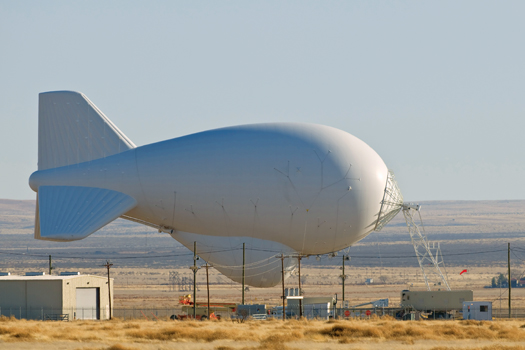
As a lone male in a rented minivan headed south on a remote stretch of border highway, I almost certainly fit some kind of profile. I passed several white pickups bearing the distinctive green stripe of the U.S. Border Patrol, but my first direct encounter with the authorities did not come until I pulled off the road to study with my binoculars a white speck that I had spotted high in the cloudless sky. It was not a Predator or any other UAV that I had ever seen or read about. It looked like a blimp. I put down my binoculars just as another of the green-and-white trucks pulled up. We both lowered our windows and I asked, in my best Texan, what that thing was floating up there in the sky. “It’s a weather balloon,” the officer said with a smile. I thanked him, and we both waved as I drove off, still headed south.
The borderlands where I came of age had ceased to exist. But I did not yet comprehend what was taking its place.In El Indio, I stopped to buy a Dr Pepper and asked the old lady behind the counter, in my best Spanish, whether she knew anything about that white thing up in the sky. She did not. I decided to inquire at the post office, but it was closed. I was wondering what to do next when a minivan pulled up. I asked the driver if she knew what that white thing was up in the sky.
“It’s a satellite for the drugs,” she said. “My brother-in-law works for it.” A boy chimed in from the backseat that if I kept driving south I’d see “the building that controls it.” I thanked the woman and her boy and continued on my way. Border Patrol vehicles continued to pass me coming and going, and, as I neared the base of what I could now see was in fact a tethered blimp, one of those trucks quickly pulled up right behind me and showed no sign of passing. Although I was doing nothing illegal, I began to sweat. Soon I drove by a couple of white buildings, in front of which was a sign: United States Air Force Tethered Aerostat Radar Site.
That settled the question. The tethered radar blimp (I have since learned) is a relatively old surveillance device, part of a system deployed decades ago when drug smugglers were having a grand time flying over the border with their cargo. I’ve seen another aerostat on the ground in West Texas, near Marfa. Rumor has it that one of them got loose in a high wind and was blown almost to Oklahoma.
Having attained my goal, I was now confronted with the more urgent question of what to do about the Border Patrol vehicle that was so determinedly following me. I had never driven this stretch of highway before, and I feared I might drive for hours before reaching another human settlement. I spotted a place to pull over and decided to turn around. That’s when the flashing lights went on behind me. I stopped, several more trucks pulled up, and soon men in green uniforms were peering through all the windows of my vehicle. “What seems to be the trouble, officer?” I asked. “You turned around,” came the reply.
The lead agent was friendly enough, but he was insistent in his inquiries. He wanted to know what I was doing out there on a remote stretch of highway not far from Mexico. My explanation, that I had driven south from Del Rio because I was curious about the security infrastructure that had materialized along the border in the 25 years since I loaded up my car and drove off to college, struck him as implausible and weird. I fought the urge to become indignant, to assert my right as an American citizen to go where I pleased on a public highway. Instead I explained again that I was curious about that blimp up there, the aerostat. Eventually, after much discussion, it was determined that I had not committed a detainable offense, and I was permitted to continue on my way, at liberty.

2. “A VIRTUAL FENCE”
Driving back up the line to my grandmother’s house, as I passed one curiously discontinuous segment of 18-foot-tall border fence after another, I brooded over the larger meaning of my encounter with the authorities. I had long nursed the belief that the borderlands where I came of age, in which my neighbors and my family and I had crossed the river to Mexico weekly if not daily with a minimum of inconvenience, had ceased to exist. But on that bright summer day in 2010, I realized that I did not yet comprehend what was taking its place. I had only begun to understand the complexities of the modern border and its intricate economies of authority and surveillance. So I decided to investigate, to experience the border complex as a sympathetic journalist rather than a suspect tourist.
My initial question was relatively simple: How does the border work? What devices and systems have we invented to secure a 1,954-mile international boundary—of river valleys and canyons, mountains, deserts and vibrant communities straddling both sides of the line—that people have crossed more or less freely for hundreds of years? What I discovered, over weeks and months of reporting, is that no real agreement exists among policymakers about how to define the border itself. Is it an obstruction or a conduit? A military domain or a civil and commercial one? Is it meant to join communities or keep them apart? I searched in vain among the pronouncements of our political leaders for clarification of such questions.
What was once little more than a line on a map has become a theater of operations.Despite this ambiguity—or perhaps as a result of it—the federal government has since 2003 doubled the flow of funds to Customs and Border Protection, the division of the Department of Homeland Security with primary responsibility for policing the border. CBP, which encompasses the Border Patrol, has in turn deployed increasingly advanced means not only to scrutinize, search out, and seize an immense stream of drugs and bodies (to use CBP parlance), but also to channel a concomitant river of data—electronic manifests, lists of travelers’ names, dates of entry, and untold terabytes of video footage—all of which must be analyzed, quantified, indexed, and stored.
Technologies of surveillance and control all aim to achieve a perspectival advantage over some adversary, but the vast quantities of data produced by these devices threaten to overload the system, thus defeating the original goal. Fusing those rivers of data into a comprehensive and intuitively manageable real-time graphical interface, for instance, had been one of the foremost aims of the Secure Border Initiative Network, or SBInet, the federal government’s doomed mega-contract with Boeing to build a “virtual fence” along the nation’s borders. In January 2011, after five years of effort and more than $1 billion had yielded a mere 53 miles of partially operative tactical infrastructure in southern Arizona, the Department of Homeland Security canceled SBInet. It was not yet clear what would take its place.
Despite the failure of SBInet, the border is increasingly defined not by geography or war or acts of Congress, but innovation. Border-control assets—from radar blimps to Predator drones to virtual fences and other military-grade surveillance machines—are evolving rapidly, if imperfectly, and with them so is the border itself. What was once little more than a line on a map has become a theater of operations.
3. “I NEED TO TALK TO YOU”
My investigation began in Brownsville, Texas, on the front line of what some have taken to calling a border war. Brownsville lies just above the mouth of the Rio Grande, at the southern tip of the largely Spanish-speaking urban sprawl of 1.2 million people that fills the lower Rio Grande Valley. My initial destination was a Border Patrol station, where I would visit a state-of-the-art command-and-control center. When I arrived at the station, just in time for the 4-p.m.-to-midnight shift, I was immediately confronted with one of the reasons they call it a war.
Customs and Border Patrol does not expect, or want, to stop everything that crosses the border.At the daily muster, where Border Patrol agents get their marching orders for the day, much of the talk was about Jaime Zapata, a special agent with Immigration and Customs Enforcement who had been shot dead six days earlier by members of Los Zetas, a Mexican drug cartel, at a roadblock several hundred miles south of the border. Zapata was both a Brownsville native and a former Border Patrol agent, so his murder was a major event. After his funeral, hundreds of law-enforcement vehicles, sirens wailing, would pass through the city as residents lined the streets waving American flags. Some of the agents I spoke to attributed the relative quiet along the border that week to the Zapata killing—the bad guys were waiting to see what the American response would be. The Gulf Cartel, a rival organization whose own war with the Zetas for control of transborder commerce had resulted in more than 1,000 deaths over the past year, denounced Zapata’s killing. “It’s clear that the federal government should act without delay against these assassins,” the cartel said in a statement. “Because the spilling of blood in the country is now drowning society.”
I was unable to attend the Zapata funeral, but I would eventually see high-definition video footage of the burial ceremony taken from a CBP helicopter. The video was shot from about three miles out; the mourners were probably not even aware that a helicopter was in the area. I watched playback of that video feed on the Web portal of a system called the Big Pipe, a surveillance network developed by Kenneth Knight, the deputy executive director of national air-security operations for the Office of Air and Marine (OAM), a lesser-known division of CBP that operates the largest law-enforcement air force in the world.
Knight is a physically imposing, ruddy man with a disarming Midwestern accent. When we met in Brownsville, he was dressed in the khaki jumpsuit that all OAM pilots wear, and it turned out that he was a helicopter pilot himself. I had no idea who he was, but he already knew about me. “I need to talk to you,” he said, decisively hijacking my tour of the station. Knight was in town to coordinate air support for the Zapata funeral, and he didn’t have much time for me right then, but he gave me a quick briefing on the Big Pipe and then invited me to Washington, where he promised to give a more detailed demonstration of his project’s capabilities.
What was the Big Pipe? The answer wasn’t clear at first, but Knight emphasized the concept of “total domain awareness” and strongly suggested that he possessed the means of attaining that state. Based on the briefing I received in Brownsville, the Big Pipe sounded like it might be the framework for the elusive “common operating picture” that would integrate and rationalize the increasingly unwieldy data streams generated by our high-definition surveillance systems. Perhaps the Big Pipe could succeed where SBInet had failed.
4. “THE MIKE SIDE”
Late that afternoon, when the low angle of the sun was beginning to lengthen the shadows, agent Dan Milian took me down to the Rio Grande to get a closer look at the border itself. Weedy, fast-growing brush often chokes the meandering banks of the Rio Grande as well as the no-man’s-land between the river and the border fence. Carrizo river cane, an invasive species that aids and abets the passage of other such species, grows everywhere. Narrow trails snake through the tall grass.
The Brownsville & Matamoros Bridge, the oldest crossing in Brownsville, loomed behind us as we walked along the river. Broken shards of glass twinkled in the dense ground cover, and thick vegetation did a good job of hiding the ubiquitous debris of human civilization: cast-off soft-drink bottles and small articles of clothing, socks, T-shirts, a sneaker. Torn black plastic trash bags rustled in the light breeze, especially along the landing spots worn slick from the passage of illegal bodies who slip out of the oily black nighttime river, briefly pause, quickly pull dry clothing and supplies from the trash bags, and then dress themselves and furtively crawl, scramble, or run toward the black steel pickets. The fence can be climbed, and so they climb.
In 2006, Congress mandated the construction of a new barrier along the southwest border, and since then contractors have built just under 700 miles of such fencing, at an average cost of $2.8 million per mile. Environmentalists and cynical bystanders in the border communities hate it. Farmers who are cut off from their fields resent the inconvenience. People whose homes ended up on the wrong side of the fence feel sacrificed and abandoned. Ocelots and other lovely wild creatures are said to be experiencing disruptions of their migratory wanderings. Smugglers, meanwhile, have used a catapult to hurl drugs into Arizona, as well as a portable ramp that permits vehicles to drive right over the fence.
It’s easy to laugh at fencing that abruptly ends in a tangle of brush. But agents here say they love even the intermittent version because it gives them a bit more time to respond to border-crossing attempts, which in Brownsville must be measured in seconds. The fence adds perhaps a minute to the equation, Milian told me, and it also channels the flow of aliens away from populated areas out into the brush, where the response time is measured in hours and days.
A heavily trafficked and well-maintained dirt road ran alongside the border fence. Dust lay thick on the ground and offered up a rich testimony to a tracker versed in the art of sign cutting. Agents drag bundles of tires behind their vehicles along such roads, both here on the line and out in the brush country far from the river, and check back periodically to see if any signs have appeared. The best trackers can tell from a footprint whether the body in question is heavy or light, fit or exhausted, his approximate age and height, how fast he is moving, whether he is carrying a load, and how heavy that load is likely to be. I’ve been told that at least one agent can cut sign from horseback at a gallop.
We were in the middle of town, right next to a port of entry. The river was perhaps 10 yards across, and the railroad bridge of the port not more than 50 yards away. Even here, they cross. We walked down a trail looking for fresh signs of traffic, and I noticed how much thicker the brush was on the other side. We observed no signs of human activity, but such appearances were deceptive. Matamoros was right there; people lived and worked and performed their daily routines just a few hundred yards away. Down here, the cartels often employ spotters to watch the river. Sometimes they fish, but often they just sit and watch from the bank, staring with impunity and insolence or maybe just boredom. The cartels choose when and where to cross; they control the other side, the “Mike side.” They own the monopoly on human traffic just as they do the traffic in drugs. No one freelances anymore.
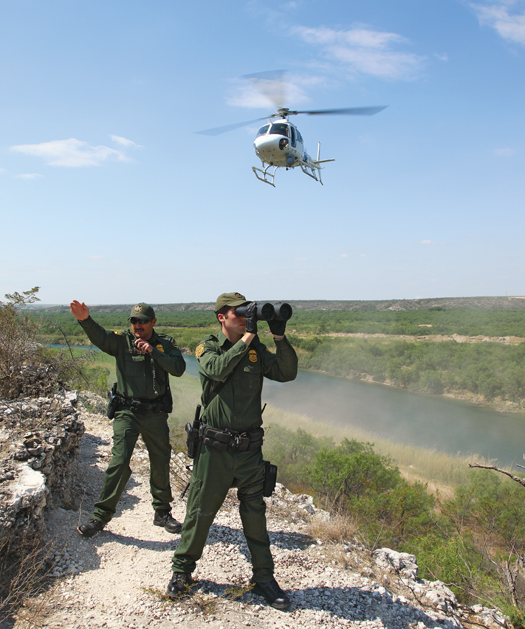
On our side, a Border Patrol camera tower looked almost pretty against the evening sky as it peered, from a height of 60 feet, up and down this broad bend in the river.
5. “BUGS”
Back at the command-and-control center a few hours later, I found myself on the other side of that camera, studying the same stretch of the river. The shift in perspective was dizzying. Twenty large screens lined the front wall of the control room and flickered from one surveillance camera to another; a television in the middle of the wall had been tuned to Fox News. Agents sat behind desks, scanning the monitors and occasionally speaking on the radio with agents in the field.
Smugglers are often stupid, and sometimes they are greedy. They are just as frequently ingenious, however.The Rio Grande Valley sector employs dozens of Remote Video Surveillance Systems, most of which are on fixed towers. Each RVSS is made up of four cameras, two of which are infrared for night duty. The agents who are assigned to camera duty in the control room zoom and pan the cameras as needed. At night they can manipulate the contrast of the infrared video, shifting from “black hot” to “white hot,” rewinding and forwarding through the digital file as needed to identify what is often merely a fleeting glimpse of an unidentified animal, possibly human. Sources of thermal energy abound. Rocks, concrete blocks and even the plants radiate heat, but warm-blooded animals stand out most vividly, and they move.
A seismic sensor buried alongside an active trail detects foot traffic and transmits its radio signal to the command center. Such unmanned ground sensors have been used for decades, but engineers continue to reduce their size and increase their sensitivity. Border Patrol agents have placed some 11,000 sensors along the U.S. border, and they move them constantly in an effort to keep up with the ever-shifting traffic patterns along the infinitely forking paths that radiate outward from the line.
Agent Jose Mancillas demonstrated what happens when he receives a signal from a ground sensor. He glanced left to a small screen displaying the current locations of his “bugs” and quickly typed a few keystrokes. One of three large flat-screen monitors at his desk instantly displayed a river camera’s infrared image. Using a joystick controller, he panned the camera and zoomed in. There wasn’t much to see just then, so he pulled up a file of a recent incursion. Eight ghostly white bodies sprang out of the brush and sprinted in an awkward hunkered-down posture toward the steel pickets of the border fence. They had activated the sensor about 50 yards south of the levee, three miles away from the Rio Grande. As soon as he had confirmed that there was traffic on the move, Mancillas had hit the radio, alerting a unit he knew was standing by just around the bend. We watched several members of the group perch on the fence; then the agents came into view and the aliens retreated. One leaped all the way from the top of the fence and hit the ground hard. We all winced. But he got up and ran south, back toward Mexico, with the rest of his group.
Suddenly all motion stopped. The file ran backward as Mancillas worked the controls of the NetGuard-EVS video client. He wanted to show me additional footage of recent traffic. Often you get just a flash of white, and it takes an experienced eye to determine whether to respond. The cameras are a good tool, but they can’t see everything, and the harsh South Texas weather degrades their performance. In January, during a severe cold snap, the cameras simply froze in place.
6. “A HUGE DIFFERENCE”
Upriver from brownsville lies McAllen, a more affluent community where local conditions, both natural (thick brush) and political (height restrictions), have prevented the deployment of remote video surveillance towers. Here the Border Patrol employs mobile surveillance systems that can be moved to hotspots as needed. Agent Jaime Medina joined us in McAllen and led an excursion into the broad fields that run alongside the levees that crisscross the fertile floodplain next to the Rio Grande.
Driving along a levee in the dark is a disconcerting experience. The land drops away sharply into an abyss of chirping crickets, singing frogs and other loud, gregarious creatures of the subtropical darkness. As I traveled with agents Milian and Medina through a night in which all fields were black, I had to strain my eyes to find some landmark. I tried to imagine what it was like patrolling out here with nothing but flashlights and a good sense of direction. We finally came to a “scope truck,” a pickup with a 20-foot retractable camera tower mounted on its bed. As with the stationary tower systems, the scope truck can shift between daylight and infrared viewing. We were parked on a kind of promontory or juncture in the levee. In daylight we no doubt would have been treated to a spectacular view of South Texas’s agricultural production. Historically, most of these vast fields have been worked by Mexican migrant workers, many of them undocumented.
Border Patrol officers monitor this area day and night, using scope trucks and also personal night-vision equipment such as the TAM-14, a short-range thermal monocular, and the Recon III Lite, a heavy thermal binocular, often mounted on a tripod, that includes a laser targeting system. The laser can guide agents wearing night-vision goggles to a group by fixing them with a beam invisible to the naked eye but brightly apparent to anyone wearing the proper eyewear. Such equipment, which was in short supply in previous years, is now widely used. After an impressive demonstration of the scope truck’s long-range thermal camera, the agents offered to show me the laser; wearing night-vision goggles, I was able to clearly see the red beam as it targeted a spot near the river.
Airplanes, helicopters and drones can highlight targets using similar devices to even greater effect. I later rode in a helicopter equipped with a FLIR Star Safire HD camera that was sensitive enough to detect the heat signature left by a body in high grass long after the body itself had moved on. The Star Safire comes equipped with a laser targeting system and a powerful infrared spotlight that can be slaved to the camera, and thereby bathe groups of aliens in a light they cannot see. As Mancillas had told me in the Brownsville control room, “it makes a huge difference when you can see in the dark.”
7. “WE SEE IT”
CBP does not expect, or want, to stop everything that crosses the border. Facilitating the flow of commerce is central to its mission, and as a result Laredo is, on a given day, the busiest commercial “land port” in the U.S. When I visited the World Trade Bridge there, the facility was nearing the end of an expansion project that would double the number of primary lanes used to help process the 1.5 million trucks that pass through the port every year.
The primary question taking shape in my mind was: Where and how would the limits of the border domain be set?Jose Uribe, the port’s amiable and efficient assistant director, described his operation as he drove us across and against oncoming truck traffic, dodging and weaving like a veteran player of Grand Theft Auto. To my inexpert eye, the scene was a chaotic riot of monstrous trucks and looming, barn-like scanners. Five thousand trucks a day on average, laden with every conceivable commodity—blue jeans, auto parts destined for just-in-time delivery to a factory in Tennessee—pass through this facility. “I’ve been in Laredo for 34 years,” Uribe told me. “I can remember back in the late ’70s we had mostly curios, some heavy steel.” Then came Nafta. “Now, you name it and we see it. Everything from laptops to three-piece suits.”
As Uribe’s tour progressed, patterns began to emerge before my untrained eyes, and I could see that the operation here was a miracle of logistics. Each vehicle, as it passed through the layered enforcement process that began with the submission of an electronic manifest at least one hour prior to its actual arrival, was tracked from station to station. At any point, a customs officer could create an “issue”: tagging the shipment for more-intensive scrutiny, which might mean submitting to a higher-resolution x-ray scan or offloading the complete contents of a shipment.
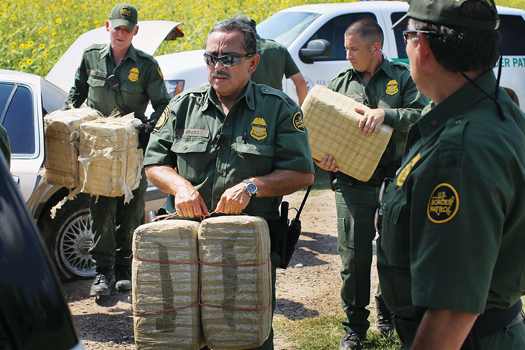
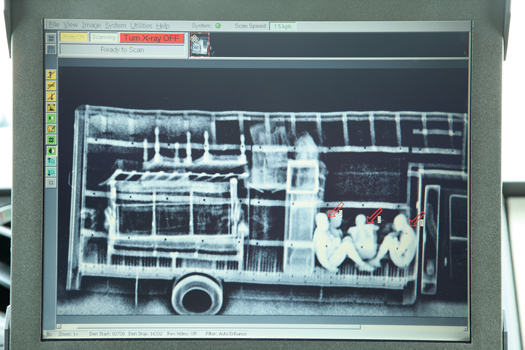
Inspectors at the World Trade Bridge deploy an impressive array of scanning devices, from old-fashioned low-energy x-ray machines to backscatter and high-energy x-ray and gamma-ray scanners. The high-energy x-rays, which inspectors used to scan the most visually challenging commodities, produce marvelous, almost gallery-quality images. One can see the internal structure of a large tractor-trailer rig with hallucinatory clarity—the gears inside a transmission, the pushrods in the engine. Uribe showed me scans of a road roller, the kind used to compress hot asphalt, and inside the large, dense roller wheel were packages of drugs. A load of gypsum board was laden with marijuana, the voids inside the pallets revealed by the scan. Scans of a southbound truck carrying rolls of fabric revealed suspicious areas of density; using software-enhancement tools, the scanning technician was able to detect the presence of $1.2 million in cash, a small fraction of the estimated $18 billion to $39 billion that the cartels smuggle across the border every year (of which $147 million was seized in 2010). Another scan showed packages of cocaine stamped with the logo of the Gulf Cartel.
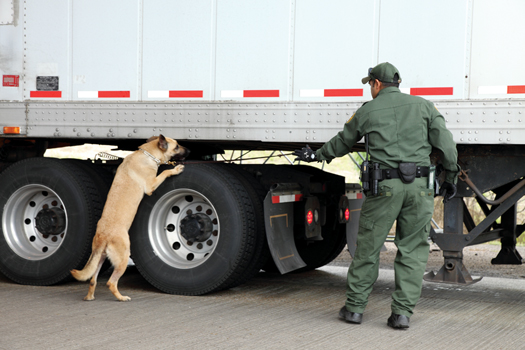
Smugglers are often stupid, and sometimes they are greedy, as when they attempt to cram one or two more packages into a well-concealed cavity in a vehicle. They are just as frequently ingenious, however, as when they hid a load of drugs inside a large tank of used oil, which scanners can’t penetrate. These smugglers were perfectly aware of the limits of the technology. What they were unable to defeat, in that case, was the power of a dog’s nose.
Dogs, at border checkpoints as well as traffic checkpoints 70 miles from the line, have found people hidden in the engine compartments of trucks, sewn sitting upright into the backseats of cars, and in one case wedged into a modified console such that when customs officers opened the hatch between the front seats, they saw a man’s face staring up.
8. “PASSIVE SECURITY”
At ports serving the general public, such as the much smaller but extremely modern crossing in Del Rio, security measures are directed not only at the endless stream of commodities that pass through these facilities, but at the bodies of the individual people presenting themselves for entry: their facial expressions, postures, affect, clothing and emotional dispositions.
Sharon Ansick, a tactical logistics officer who went to high school with my sister, gave me the grand tour of the Del Rio facility. Video cameras were everywhere, 150 in all. Doors and windows were secured, and passage in and out of facilities, as well as from one area to another within a compound or building, was tightly controlled. Ansick explained that this was called passive security. Everyone who entered this facility, whether they knew it or not, had entered a panopticon. Their every move was registered, recorded, observed, and controlled. No one could leave without permission. Border runners would be met with road spikes that jut up from the pavement at the push of a distress button. Few would ever realize the degree to which their liberty had been constrained.
All incoming and outgoing license plates are photographed, and all drivers too. All recently issued passports, green cards and day-entry cards contain radio-frequency ID chips that broadcast the identify of a traveler at the primary checkpoint, and the Del Rio port is the first to deploy a special RFID lane to speed processing. When I was there, traffic was light and lines were short, but there was a sense of high alertness throughout the facility. Immigration and Customs Enforcement agents armed with M-4 rifles loitered near the secondary station. Supervisory agents, in a glass-encased control room overlooking the traffic lanes, kept watch over the whole proceeding, monitored the video feeds, and maintained radio contact with personnel all over the port.
The port’s noncommercial traffic—about two million vehicular travelers and 50,000 pedestrians annually—is not routinely scanned. Instead, CBP officers interview drivers in a primary lane and use special angled mirrors to inspect the underside of all vehicles, and if a dog sniffs something suspicious or something about the car seems unusual, or if the driver seems nervous or simply came from an area of interest, the officer will call for a secondary inspection. At that point, density meters, mirrors, x-ray scanners and the whole repertoire of what CBP terms non-intrusive inspection techniques come into play. Nowadays few cars are dismantled or drilled without evidence derived from one of these methods. One recent seizure came about because an officer manning the primary lane noticed that a vehicle, driven by a lone male, was uncommonly clean. A trip to the VACIS x-ray scanner settled the matter. After some probing and chipping, agents discovered several pounds of heroin and methamphetamine.
As we passed through the port, the routine business of inspection and seizure continued all around us, and it was that routine of passive and all-encompassing surveillance that seemed to offer the most plausible model for what Kenneth Knight’s total domain awareness might look like. The primary question taking shape in my mind was: Where and how would the limits of the border domain be set?
As if in answer to my silent wonderment, Ansick pointed out that CBP enforces regulations on behalf of 44 other governmental agencies, including the FDA, the EPA and the USDA. Inspectors go through agricultural loads by hand, searching for tiny insects, egg casings under leaves, and other stowaways on legitimate imports. Palo Verde wood borers show up in stacks of firewood. Cattle must be examined for Rocky Mountain spotted fever ticks. In Del Rio, people arrive with juicy, stinky fermenting cheeses, deer heads, oranges, cowboy boots made from endangered species like sea turtles. The guy with the sea-turtle boots was a recent case, a native of San Luis Potosí, the state where Jaime Zapata was murdered, and the officer interviewing him just happened to notice the boots. The boots went into a freezer, and the poor man, who naively admitted what they were, left in his socks.
9. “DIFFERENT PURPOSE. DIFFERENT MISSION.”
Everywhere i traveled along the Rio Grande, when I asked questions about the different devices being used on the border, my companions invoked the name Borkowski—as in, “You’d better ask Borkowski about that.” They were talking about Mark Borkowski, CBP’s assistant commissioner for the Office of Technology Innovation and Acquisition. All the most advanced equipment, and all the new contracts, flowed through him. So I went to the source, to Washington, D.C. I had many questions. The week before I arrived, Borkowski had testified before Congress about the failure of SBInet, the infamous virtual fence, so I asked him to elaborate. In long, well-punctuated paragraphs, he told me the story of the program’s genesis and its fall.
[Technology] would most likely be every bit as transformative for border operations as air power was in military affairs.In his view, the original sin of SBInet was a pervasive naiveté—among the general public, the media and the government—about the ability of technology to solve a vexing political problem. In the years after 9/11, when the border began to be regarded with a new sense of urgency, there was a strong feeling that something dramatic needed to be done and that technology, which everyone agreed was a good thing, would somehow provide an answer. Unfortunately, Borkowski told me, no one had a clear theory of what exactly technology was supposed to accomplish. That rush to find a universal technological solution contributed to the failure of SBInet, which was plagued from the very beginning by cost overruns, delays and poor design on the part of Boeing and bad program management on the part of Homeland Security. Looking forward, the immediate goal was to find specific technological solutions that fit the particular challenges of different stretches of the border. Policy changes, such as comprehensive immigration reform—which, Borkowski hastened to point out, was not the same thing as amnesty—could make a huge difference as well. If Congress would create a rational and orderly system to match immigrants with jobs in a legal manner, and if the laws against hiring undocumented aliens were consistently enforced, “that would cut off a lot of the traffic between the points of entry. In fact, at a certain point, you would only have the really bad people left, the drug smugglers and the terrorists.”
At that point, though, technology would continue to play a major role. Indeed, it would most likely be every bit as transformative for border operations as air power was in military affairs. Borkowski singled out the domestic use of unmanned aerial systems as having the most potential for radical operational change. SBInet might have failed, but the idea behind it was sound: watching as much of the border as possible, all the time. A drone has a different, but complementary, mission: targeted surveillance. “A UAV can get somewhere fast, and can stay there,” he said—far longer than a conventional aircraft—”but it looks through a soda straw. Different purpose. Different mission.”
Leaning forward on his desk, Borkowski was quick to credit his fellow assistant commissioner Michael Kostelnik, the retired Air Force general who runs OAM, for pushing the deployment of drones along the border and elsewhere. OAM has been operating Predators in domestic airspace for six years now and is using them in many situations that have little or nothing to do with border security, notably in disaster-recovery missions after hurricanes, fires and floods, but also in what Kostelnik (at a border summit I later attended in El Paso) called “pop up” missions responding to contingent homeland-security situations. For routine border missions, OAM operates its unmanned aircraft with a certificate of authorization from the FAA that permits it to fly them over the entire southwestern border, as well as the Gulf Coast as far east as New Orleans and the northern border from Spokane, Washington, to the western end of the Great Lakes. The agency also has transit certificates that allow it to fly drones across the country from one area of operations to another.
The FAA will not yet permit OAM drones to fly over large metropolitan areas on a routine basis, but Kostelnik said his agency can now secure an emergency authorization and within a day put a Predator drone in the sky anywhere in the country.
10. “THEY CAN’T DO WHAT WE DO”
When Kenneth Knight was in Brownsville to coordinate air support for the Zapata funeral, one of his prime objectives had been to set up the helicopter video feed, which was transmitted by direct downlink to a microwave antenna he had installed on the roof of the Border Patrol station. While I was there, Knight had pulled up the Big Pipe portal on a Border Patrol PC, logged in, and within a few mouse clicks we had that helicopter feed on the screen. The same feed could be pushed out through the Big Pipe to a local sheriff, the FBI, or any one of the hundreds of other local, state and federal “customers” with whom Knight works regularly. “We’re doing some really cool shit,” he had explained.
Several weeks later at his spartan office in Washington, Knight gave me the more comprehensive briefing he had promised. As things now stood, sitting at his own desk or at any registered computer (or tablet or smartphone) anywhere in the world, Knight could click from a feed originating from a helicopter or a Predator or a P3 surveillance plane to any other feed, including a new test sight—a DHS camera pointed at a security line inside Hartsfield-Jackson Atlanta International Airport. Click, scroll, click; just like that.
I asked Knight how this might all work in practice, and he described a hypothetical mission in which a Guardian drone (the maritime version of the Predator) encounters an unidentified watercraft in the waters off Miami. The Big Pipe enables all the people from all the agencies who have an interest in the mission to be logged in simultaneously, each one watching the same video feed in real time, along with the same charts and maps and other mission data. The OAM drone operator might not be able to identify the craft, but a Coast Guard analyst could pronounce his take on the matter without having to wait for the pilot to verbalize what he thinks he’s seeing on the water.
That all sounded useful and efficient, but the real advantage, Knight continued, was not just being able to see things; it was being able to switch perspectives on the fly. Say the target vessel is approaching Miami, a major metropolitan area and therefore off limits. The drone could hand off the target to a manned Dash 8 aircraft. Then, as the vessel enters the port, it could be handed off again, now to fixed video cameras, whereupon ground personnel could also play a role. One platform can’t do it all—the air assets can’t stay airborne forever or go wherever you want them; the still cameras can’t move—”but if you start putting all these camera systems together, you’ve functionally closed the gap.”
It was becoming clear that the Big Pipe, with its persistent and pervasive surveillance capacity and its ability to archive everything into an easily accessible mission data package for intelligence analysis, could soon outstrip the command-and-control software used by American soldiers in war zones around the world. Knight wasn’t just talking about a specific operational zone like the Rio Grande Valley sector or the waters off the coast of Florida. He was targeting a much larger domain: the national air radar picture and the coastal marine surface radar picture, not just the surveillance cameras in the ports and along the border but also the surveillance cameras in metropolitan areas—airports, train stations, on the side of buildings, anywhere—such that the theater of operations was expanded to the widest possible extent. This broad spectrum of surveillance was really what Knight had in mind when he told me about total domain awareness, an operating picture that encompassed pretty much the entire country. Total domain awareness meant the ability to apply these tools, at will and as needed, anywhere in the U.S.
As I listened to Knight describe his vision, I recalled Borkowski’s skepticism about the ability of technology, by itself, to solve our border problems. It wasn’t clear, for example, that a fully robust Big Pipe could have prevented the gun that was purchased near Dallas and later killed Jaime Zapata from ending up in the Zetas’ arsenal—unless, of course, the movement of goods and people inside our borders were managed with the same rigor we apply to the traffic crossing the border. That level of operational control is beyond reach for now, but judging from the logistical expertise I saw demonstrated at the World Trade Bridge, it is far from unattainable. In October, a DHS official named Mariko Silver, testifying before Congress on border security, would make a similar point, explaining that President Obama’s border-security policy “requires us to move beyond seeing border management as simply guarding or policing the jurisdictional line between the United States and Mexico. The border and the interior are inextricably linked.”
The mission of securing our national borders has thus become indistinguishable from a new and still emerging understanding of what constitutes homeland security. The border has become a laboratory in which new security techniques can be perfected and where military tactics can be adapted for domestic application. Indeed, it is hard to avoid the conclusion that the border is slowly expanding to fill the entire continent.
Knight had tried to explain all of this to me back in Texas, but at that point I hadn’t fully understood what he meant. Now I could see. “The military does some of the same stuff, but they can’t do what we do. They work in the classified world. We actually cross domains,” he had said. “We are paving the way.”
Roger D. Hodge is the former editor of Harper’s Magazine and the author of The Mendacity of Hope_. He lives in Brooklyn._
