Renovating American Infrastructure, Step 5: Sewage
Banishing energy-hogging treatment plants and rotting pipes
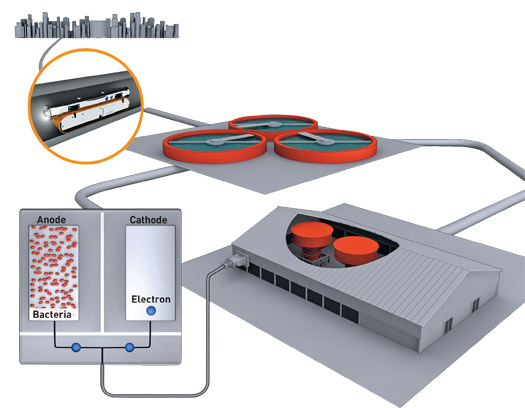
Every year, Americans produce 12 trillion gallons of wet sewage and burn 21 billion kilowatt-hours of electricity to clean it to drinking-water standards. Why not put the smelly stuff to good use? Thanks to clever new technology, sewage will be reclaimed to provide power, produce fertilizer and, eventually, yield clean water. In other words, sooner than you think, you’ll be drinking your own urine.
Turn Sludge into Electricity
Task: Reduce the energy we use to treat wastewater, currently 1.5 percent of our total national power
Status: Field-testing reactors; commercial units by 2015
Bruce Logan, a professor of environmental engineering at Penn State University, has designed a microbial fuel cell to turn the chemical energy in sewage directly into electricity—and clean the sewage in the process. Bacteria housed on a graphite fiber anode break down the fats, proteins and sugars in sewage, freeing up a steady stream of electrons, which the bacteria transfer directly into the electrode. Those electrons move to the cathode, providing electrical power and, at the cathode, producing hydrogen gas.
Drop Robots Down the Drain
Task: Deploy fleets of autonomous machines to spot leaks in sewage pipes
Status: New models that use a laser to measure inside pipes could be ready by 2011
RedZone Robotics’s new Solo sewer robots will use image-interpreting software developed at Carnegie Mellon University to analyze their video feeds and tag potential problems in the pipe, so a 10-hour run can be condensed to a two-hour highlight reel of dripping cracks and grasping roots. Each Solo carries a camera at either end, sonar to scan below the water, and lasers to search sewer walls for acid corrosion.
Recycle Urine
Task: Recover phosphorus and nitrogen from wastewater to make fertilizer
Status: First U.S. plant opened last June; another coming this year
Believe it or not, the wastewater of 100,000 people could yield an annual crop of about 200 tons of high-grade fertilizer. The Vancouver company Ostara hopes to use this fact to overcome our shrinking supply of recoverable phosphorus rock, one of three essential components of modern fertilizer. Ostara’s PEARL Nutrient Recycling system extracts phosphates and other minerals like ammonia from municipal wastewater and then churns the nutrients into safe, slow-release fertilizer pellets sold under the name Crystal Green. The challenge is sequestering the urine, which accounts for just 1 percent of sewage by volume. One solution: source-separated toilets (think: a little bowl within a big bowl), already being tried in Sweden and Denmark.
Read the rest of PopSci’s plan to rebuild America here.