It's been gone since 1983, but the Lazarus Project has brought it back to life.
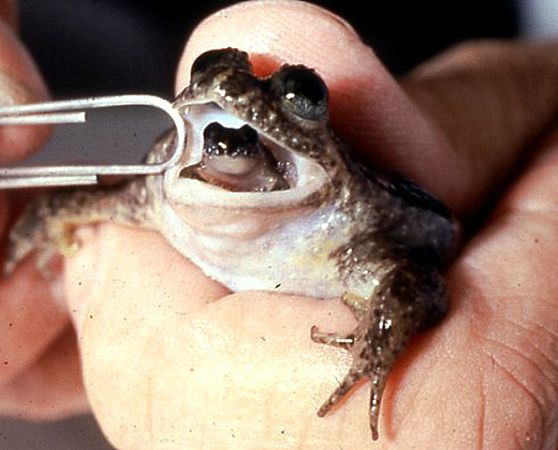
Gastric-Brooding Frog Australian Government Department of the Environment, Water, Heritage and the Arts

In 1983, the world lost one of its weirdest frogs. The gastric-brooding frog, native to tiny portions of Queensland, Australia, gave birth through its mouth, the only frog to do so (in fact, very few other animals in the entire animal kingdom do this--it's mostly this frog and a few fish). It succumbed to extinction due to mostly non-human-related causes--parasites, loss of habitat, invasive weeds, a particular kind of fungus. There were two subspecies, the northern and souther gastric-brooding frog, and they both became extinct in the mid-80s sometime.

Except--what if they didn't?

Taking place at the University of Newcastle, the quest to revive the gastric-brooding frog became known as the Lazarus Project. Using somatic-cell nuclear transfer (SCNT), a method for cloning, the project has achieved the major step forward of creating an early embryo of the extinct frog. Essentially, they found a related frog--the great barred frog, which also lives in Queensland and has cool eye markings, like it's wearing sunglasses--deactivated its eggs, and replaced them with eggs taken from the extinct frog.

Even though the gastric-brooding frog has been extinct for decades, it's possible to do this because individual specimens were kept preserved in, believe it or not, everyday deep freezers. When going through somatic-cell nuclear transfer, the eggs began to divide and form into the early embryo stage.

The embryos didn't survive much longer than that, but it was confirmed that these embryos contain genetic information from the gastric-brooding frog--that yes, in fact, they have brought it back to life. The researchers are confident that this is a "technical, not biological" problem at this stage to breed gastric-brooding frogs to adulthood. This is a big step forward for the worldwide attempts to revive extinct animals--the Lazarus Project researchers will soon meet with those working to revive the woolly mammoth, dodo, and other extinct beasties to share what they've learned.

Oh, and in case you were wondering: the gastric-brooding frog lays eggs, which are coated in a substance called prostaglandin. This substance causes the frog to stop producing gastric acid in its stomach, thus making the frog's stomach a very nice place for eggs to be. So the frog swallows the eggs, incubates them in her gut, and when they hatch, the baby frogs crawl out her mouth. How delightfully weird!

12 Comments

Leaping lizards, Kermit the frog and clone his own girly friend and give Miss Piggy the walking papers!

Oh, cool science too!

in order to thank everyone, characteristic, novel style, varieties, low price and good quality, and the low sale price. Thank everyone
http://al.ly/3JF

http://al.ly/3JF

http://al.ly/3JF

http://al.ly/3JF

http://al.ly/3JF

│\_╭╭╭╭╭_/│  
 │         │\|/  
 │ ●     ● │—☆—  
 │○ ╰┬┬┬╯ ○│/|\  
 │   ╰—╯   /  
 ╰—┬○————┬○╯  
  ╭│     │╮  
  ╰┴—————┴╯ sdfgwegweg

cool.

Frog-gastric Park

Serious question; if the frog eggs need to incubate in the parent's gut how are they going to incubate them without an adult frog?

Simulated environment? I don't think it would be too difficult to create once. Just use a similar temperature and fluid. Granted, this would require extracting the eggs from the original host frog.

Colton. if you, thought Kelly`s comment is impossible, last wednesday I bought a gorgeous Citroën 2CV from bringing in $9589 this munth and just over ten grand this past month. it's by-far the easiest-job I've ever had. I began this 8-months ago and almost straight away was bringin home minimum $71 per-hr. I use this web-site.......... BIT40.ℂOM

While "Lazarus Project" is a fitting name for such an endeavor, it sounds like something from a movie/video game.
Could this be potentially used for bringing back similarly extinguished species?

This is awesome! Science Rules! :)

Amazing! Look how advanced science is these days.

I believe the large frog is actually an organic created robot, created by the smaller frog. The smaller frog sitting inside is actually steering the outside frog via the tongue and cheek controls. ;)

LoL

This is cool and yay science!, but I'm curious about one assertion: how are loss of habitat and invasive weeds considered non-human-related causes?

Wow, got me all excited, but hey, call back when they've got the "technical" problems worked out and ACTUALLY HAVE A LIVE ADULT FROG OR TWO, K?


June 2013: American Energy Independence

Five amazing, clean technologies that will set us free, in this month's energy-focused issue. Also: how to build a better bomb detector, the robotic toys that are raising your children, a human catapult, the world's smallest arcade, and much more.


Online Content Director: Suzanne LaBarre | Email
Senior Editor: Paul Adams | Email
Associate Editor: Dan Nosowitz | Email
Assistant Editor: Colin Lecher | Email
Assistant Editor: Rose Pastore | Email

Contributing Writers:
Rebecca Boyle | Email
Kelsey D. Atherton | Email
Francie Diep | Email
Shaunacy Ferro | Email

circ-top-header.gif
circ-cover.gif